
Master Turncoat Debate Skills with PlanetSpark Course
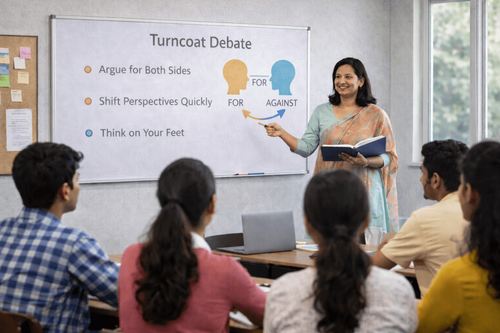

Table of Contents
- What is Turncoat Debate?
- The Unique Learning Value of Turncoat Debate
- Turncoat Debate Format Explained
- Key Skills Required for Turncoat Debate
- How to Prepare for a Turncoat Debate
- Popular Turncoat Debate Topics
- Tips to Deliver an Excellent Turncoat Debate Speech
- Common Mistakes in Turncoat Debate
- Real Life Benefits of Learning Debate Skills
- How PlanetSpark Helps Build Powerful Debate Skills
- Why Turncoat Debate is a Powerful Skill for the Future
Turncoat debate is one of the most exciting and intellectually stimulating debate styles where participants must argue both for and against the same topic. If you have ever wondered what is turncoat debate, how the turncoat debate format works, or how to prepare for engaging turncoat debate topics, this guide explains everything in detail.
This blog explores the turncoat debate meaning, structure, benefits, preparation strategies, and real examples to help learners develop strong argumentation skills.
What is Turncoat Debate?
A turncoat debate is a debate style in which the speaker must present arguments both in favour and against the same topic within a single speech.
Unlike traditional debates where participants stick to one position, turncoat debates challenge speakers to:
Switch perspectives quickly
Think critically about both sides of an argument
Present balanced reasoning
Demonstrate analytical thinking
This debate format is widely used in schools, public speaking competitions, and communication training programs because it develops flexible thinking and persuasive speaking.

Turncoat Debate Meaning in Simple Words
The turncoat debate meaning comes from the idea of “changing sides”. In this debate format, a speaker must turn their argument mid-speech.
For example:
Topic: Social media is beneficial for students
First half:
Speaker argues for the topic
Second half:
Speaker switches and argues against the topic
This transition tests the speaker’s logical thinking, adaptability, and persuasive ability.
Why Turncoat Debate is Popular in Schools and Competitions
Turncoat debates are gaining popularity because they help learners develop multiple essential skills.
Key reasons include:
Encourages balanced thinking
Improves argument development
Enhances public speaking confidence
Builds critical analysis skills
Trains students to view issues from multiple perspectives
The Unique Learning Value of Turncoat Debate
Turncoat debates are not just competitions. They are powerful learning tools.
1. Develops Critical Thinking
Students learn to:
Evaluate both sides of an issue
Identify strengths and weaknesses in arguments
Analyze evidence and logic
2. Improves Perspective-Taking
Many debates involve complex issues with multiple viewpoints. Turncoat debates teach learners to:
Understand opposing perspectives
Respect different opinions
Build balanced arguments
3. Strengthens Public Speaking Skills
Debaters must:
Speak clearly
Maintain confidence
Transition arguments smoothly
4. Encourages Logical Structuring
Speakers must organise arguments logically, which improves:
Speech structure
Argument clarity
Persuasive impact
5. Enhances Adaptability
Switching arguments mid-speech requires mental agility and fast thinking.
These skills are extremely valuable for:
Leadership
Academic discussions
Professional presentations
Turncoat Debate Format Explained
Understanding the turncoat debate format is essential before preparing for a debate.
Basic Structure of Turncoat Debate
Most competitions follow this format:
Speaker receives a topic
The speech lasts 3–4 minutes
First half - argue for the topic
Second half - argue against the topic
Some competitions allow speakers to choose the starting side, while others assign it randomly.
Example Turncoat Debate Structure
Topic: Online learning is better than classroom learning
Speech structure:
Introduction
Introduce the topic
Present the first viewpoint
First Section – For the Topic
Arguments supporting online learning:
Flexibility
Accessibility
Technology integration
Transition
Speaker signals a shift.
Example:
"However, while online learning offers many advantages, it also presents serious challenges."
Second Section – Against the Topic
Arguments opposing online learning:
Lack of social interaction
Reduced discipline
Limited hands-on learning
Conclusion
Summarise both perspectives and end with a thoughtful closing.
Time Division in Turncoat Debate
A common time structure:
Introduction – 20 seconds
For arguments – 1.5 minutes
Against arguments – 1.5 minutes
Conclusion – 20 seconds
Key Skills Required for Turncoat Debate
To succeed in turncoat debates, speakers must develop several essential skills.
Analytical Thinking
Debaters must examine:
Facts
Evidence
Counterarguments
Argument Construction
Strong arguments include:
Claim
Supporting reason
Example or evidence
Smooth Transitions
One of the most challenging aspects of turncoat debate is switching sides effectively.
Good transition phrases include:
However
On the other hand
Despite these advantages
Looking from another perspective
Confident Delivery
Effective speakers use:
Strong voice projection
Clear articulation
Natural gestures
Engaging eye contact
How to Prepare for a Turncoat Debate
Preparation plays a major role in debate success.
Step 1: Research Both Perspectives
Study the topic from multiple angles.
Ask questions such as:
What arguments support the topic?
What criticisms exist?
What examples illustrate both sides?
Step 2: Create Balanced Arguments
Prepare at least 3 points for each side.
Example:
Topic: Homework should be banned
For:
Reduces student stress
Encourages independent learning
Provides extra practice
Against:
Limits skill reinforcement
Reduces discipline
Weakens academic performance
Step 3: Practice Transition Statements
Transitions must feel natural and confident.
Examples:
"While these benefits are undeniable, there is another side to consider."
"Let us now examine the opposite perspective."
Step 4: Practice Speaking Aloud
Debate skills improve through practice.
Focus on:
Voice modulation
Timing
Clear structure
Popular Turncoat Debate Topics
Choosing the right turncoat debate topics is essential for practice.
Education Topics
Homework should be banned
Online learning is better than classroom learning
Exams are necessary for education
Schools should start later in the morning
Technology Topics
Social media improves communication
Artificial intelligence will replace human jobs
Technology improves education
Smartphones should be banned in schools
Social Issues
Space exploration is worth the cost
Competition improves performance
Advertising influences children negatively
Public transport should be free
Fun and Creative Topics
Superheroes are better than real heroes
Books are better than movies
Video games improve intelligence
Robots will become friends with humans
Practicing with diverse topics helps develop flexible argumentation skills.
Tips to Deliver an Excellent Turncoat Debate Speech
Great debaters follow certain strategies.
Start With a Strong Opening
A powerful introduction grabs the audience’s attention.
Example:
"Imagine a classroom where students can learn from anywhere in the world. Online learning promises exactly that."
Use Evidence and Examples
Arguments become stronger when supported by:
Statistics
Real-world examples
Expert opinions
Keep Arguments Clear
Avoid complicated explanations.
Use:
Short sentences
Simple logic
Clear reasoning
Maintain Energy Throughout
Even when switching sides, maintain confidence and enthusiasm.
End With a Thoughtful Conclusion
A good conclusion summarizes the debate and leaves the audience thinking.
Example:
"In reality, every issue has multiple perspectives. The real challenge is learning to understand them all."
Common Mistakes in Turncoat Debate
Many beginners struggle with certain mistakes.
Weak Transitions
Switching sides abruptly can confuse the audience.
Unbalanced Arguments
Some speakers give strong arguments for one side and weak ones for the other.
Lack of Structure
Without clear organisation, speeches become difficult to follow.
Poor Time Management
Spending too much time on one side can weaken the overall speech.
Real Life Benefits of Learning Debate Skills
Turncoat debate skills go beyond competitions.
They help students develop abilities valuable in many fields.
Academic Success
Debate improves:
Analytical thinking
Research skills
Writing ability
Career Development
Professionals benefit from debate skills in:
Presentations
Negotiations
Leadership discussions
Personal Growth
Debate builds:
Confidence
Communication clarity
Open-minded thinking
These abilities are critical in modern education and workplaces.

How PlanetSpark Helps Build Powerful Debate Skills
PlanetSpark provides structured training designed to transform children and adults into confident communicators and persuasive speakers. The Public Speaking Course focuses on building real debate skills through personalised mentorship, technology-enabled feedback, and practical speaking opportunities.
Every learner is matched with 1:1 personal trainers, certified communication experts who understand the child’s learning style and pace. These mentors provide live feedback while strengthening fluency, storytelling, debate, grammar, and creative writing.
PlanetSpark designs a personalised curriculum and learning roadmap after assessing each learner’s current skill level. The roadmap identifies gaps in grammar, vocabulary, and confidence while gradually building advanced speaking abilities.
Students benefit from SparkX, an AI-enabled video analysis tool that evaluates voice clarity, body language, grammar usage, and overall presentation quality. Detailed reports help learners improve with measurable progress.
The platform also offers AI-led practice sessions where students rehearse speeches, respond to prompts, and receive instant feedback on delivery and fluency.
Writing skills grow through Spark Diary, a digital journal where students practise creative writing, reflections, speeches, and storytelling.
PlanetSpark integrates gamified learning modules, vocabulary challenges, grammar games, and quizzes to make language learning engaging.
Parents stay involved through structured PTMs and detailed progress reports, while children participate in debate clubs, storytelling circles, podcasting communities, and speech competitions.
With platforms like Sparkline, learners can share speeches and creative work safely while gaining recognition through contests and showcases.
Together, these features make PlanetSpark a comprehensive learning ecosystem for mastering public speaking and debate skills.
Enrol in the PlanetSpark Public Speaking Course and transform debate confidence, communication clarity, and stage presence.
Why Turncoat Debate is a Powerful Skill for the Future
Turncoat debate is more than a speaking exercise. It is a powerful tool for developing critical thinking, balanced reasoning, and confident communication.
By learning how to present both sides of an argument, students become more thoughtful thinkers and persuasive speakers. They learn to analyse complex issues, organise ideas logically, and deliver impactful speeches.
In today’s world, where communication, negotiation, and leadership are essential skills, debate training gives learners a strong advantage. From school competitions to professional presentations, the ability to understand multiple perspectives is invaluable.
With structured training, practice opportunities, and expert guidance, learners can master the art of debate and public speaking.
You can also read:
Frequently Asked Questions
A turncoat debate is a debate format where the speaker must argue both for and against the same topic within a single speech. The speaker begins by supporting the topic and then switches perspective to oppose it. This format tests a speaker’s ability to analyse multiple viewpoints and think critically.
Unlike traditional debates where participants defend only one side, turncoat debates require flexibility, logical reasoning, and balanced argumentation.
The turncoat debate format typically involves a speech of 3 to 4 minutes. The speaker divides the speech into two parts:
First half
Arguments supporting the topic
Second half
Arguments opposing the topic
The speaker must clearly transition between perspectives and present logical arguments for both sides.
Some popular turncoat debate topics include:
Social media is beneficial for students
Homework should be banned
Technology improves education
Online learning is better than classroom learning
Artificial intelligence will replace human jobs
These topics allow speakers to explore multiple perspectives and develop balanced reasoning.
Turncoat debates help students develop essential skills such as:
Critical thinking
Logical reasoning
Public speaking confidence
Perspective-taking
Structured communication
These skills are valuable not only in academic environments but also in future careers that require strong communication and analytical abilities.
Students can improve their turncoat debate skills by practising regularly, researching both sides of topics, and developing strong speech structures. Participating in debate training programs can significantly accelerate improvement.
Programs like the PlanetSpark Public Speaking Course provide structured debate practice, personalised coaching, AI-based feedback, and real speaking opportunities through debate clubs and competitions. This helps learners build confidence, clarity, and persuasive communication skills