
A Learning Sprint Framework for Navigating Career Change in 2026
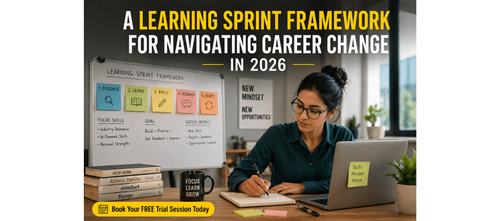

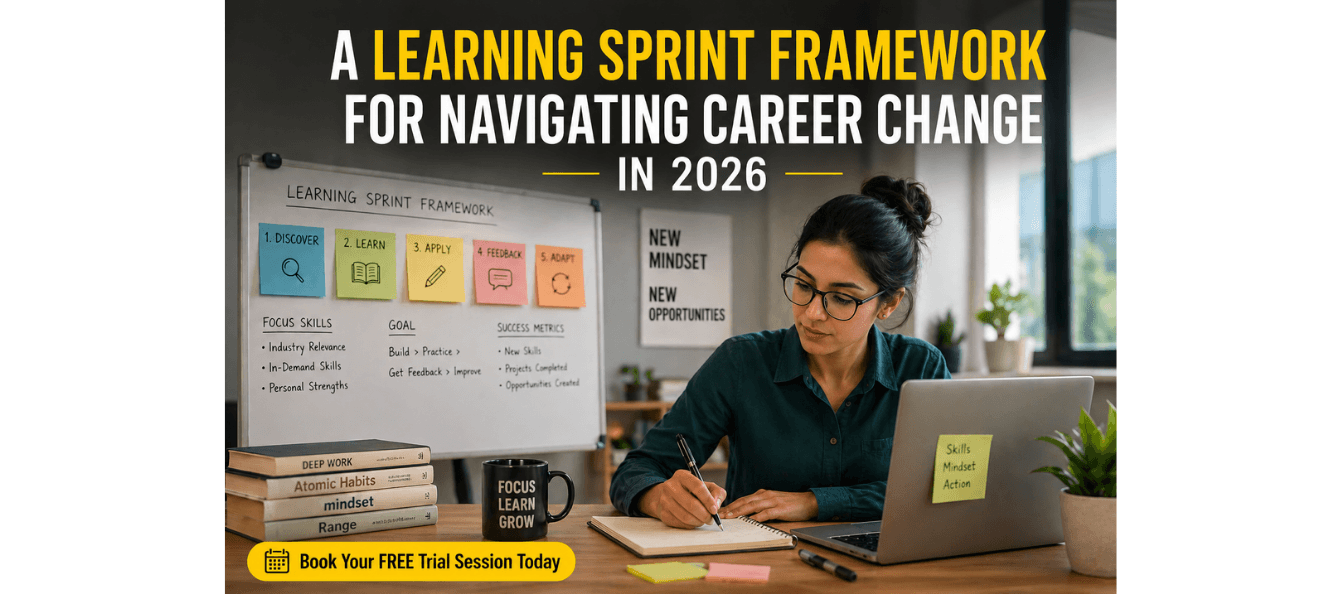
Creating Personal Learning Sprints for Smooth Career Transitions: A Practical System to Build Skills, Stay Consistent, and Accelerate Career Growth
Most working professionals don’t fail at career growth because they lack ambition. They fail because they lack a system that works within the reality of their lives.
You start a course with enthusiasm. You watch a few modules. Then work deadlines, personal commitments, and fatigue take over. Weeks pass. The course remains unfinished. The career transition you planned quietly stalls.
The problem is not motivation. It is method.
This is exactly where the concept of learning sprints becomes powerful. Instead of relying on long, unstructured learning plans, learning sprints introduce a focused, time-bound system that helps you build real, demonstrable skills in just two to four weeks. The “Designing Personal Learning Sprints for Career Transitions” guidebook provides a complete framework to help working professionals plan, execute, and sustain this approach effectively.
Download these resources and apply them alongside your daily work for improved clarity, productivity, and professional growth. You can also book a free trial to gain expert guidance and enhance your communication, problem-solving, and decision-making skills. The materials are designed in a clear, structured format to help professionals learn efficiently and implement insights with confidence.
Who Is This Blog For?
- Working professionals planning a career transition into a new role or industry
- Early to mid-career individuals seeking structured skill development
- Managers and consultants looking to reposition their expertise
- Professionals struggling with consistency in learning and upskilling
- Individuals aiming to build portfolio-ready, real-world skills
- Anyone balancing full-time work with career growth ambitions
Why This Topic Matters Today?
Career transitions today are more complex than ever. Professionals are no longer switching roles based only on experience. Employers now expect demonstrable skills, applied knowledge, and visible proof of capability.
A major challenge highlighted in the guidebook is that most professionals rely on outdated learning approaches:
- Setting vague goals like “learn data analytics”
- Consuming content without applying it
- Measuring progress in hours instead of outcomes
- Pausing learning when life becomes busy
This leads to stalled growth and missed opportunities.
In contrast, the learning sprint approach addresses modern career demands by focusing on outcomes, real-world application, and structured timelines. It aligns with how high-performing teams work today, using short, focused cycles to deliver results consistently.
Core Concept
At the heart of this guidebook is the concept of Learning Sprints.
A learning sprint is a focused, time-boxed period of skill-building, typically lasting two to four weeks, designed around a single measurable outcome. Instead of spreading effort across multiple goals, it concentrates your energy on one specific capability.
The framework follows a clear cycle:
- Define Outcome
Identify a clear, measurable goal
- Plan Tasks
Break the goal into manageable activities
- Execute and Iterate
Practice, refine, and improve continuously
- Demonstrate
Produce a visible output that proves your capability
- Timebox
Limit the sprint to a fixed duration to maintain focus
This approach shifts learning from passive consumption to active creation. It ensures that every effort leads to something tangible that can be showcased in professional settings.
How This Blog and Guidebook Help You?
This blog and the guidebook provide a complete system to transform how you approach learning and career growth.
They help you:
- Gain clarity on what to learn based on your target role
- Replace vague goals with outcome-driven objectives
- Build real-world projects that strengthen your profile
- Stay consistent despite a busy professional schedule
- Develop a repeatable system for continuous improvement
- Create visible proof of your skills for employers or clients
Instead of feeling stuck or overwhelmed, you move forward with structure, direction, and measurable progress.
Step-by-Step Breakdown
Diagnose Your Transition Gap
Before starting any learning sprint, the guidebook emphasises the importance of understanding your transition gap.
This gap has three key dimensions:
- Knowledge gaps
Missing concepts, frameworks, or domain understanding
- Skill gaps
Practical abilities you need to demonstrate in real scenarios
- Credibility signal gaps
Evidence such as portfolios, case studies, or certifications that prove your expertise
By mapping your current state against your target role, you ensure that your efforts are focused and relevant.
Set Your Sprint Goal the Right Way
A common mistake professionals make is setting activity-based goals instead of outcome-based ones.
The guidebook introduces the SOLO framework:
- Specific
Clearly define what you want to learn
- Outcome-led
Focus on what you will be able to do
- Linked
Connect the goal to your identified gap
- Observable
Ensure the result can be seen or evaluated
For example, instead of “complete a course,” a strong goal would be “build a working dashboard and present insights.”
Design Your Sprint Plan
Once the goal is defined, the next step is planning execution.
The guidebook recommends structuring your sprint into three phases:
- Load phase
Learn core concepts through curated resources
- Apply phase
Work on projects, simulations, or real tasks
- Reflect phase
Review progress, document learnings, and plan improvements
A typical four-week structure ensures balanced progress and prevents burnout.
Choose Learning Resources Strategically
Not all learning resources contribute equally to career transitions.
The guidebook highlights the importance of selecting resources based on output proximity, meaning how closely they help you produce real-world results.
Key resource types include:
- Structured courses for foundational knowledge
- Expert conversations for practical insights
- Applied projects for skill demonstration
- Peer communities for accountability and feedback
This ensures your time is invested in high-impact activities.
Build Your Sprint Resilience System
Consistency is one of the biggest challenges for working professionals.
The guidebook recommends building a resilience system that includes:
- Fixed learning time slots in your calendar
- Backup sessions for flexibility
- Minimum viable sessions to maintain momentum
- Accountability partners for support
This approach ensures that progress continues even during busy periods.
Learn from a Real-World Case Study
The guidebook presents a practical example of a professional transitioning from finance to product analytics using learning sprints.
Across three sprints, the individual:
- Built a product requirements document
- Conducted user research interviews
- Created a data dashboard
These outputs helped her build a strong portfolio and secure interviews, all without leaving her job.
Run a Sprint Retrospective
The final step is reflection.
After each sprint, you evaluate:
- What worked and what didn’t
- Which activities added the most value
- How your time estimates aligned with reality
- What gaps have been closed
This ensures continuous improvement and sharper future sprints.
Common Mistakes
The guidebook highlights several common mistakes professionals make:
- Setting vague or activity-based goals
Leads to lack of measurable progress
- Overloading the sprint plan
Causes burnout and abandonment
- Focusing only on learning, not applying
Prevents skill development
- Waiting for the perfect resource
Delays action and reduces momentum
- Skipping retrospectives
Limits learning from experience
Avoiding these mistakes significantly improves your chances of completing successful sprints.
How Should You Use This Guidebook Effectively?
To get the most value, the guidebook should be used actively and consistently.
A practical workflow includes:
- Spend one initial session understanding the full framework
- Use the worksheets to map your gaps and define goals
- Commit 5 to 8 hours per week for your sprint
- Follow the Load, Apply, Reflect structure
- Document outputs and track progress
- Schedule a retrospective at the end of each sprint
This structured approach ensures that learning becomes a repeatable system rather than a one-time effort.
Key Takeaways
- Learning sprints replace vague learning with structured execution
- Focus on outcomes, not just content consumption
- Diagnose your gaps before designing your learning plan
- Apply skills early to build confidence and credibility
- Use short, time-bound cycles to maintain momentum
- Build resilience systems to stay consistent
- Reflect after each sprint to improve continuously
- Create visible outputs that strengthen your professional profile
Your Next Step: Accelerate Your Career with PlanetSpark
Creating an impact-driven resume is not just about landing your next job—it’s about owning your professional story and presenting it with clarity, confidence, and credibility. When your resume clearly communicates value, results, and impact, opportunities follow naturally.
At PlanetSpark, we are committed to empowering working professionals with practical, outcome-focused resources that drive real career growth. From resume building and workplace communication to leadership presence and professional writing, our programs are designed to help you succeed in today’s fast-evolving job market.
Visit https://www.planetspark.in/resources to explore:
- Career and resume-building guides
- Workplace communication and professional writing resources
- Skill-development tools curated for working professionals
Want a deeper, hands-on experience?
You can also book a free trial session to learn more about PlanetSpark’s Working Professional Courses, designed to accelerate your career through personalised coaching, real-world practice, and expert guidance.
Your career deserves more than generic advice.
It deserves clarity, confidence, and measurable impact.
Personalized Communication Roadmaps
Record a video to get a AI generated personalized communication reports