
Align Daily Systems With Long-Term Career Vision Guide
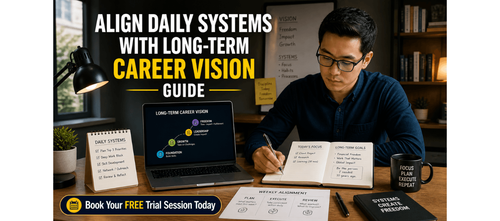

How to Align Daily Systems With Long-Term Vision for Sustainable Career Growth
Most working professionals are incredibly busy.
Their calendars are full. Their inboxes are overflowing. Their days are packed with meetings, deadlines, status updates, and constant task execution. Yet despite all this activity, many professionals quietly feel stuck.
Months pass. Years pass. And despite working hard every day, they realise they are not significantly closer to the career, lifestyle, leadership role, or personal growth they originally wanted.
This is one of the most common but least discussed professional problems today: the gap between productivity and alignment.
Being productive is not the same as moving forward.
When daily systems are disconnected from long-term vision, professionals often become highly efficient at advancing other people’s priorities while neglecting their own strategic direction. The result is burnout, frustration, and a persistent feeling of “running hard in place.”
The guidebook “How to Align Daily Systems With Long-Term Vision” addresses this exact challenge. It provides a structured framework for helping professionals design routines, priorities, rituals, and review systems that connect everyday actions to meaningful long-term goals.
Instead of relying on temporary motivation, the playbook focuses on system design. It helps professionals build intentional structures that translate vision into consistent execution over time.
Whether you are aiming for leadership growth, career transition, entrepreneurship, skill development, or better work-life alignment, the frameworks in this resource provide a practical roadmap for creating strategic momentum instead of reactive busyness.
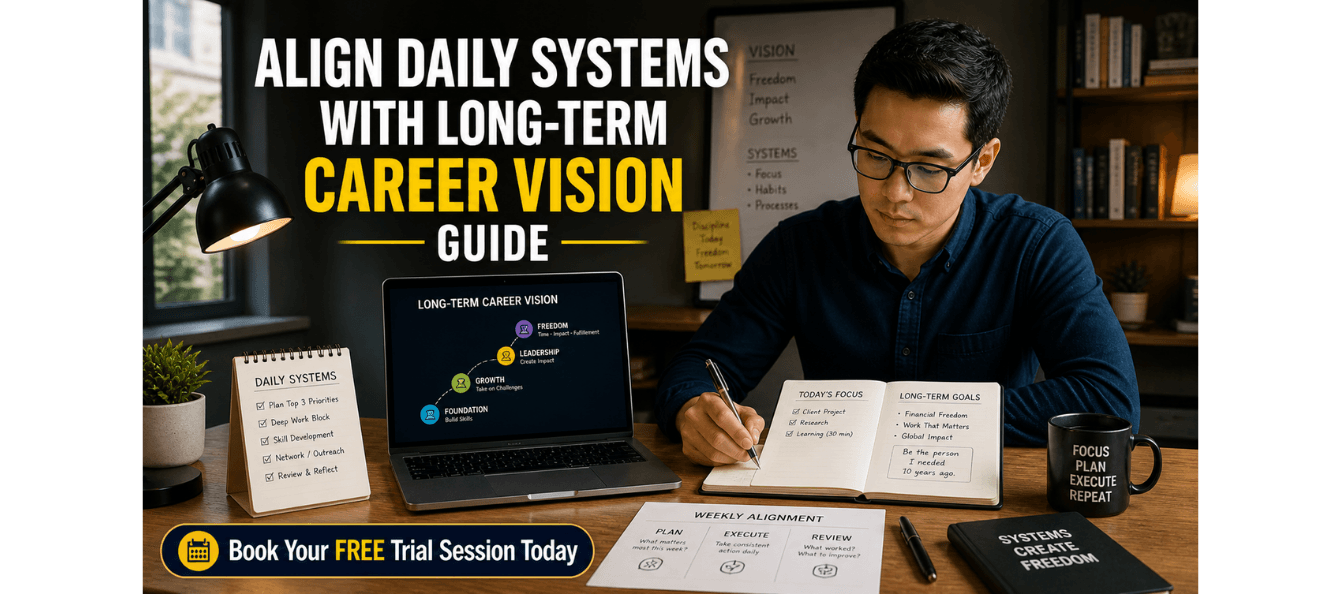
Download these resources and apply them alongside your daily work for improved clarity, productivity, and professional growth. You can also book a free trial to gain expert guidance and enhance your communication, problem-solving, and decision-making skills. The materials are designed in a clear, structured format to help professionals learn efficiently and implement insights with confidence.
Who Is This Blog For?
- Working professionals who feel busy but directionless
- Managers trying to balance operational work with strategic growth
- Professionals planning long-term career transitions or promotions
- Individuals struggling to translate goals into consistent execution
- Professionals overwhelmed by reactive work cultures
- Leaders seeking stronger alignment between priorities and time usage
- Career-focused individuals building intentional growth systems
- Professionals wanting sustainable productivity instead of burnout
Why This Topic Matters Today?
Modern professional culture rewards responsiveness, urgency, and constant availability.
As a result, many professionals spend most of their time reacting rather than intentionally building toward long-term goals.
The guidebook introduces the concept of the “Alignment Gap,” defined as the distance between:
- What professionals say matters most
- How they actually spend their time and energy daily
This gap widens when professionals experience:
- Reactive work cultures
- Undefined personal success criteria
- Lack of structured planning systems
- Excessive short-term focus
- Constant interruption and urgency
The consequences are significant.
Professionals often experience:
- Productivity without progress
- Strategic confusion
- Energy depletion
- Career stagnation
- Decreased motivation
- Reduced confidence and direction
Today’s work environment makes alignment more important than ever because professionals are increasingly responsible for managing their own career trajectories.
No organisation will automatically design your ideal future for you.
Professionals who intentionally align their systems with long-term vision gain several advantages:
- Clearer decision-making
- Better strategic focus
- More meaningful progress
- Improved energy management
- Greater career ownership
- Higher-quality opportunities
- Reduced reactive overwhelm
The ability to connect daily systems to long-term direction is becoming a critical professional advantage.
Core Concept or Framework Explained
The guidebook introduces a complete alignment framework designed to connect long-term vision with daily execution.
The Alignment Gap Framework
The first major concept is the Alignment Gap.
This refers to the difference between stated priorities and actual behaviour patterns.
Many professionals claim they value:
- Leadership growth
- Skill development
- Strategic thinking
- Health and wellbeing
- Relationship building
Yet their calendars show almost no protected time allocated to these priorities.
The guidebook explains that the solution is not more hustle or discipline.
The solution is intentional system design.
The North Star Vision Framework
The foundation of the playbook is creating a clear “North Star Vision.”
Unlike vague aspirations such as “I want success,” the North Star Vision is:
- Specific
- Emotionally compelling
- Long-term focused
- Decision-guiding
The guidebook defines four essential components:
Who are you becoming?
This focuses on professional identity, capability, reputation, and character.
What are you creating?
This includes projects, businesses, relationships, skills, or impact.
How are you living?
This describes desired daily experience, energy, flexibility, and lifestyle.
Why does it matter?
This connects vision to deeper purpose and meaning.
The Priority Domain System
The second major framework translates long-term vision into annual focus areas.
Instead of managing endless goals simultaneously, professionals identify 3–5 “Priority Domains.”
Examples include:
- Strategic Influence
- Leadership Presence
- Skill Development
- Network Expansion
- Financial Growth
- Executive Communication
These domains become the primary strategic focus for the year.
The Weekly Architecture Model
The guidebook also introduces a structured weekly framework that protects strategic work.
Instead of reacting continuously, professionals intentionally design:
- Deep work blocks
- Collaboration windows
- Planning sessions
- Reflection periods
- Recovery time
The Quarterly Review Framework
Finally, the guidebook emphasises quarterly reflection and course correction.
The review process includes:
- Looking Back
- Looking In
- Looking Forward
- Recommitting
This creates ongoing alignment instead of passive drift.
How This Blog and Guidebook Help You?
This blog and the original playbook help professionals move from reactive productivity toward intentional career design.
Many professionals already work extremely hard. The missing piece is alignment.
The guidebook helps you:
- Clarify your long-term professional direction
- Translate vision into practical systems
- Identify strategic priorities clearly
- Design intentional weekly structures
- Build sustainable productivity rituals
- Conduct meaningful reviews and reflection
- Reduce reactive work patterns
- Improve decision-making quality
Perhaps the most important benefit is strategic clarity.
Professionals stop asking:
“What should I do next?”
and start asking:
“Does this move me toward my vision?”
That shift fundamentally changes how time, energy, and opportunities are managed.
Step-by-Step Breakdown
Step 1: Define Your North Star Vision
The guidebook strongly emphasises that professionals cannot align systems without defining direction first.
The North Star Vision exercise helps professionals clarify:
- Desired professional identity
- Long-term outcomes
- Lifestyle preferences
- Core motivations
The resource differentiates between:
Vision
- Long-term
- Directional
- Emotionally motivating
Goals
- Short-term
- Operational
- Measurable
The vision becomes a strategic compass for decision-making.
Without it, professionals default to reactive behaviour and external expectations.
Step 2: Translate Vision Into Annual Priorities
Long-term vision must become operational.
The guidebook recommends selecting 3–5 Priority Domains for the current year.
These domains represent areas with the highest strategic leverage.
Examples for career changers include:
- Portfolio Development
- Network Activation
- Skill Building
Examples for managers include:
- Strategic Leadership
- Executive Presence
- Team Development
The guidebook strongly recommends limiting domains to three to five.
Too many priorities dilute focus and create strategic confusion.
Each domain then receives a measurable 90-day milestone.
This creates actionable momentum.
Step 3: Design Your Weekly Architecture
One of the strongest concepts in the playbook is designing intentional weekly structure.
Most professionals “wing” their weeks reactively.
The guidebook instead recommends structured weekly architecture.Example framework:
Monday
- Weekly planning and prioritisation
Tuesday and Wednesday
- Deep strategic work sessions
Thursday
- Collaboration, mentoring, and relationship work
Friday
- Reflection, review, and closure
The guidebook repeatedly emphasises calendar protection.
Strategic work must be blocked before reactive demands consume available time.
Professionals are also encouraged to conduct a time audit categorising activities into:
- Reactive work
- Maintenance work
- Strategic work
- Recovery activities
The target is increasing strategic time allocation significantly.
Step 4: Build Daily Rituals
The playbook explains that systems are sustained through rituals.
Morning rituals orient attention toward strategic priorities before reactive work begins.
Suggested morning practices include:
- Reading the North Star Vision
- Writing top three priorities
- Gratitude reflection
- Movement and activation
Evening rituals create closure and learning.
Suggested evening practices include:
- Capturing wins
- Extracting lessons
- Planning tomorrow’s priorities
- Formal shutdown routines
The guidebook emphasises simplicity and consistency over complexity.
Even ten intentional minutes daily can create substantial long-term strategic focus.
Step 5: Build a Quarterly Review System
Quarterly reviews act as course correction mechanisms.
Without reflection, small misalignments compound over time.
The review process includes:
Look Back
- Evaluate wins, failures, and progress
Look In
- Reflect on patterns, resistance, beliefs, and behaviours
Look Forward
- Set next-quarter priorities and milestones
Recommit
- Reconnect with long-term vision intentionally
The guidebook strongly encourages scheduling all quarterly reviews in advance.
This creates ongoing strategic maintenance.
Step 6: Learn from Real-World Application
The guidebook includes a case study featuring Priya, a project manager working 55-hour weeks without strategic progress.
Before alignment:
- No defined long-term vision
- No personal strategic priorities
- Highly reactive schedule
- No protected strategic work time
After implementing the framework:
- Created a clear five-year leadership vision
- Defined three strategic priority domains
- Protected deep work time weekly
- Reduced unnecessary meetings significantly
Within weeks, her strategic direction improved dramatically.
Eventually, she achieved promotion into senior leadership.
The case study demonstrates that alignment changes both productivity and professional trajectory.
Common Mistakes or Pitfalls to Avoid
The guidebook identifies several common alignment mistakes.
Vague Vision
Professionals often define goals too broadly.
Better approach:
- Create vivid, specific long-term vision statements
Too Many Priorities
Trying to improve everything simultaneously reduces focus.
Better approach:
- Limit strategic domains to three to five
Planning Without Protection
Professionals create plans but fail to protect time operationally.
Better approach:
- Calendar block strategic work first
Skipping Reviews
Without reflection, systems gradually degrade.
Better approach:
- Schedule recurring weekly and quarterly reviews
Waiting for Perfect Conditions
Many professionals delay implementation indefinitely.
Better approach:
- Begin imperfectly and refine continuously
How Should You Use This Guidebook Effectively?
The guidebook is designed for active implementation rather than passive reading.
Recommended workflow:
- Read the guide once fully for context
- Complete the North Star Vision exercise
- Define annual Priority Domains
- Conduct a weekly time audit
- Build a structured weekly architecture
- Create morning and evening rituals
- Schedule quarterly reviews immediately
Suggested time investment:
- 20–30 minutes for vision drafting
- One week for time auditing
- 10–20 minutes daily for rituals
- 90 minutes quarterly for reviews
The guidebook also includes several practical worksheets and reflection exercises designed to deepen self-awareness and strategic clarity.
Professionals are encouraged to revisit the framework quarterly as priorities evolve.
Key Takeaways
- Productivity without alignment creates frustration and stagnation
- The Alignment Gap reflects the difference between priorities and actual behaviour
- Long-term vision must guide daily systems intentionally
- Priority Domains create strategic focus and prevent overload
- Weekly architecture protects strategic work from reactive demands
- Small daily rituals create long-term behavioural alignment
- Quarterly reviews prevent gradual strategic drift
- Calendar protection is critical for meaningful progress
- Reflection and review are essential components of growth systems
- Alignment is fundamentally a system design challenge, not a motivation problem
Your Next Step: Accelerate Your Career with PlanetSpark
Creating an impact-driven resume is not just about landing your next job—it’s about owning your professional story and presenting it with clarity, confidence, and credibility. When your resume clearly communicates value, results, and impact, opportunities follow naturally.
At PlanetSpark, we are committed to empowering working professionals with practical, outcome-focused resources that drive real career growth. From resume building and workplace communication to leadership presence and professional writing, our programs are designed to help you succeed in today’s fast-evolving job market.
Visit https://www.planetspark.in/resources to explore:
- Career and resume-building guides
- Workplace communication and professional writing resources
- Skill-development tools curated for working professionals
Want a deeper, hands-on experience?
You can also book a free trial session to learn more about PlanetSpark’s Working Professional Courses, designed to accelerate your career through personalised coaching, real-world practice, and expert guidance.
Your career deserves more than generic advice.
It deserves clarity, confidence, and measurable impact.
Start building that advantage today—with PlanetSpark.
Personalized Communication Roadmaps
Record a video to get a AI generated personalized communication reports