
Aligning Career Achievements with Role Expectations
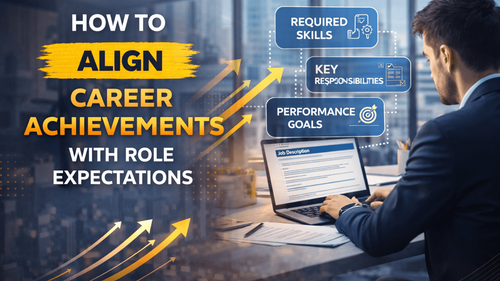

How to Align Your Career Achievements with Role Expectations for Faster Career Growth
One of the biggest reasons strong
professionals fail to get shortlisted is not a lack of experience—it is a lack of alignment.
You may have delivered impressive results, handled complex responsibilities, and built valuable skills. Yet, if your resume does not clearly connect those achievements to what the employer is looking for, it gets overlooked.
Recruiters are not just scanning for accomplishments. They are scanning for relevance.
In today’s competitive job market, the ability to align your career achievements with specific role expectations is what separates high-impact candidates from the rest.
This guide helps you bridge that gap—so your experience is not just impressive, but strategically positioned.
Who Is This Blog For?
This blog and guidebook are ideal for professionals looking to improve how they present their experience.
- Working professionals aiming to improve resume effectiveness
- Job seekers struggling with low interview callback rates
- Career switchers trying to reposition past experience
- Mid-career professionals targeting leadership roles
- Specialists and consultants building a strong professional narrative
Why This Topic Matters Today?
Hiring today is driven by precision and speed.
Recruiters often spend only a few seconds scanning each resume. During that time, they are not evaluating your entire career—they are checking one thing:
Does this candidate match what we need?
The guidebook highlights a critical insight:
Even strong achievements lose impact if they are not aligned with the role’s expectations.
For example:
- A cost-saving achievement may not matter for a growth-focused role
- A technical accomplishment may not resonate for a leadership position
- A generic list of achievements fails to show role-specific value
Alignment ensures that your achievements are not just seen—but understood and valued.
Core Concept or Framework Explained
The guide introduces a structured alignment approach that connects three key elements:
- Role Expectations: What the employer is looking for
- Career Achievements: What you have accomplished
- Alignment Bridge: How you connect the two
At the centre of this approach is a simple but powerful principle:
Relevance drives impact.
Instead of listing all achievements, you selectively present those that directly address the role’s priorities.
This transforms your resume from a career summary into a targeted value proposition.
How This Blog and Guidebook Help You?
This guide helps you build a more strategic and effective application.
You will learn how to:
- Decode role expectations from job descriptions
- Identify the most relevant achievements in your career
- Reframe your experience to match employer needs
- Create a strong, role-specific professional narrative
- Increase your chances of shortlisting and interview success
The outcome is a resume that communicates clarity, focus, and value.
Step-by-Step Breakdown
Step 1: Understand Role Expectations Clearly
Start by analysing the job description in detail.
Focus on:
- Key responsibilities
- Required skills and competencies
- Repeated themes and priorities
- Expected outcomes or goals
These elements define what success looks like in the role.
Step 2: Break Down Expectations into Core Requirements
Group the expectations into clear categories such as:
- Technical or functional expertise
- Business outcomes like growth or efficiency
- Leadership and team management
- Problem-solving and innovation
This helps you organise your alignment process.
Step 3: Audit Your Career Achievements
List your key achievements across roles without filtering initially.
Include:
- Projects delivered
- Problems solved
- Measurable outcomes achieved
- Initiatives led or supported
This creates a complete pool of potential alignment points.
Step 4: Match Achievements to Role Requirements
Now connect your achievements to each requirement category.
Ask:
- Which of my achievements directly relate to this expectation?
- What results did I deliver in similar situations?
- How can I demonstrate relevance clearly?
This step ensures your resume is tailored, not generic.
Step 5: Prioritise High-Impact Matches
Not all achievements carry equal weight.
Prioritise those that are:
- Most relevant to the role
- Quantified and measurable
- Recent and reflective of current capabilities
- Demonstrative of scale or complexity
These should appear prominently in your resume.
Step 6: Reframe Achievements for Clarity and Relevance
Adjust your language to reflect the role’s priorities.
For example:
- Highlight leadership for managerial roles
- Emphasise growth metrics for business roles
- Focus on efficiency for operations roles
This ensures your achievements resonate with the recruiter.
Step 7: Integrate Alignment Across Your Resume
Alignment should be visible throughout your application.
- Professional summary should reflect key role expectations
- Experience section should showcase aligned achievements
- Skills section should reinforce required competencies
Consistency strengthens your positioning.
Common Mistakes or Pitfalls to Avoid
Misalignment often happens due to avoidable mistakes.
- Listing all achievements without filtering for relevance
- Using the same resume for multiple roles
- Ignoring role-specific priorities
- Failing to quantify achievements
- Overloading the resume with unrelated information
Avoiding these mistakes improves clarity and effectiveness.
How Should You Use This Guidebook Effectively?
Follow a structured and focused approach:
- Choose a target role before starting
- Analyse role expectations thoroughly
- Map your achievements carefully
- Tailor your resume for each application
- Review and refine before submission
Recommended time investment:
- 1 hour for role analysis
- 1–2 hours for achievement mapping
- 1 hour for resume customisation
This process ensures quality over quantity in applications.
Key Takeaways
- Alignment is more important than volume of achievements
- Recruiters prioritise relevance over completeness
- Role expectations should guide your resume content
- Select and highlight achievements strategically
- Tailored resumes significantly improve interview chances
- Clear positioning creates stronger professional impact
Your Next Step: Accelerate Your Career with PlanetSpark
Creating an impact-driven resume is not just about landing your next job—it’s about owning your professional story and presenting it with clarity, confidence, and credibility. When your resume clearly communicates value, results, and impact, opportunities follow naturally.
At PlanetSpark, we are committed to empowering working professionals with practical, outcome-focused resources that drive real career growth. From resume building and workplace communication to leadership presence and professional writing, our programs are designed to help you succeed in today’s fast-evolving job market.
Visit https://www.planetspark.in/resources to explore:
- Career and resume-building guides
- Workplace communication and professional writing resources
- Skill-development tools curated for working professionals
Want a deeper, hands-on experience?
You can also book a free trial session to learn more about PlanetSpark’s Working Professional Courses, designed to accelerate your career through personalised coaching, real-world practice, and expert guidance.
Your career deserves more than generic advice.
It deserves clarity, confidence, and measurable impact.
Start building that advantage today—with PlanetSpark.
Personalized Communication Roadmaps
Record a video to get a AI generated personalized communication reports