
Application Audit Guide to Improve Interview Success Rate
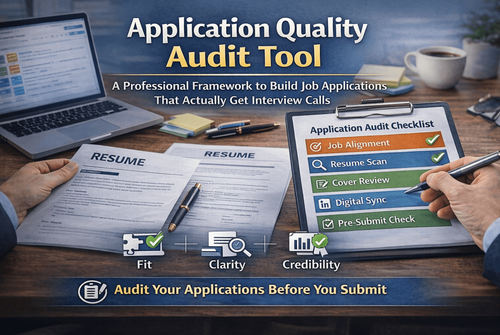

Application Quality Audit Tool: A Professional Framework to Build Job Applications That Actually Get Interview Calls
Many professionals believe that if they have the right qualifications, job applications should naturally lead to interview calls. Yet the reality is often frustrating. Candidates invest time writing resumes, preparing cover letters, and submitting applications — only to receive silence.
In most cases, the issue is not capability or experience. The issue is application quality.
Small mistakes such as missing keywords, generic cover letters, weak achievement statements, or inconsistent formatting can quietly eliminate strong candidates before a hiring manager ever reads their application. Applicant Tracking Systems (ATS) filter resumes, recruiters scan documents in seconds, and hiring managers expect immediate clarity about why a candidate fits the role.
The Application Quality Audit Tool was created to solve this exact problem. It provides a structured framework that allows professionals to evaluate every job application before submission, ensuring that each document clearly communicates fit, clarity, and credibility.
Instead of submitting applications based on hope, professionals can use this audit system to submit applications with confidence and strategic precision.
Who Is This Blog For?
This guide is particularly valuable for professionals who want to improve their application-to-interview conversion rate.
- Career switchers repositioning their experience for a new industry or role
- Early-career professionals building strong application habits
- Consultants applying for project-based or strategic roles
- Mid-career managers targeting leadership positions
- Job seekers who want to improve the quality and effectiveness of their applications
Why This Topic Matters Today?
The hiring process has evolved significantly. Modern recruitment relies heavily on digital systems and structured screening processes.
Resumes are often filtered by Applicant Tracking Systems before reaching human recruiters. Recruiters themselves spend only a few seconds scanning each resume initially. This means the margin for error in an application is extremely small.
According to the audit framework described in the guide, application quality is defined by three core elements:
Fit
Your experience clearly matches the requirements of the role.
Clarity
Your value and achievements are communicated immediately and effectively.
Credibility
Your claims are backed by quantifiable results and presented in a professional format.
When any one of these pillars is weak, the application loses traction and risks being rejected early in the process.
This is why structured application auditing is essential for professionals seeking consistent interview results.
Core Concept or Framework Explained
The Application Quality Audit Tool introduces a structured five-phase framework that evaluates an application at multiple levels.
The visual framework diagram on page 4 of the guide shows these five phases arranged sequentially, beginning with strategic alignment and ending with a final quality check before submission.
The five phases include:
Job Alignment
Confirming that your experience and background genuinely match the requirements of the role.
Resume Scan
Reviewing your resume for keyword alignment, quantification, formatting, and relevance.
Cover Review
Ensuring your cover letter demonstrates a clear narrative and company-specific research.
Digital Sync
Verifying that your LinkedIn profile and digital presence reinforce your application.
Pre-Submit Check
Conducting a final quality audit before submitting the application.
When applied consistently, this framework transforms job applications into a repeatable professional process rather than a rushed task.
How This Blog and Guidebook Help You?
Using the Application Quality Audit Tool allows professionals to dramatically improve the effectiveness of their job search.
Key benefits include:
- Higher interview callback rates due to stronger alignment with job descriptions
- Improved clarity and credibility in resumes and cover letters
- Greater confidence when submitting applications
- Stronger professional branding across documents and online presence
- A repeatable system for evaluating and improving every application
Instead of sending large volumes of rushed applications, professionals can focus on fewer, higher-quality submissions that produce better results.
Step-by-Step Breakdown
Phase 1: Job Alignment Check
Before editing a resume or writing a cover letter, professionals must determine whether the role is genuinely a good match.
This begins with reading the job description multiple times to identify the employer's priorities and requirements.
The guide recommends separating requirements into two categories:
Must-have requirements
Core skills or experience required for the role.
Nice-to-have requirements
Additional qualifications that strengthen a candidate but are not essential.
Applicants should then map their own experience to these requirements and evaluate whether they can demonstrate at least 70 percent of the must-have criteria.
If major gaps exist, the cover letter must strategically address them.
This process ensures that time and effort are invested in roles where the candidate has a realistic chance of success.
Phase 2: Resume Quality Scan
The resume audit focuses on six critical quality dimensions.
Keyword Alignment
Resumes should mirror the language used in the job description to pass ATS filters.
Achievement Orientation
Bullet points should focus on results and outcomes rather than responsibilities.
Quantification
Achievements should include numbers, percentages, timeframes, or measurable scale whenever possible.
Relevance Hierarchy
The most relevant experience should appear prominently in the document.
Formatting Consistency
Fonts, spacing, and bullet formatting must remain consistent throughout.
Length and White Space
The resume should remain concise and visually scannable.
These elements collectively determine whether a recruiter will continue reading beyond the initial resume scan.
Phase 3: Cover Letter Review
The cover letter provides an opportunity to connect the candidate's story to the organization's needs.
A strong cover letter typically includes four components:
Opening Signal
A compelling opening that explains why the role and candidate are a strong match.
Achievement Story
A specific example demonstrating a key qualification.
Company Insight
Evidence that the candidate has researched the organization.
Confident Closing
A clear statement expressing interest in further discussion.
If the same cover letter could be sent to multiple companies without modification, it is not sufficiently tailored.
The most effective cover letters are concise, specific, and aligned with the employer's priorities.
Phase 4: Digital Presence Alignment
Recruiters frequently search candidates online after reviewing their applications.
The guide emphasizes that LinkedIn profiles should reinforce the narrative presented in the resume and cover letter.
Important areas to audit include:
Profile headline aligned with the target role
Compelling career narrative in the About section
Consistency between LinkedIn experience and resume details
Professional recommendations and skill endorsements
This alignment strengthens credibility and confirms the candidate's professional brand.
Phase 5: Final Pre-Submit Quality Check
The final phase acts as the quality control gate before submission.
This step focuses on small but critical details such as:
Professional file naming conventions
Correct document format, typically PDF
Accurate company and role references throughout the application
Proofreading for spelling, grammar, and formatting errors
Verification of application portal details and contact information
These final checks ensure that otherwise strong applications are not undermined by avoidable mistakes.
Common Mistakes or Pitfalls to Avoid
Even strong candidates frequently undermine their applications through common errors.
Typical mistakes include:
- Using the same resume for every job application
- Sending generic cover letters with no company research
- Ignoring keyword alignment required by ATS systems
- Describing responsibilities rather than measurable achievements
- Having inconsistent narratives between resume and LinkedIn
- Submitting applications without a final proofread
- Over-explaining career gaps or transitions
- Applying without researching the company or industry context
Avoiding these mistakes significantly improves application quality and professionalism.
How Should You Use This Guidebook Effectively?
To gain maximum value from this resource, professionals should integrate the audit process into their job search workflow.
Recommended approach:
- Read the guide once to understand the full five-phase framework
- Apply the audit process to every new job application
- Allocate approximately 40 to 45 minutes per application for a full audit
- Track application-to-interview conversion rates over time
- Identify which phases require improvement and focus efforts there
Consistency is the key factor that determines success with this system.
Key Takeaways
- Most job applications fail due to weak alignment, clarity, or credibility
- The five-phase audit framework provides a structured review process for every application
- Tailored resumes and cover letters significantly increase interview conversion rates
- Quantified achievements strengthen credibility and impact
- LinkedIn and digital presence must reinforce the application narrative
- Final proofreading and formatting checks prevent avoidable errors
- High-quality applications consistently outperform large volumes of rushed submissions
Your Next Step: Accelerate Your Career with PlanetSpark
Creating an impact-driven resume is not just about landing your next job—it’s about owning your professional story and presenting it with clarity, confidence, and credibility. When your resume clearly communicates value, results, and impact, opportunities follow naturally.
At PlanetSpark, we are committed to empowering working professionals with practical, outcome-focused resources that drive real career growth. From resume building and workplace communication to leadership presence and professional writing, our programs are designed to help you succeed in today’s fast-evolving job market.
Visit https://www.planetspark.in/resources to explore:
- Career and resume-building guides
- Workplace communication and professional writing resources
- Skill-development tools curated for working professionals
Want a deeper, hands-on experience?
You can also book a free trial session to learn more about PlanetSpark’s Working Professional Courses, designed to accelerate your career through personalised coaching, real-world practice, and expert guidance.
Your career deserves more than generic advice.
It deserves clarity, confidence, and measurable impact.
Personalized Communication Roadmaps
Record a video to get a AI generated personalized communication reports