
Application Package Audit Guide for Working Professionals
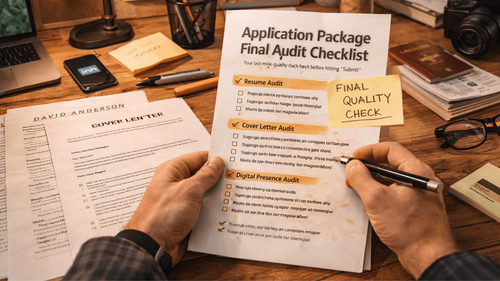

Application Package Final Audit Checklist: The 45-Minute System to Submit Error-Free Job Applications Every Time
You’ve invested hours—sometimes days—perfecting your resume, tailoring your cover letter, and assembling your portfolio. Yet, despite all that effort, many applications fail in the final moments before submission. A wrong company name, inconsistent job title, or broken portfolio link can instantly undermine your credibility.
The reality is simple: the last 30 minutes before you hit “Submit” are often the most critical—and the most overlooked. This is where fatigue, urgency, and lack of a structured review system lead to costly mistakes.
This blog is built on a professional-grade audit system from the Application Package Final Audit Checklist —a repeatable, high-impact framework designed to ensure every application you send is polished, aligned, and submission-ready.
Who Is This Blog For?
- Career changers transitioning into new industries or roles
- Job seekers aiming to improve application quality and callback rates
- Consultants and freelancers applying for structured roles
- Early to mid-career professionals (0–15 years experience)
- Managers looking to present a cohesive leadership narrative
Why This Topic Matters Today?
Today’s hiring process is more competitive and system-driven than ever. Applicant Tracking Systems (ATS), recruiter screening, and digital presence checks mean your application is evaluated across multiple layers—often before a human even reads it.
Common challenges professionals face include:
- ATS rejection due to formatting issues or missing keywords
- Misaligned narratives across resume, LinkedIn, and cover letter
- Generic applications that fail to stand out
- Technical errors like broken links or incorrect file names
The checklist highlights a crucial insight: most errors are not due to lack of skill, but lack of process. Without a structured audit, even experienced professionals make preventable mistakes that cost them opportunities.
Core Concept or Framework Explained
At the heart of this system is a five-phase audit framework—a sequential, modular process that ensures every component of your application package is reviewed with precision.
Think of it as a “pre-flight checklist” for your career. Just as pilots don’t rely on memory when stakes are high, professionals shouldn’t rely on intuition when submitting applications.
The five phases are:
- Resume Audit: Strategic alignment, accuracy, and formatting
- Cover Letter Audit: Personalisation and clarity of voice
- Digital Presence Audit: LinkedIn and portfolio validation
- Strategic Alignment Audit: Narrative consistency across all documents
- Submission Mechanics Audit: Final technical verification
Each phase builds on the previous one, creating a comprehensive system that can be completed in under 45 minutes.
How This Blog and Guidebook Help You?
This framework delivers tangible career outcomes:
- Higher callback rates through error-free submissions
- Stronger personal branding via consistent storytelling
- Reduced stress by replacing guesswork with a repeatable system
- Faster application turnaround with a structured workflow
Instead of relying on last-minute checks or memory, you gain a disciplined, professional approach to submitting applications—every single time.
Step-by-Step Breakdown
Resume Audit: The Foundation Document
Your resume is often the first filter—both for ATS systems and recruiters.
Start by ensuring targeting and alignment:
- Your resume headline matches the job title
- Key job description keywords appear naturally
- Relevant experience is prioritised in the top third
- At least 60% of bullet points include quantified achievements
Next, validate content accuracy:
- Dates, roles, and company names are consistent
- No personal pronouns are used
- Skills are relevant and demonstrable
- Education is updated and prioritised correctly
Finally, check technical formatting:
- Save as PDF unless specified otherwise
- Use clean formatting (no tables or text boxes for ATS-heavy roles)
- Maintain readable font size and margins
End with a final read-through:
- Read aloud to catch awkward phrasing
- Run grammar and spell checks
- Get a second pair of eyes
Cover Letter Audit: Your Voice, Personalised
The cover letter is where most costly mistakes occur due to reuse and lack of personalisation.
Start with personalisation:
- Correct hiring manager name
- Accurate company name throughout
- Role title matches the job posting
- Opening references something specific about the company
Structure and substance matter:
- Keep it within 3–4 paragraphs
- Clearly explain why you are a strong fit
- Include 2–3 relevant achievements
- End with a confident call to action
Tone and technical checks:
- Use confident, natural language
- Avoid clichés and generic phrases
- Ensure formatting matches your resume
- Proofread in print preview
Digital Presence Audit: LinkedIn and Portfolio
Recruiters will search for you—it’s standard practice.
For LinkedIn:
- Headline aligns with your target role
- Profile is complete and up-to-date
- Experience mirrors your resume
- Skills reflect job description keywords
For portfolio or work samples:
- All links are functional
- Projects are relevant to the role
- Case studies highlight your contribution
- Mobile accessibility is ensured
Also verify contact details:
- Professional email address
- Consistent phone number and location
- Working hyperlinks
Strategic Alignment Audit: Does Your Package Tell One Story?
This is the most critical—and most overlooked—step.
Even if each document is individually strong, misalignment can weaken your application.
Ensure:
- Resume, cover letter, and LinkedIn present the same narrative
- Key achievements appear across platforms
- Your positioning matches the role’s priorities
Ask yourself:
- Do all documents communicate the same professional identity?
- Are your claims supported by evidence?
- Does your portfolio reflect your stated expertise?
Misalignment creates confusion—and recruiters choose clarity every time.
Submission Mechanics Audit: The Final Technical Pass
This phase protects all your previous work.
Start by re-reading application instructions:
- Confirm required documents
- Check submission format
- Note any specific guidelines
Then verify files:
- Open each document in final format
- Ensure formatting is intact
- Check file size and naming conventions
For submission:
- Complete all required fields
- Use professional subject lines for email
- Send test emails if needed
Finally, record everything:
- Log application details
- Save submitted versions
- Set follow-up reminders
Common Mistakes or Pitfalls to Avoid
Even experienced professionals make these errors:
- Wrong company name in cover letter
- Resume headline not aligned with role
- LinkedIn profile outdated or inconsistent
- Broken portfolio links
- Skills listed without evidence
- Generic cover letter openings
- Inconsistent formatting across documents
Each of these mistakes has a simple fix—but only if you catch them before submission.
How Should You Use This Guidebook Effectively?
To get maximum value from this system:
- Run all five phases sequentially for initial applications
- Use it as a checklist, not a reference document
- Keep it open while reviewing your application
- Confirm each item visually—not from memory
Suggested workflow:
- Time required: 30–45 minutes per application
- First few uses: full checklist
- Later: targeted spot-checks
Treat this as a standard operating procedure, not a one-time exercise.
Key Takeaways
- Most application failures happen in the final review stage
- A structured audit system eliminates preventable errors
- Narrative consistency across documents is a major differentiator
- ATS optimisation and formatting are critical for visibility
- Submission mechanics are as important as content
- A repeatable checklist improves both quality and confidence
- Professionals who follow systems outperform those who rely on memory
Your Next Step: Accelerate Your Career with PlanetSpark
Creating an impact-driven resume is not just about landing your next job—it’s about owning your professional story and presenting it with clarity, confidence, and credibility. When your resume clearly communicates value, results, and impact, opportunities follow naturally.
At PlanetSpark, we are committed to empowering working professionals with practical, outcome-focused resources that drive real career growth. From resume building and workplace communication to leadership presence and professional writing, our programs are designed to help you succeed in today’s fast-evolving job market.
Visit https://www.planetspark.in/resources to explore:
- Career and resume-building guides
- Workplace communication and professional writing resources
- Skill-development tools curated for working professionals
Want a deeper, hands-on experience?
You can also book a free trial session to learn more about PlanetSpark’s Working Professional Courses, designed to accelerate your career through personalised coaching, real-world practice, and expert guidance.
Your career deserves more than generic advice.
It deserves clarity, confidence, and measurable impact.
Personalized Communication Roadmaps
Record a video to get a AI generated personalized communication reports