
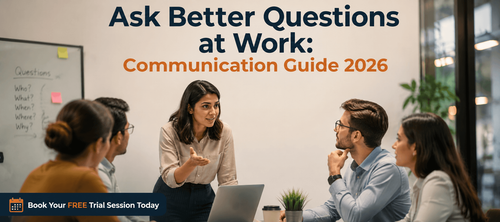
Ask Better Questions at Work: Communication Guide 2026

How Strategic Questioning Can Improve Workplace Communication and Decision-Making
Strong communication is no longer just a soft skill in today’s professional environment. It is a competitive advantage. Whether you are leading meetings, interviewing candidates, managing clients, collaborating with teams, or handling workplace conflicts, the quality of your conversations directly impacts the quality of your results.
Yet many professionals unknowingly limit conversations by asking rushed, surface-level, or leading questions. Meetings become repetitive, feedback discussions remain shallow, and important insights stay hidden because the right questions were never asked. In many cases, professionals focus so heavily on providing answers that they overlook the power of curiosity-driven communication.
The ability to ask thoughtful, open, and strategic questions can completely transform professional interactions. Better questions encourage deeper thinking, improve collaboration, uncover hidden challenges, and help teams make stronger decisions. This is why mastering questioning techniques has become an essential leadership and communication skill across industries.
Download these resources and apply them alongside your daily work for improved clarity, productivity, and professional growth. You can also book a free trial to gain expert guidance and enhance your communication, problem-solving, and decision-making skills. The materials are designed in a clear, structured format to help professionals learn efficiently and implement insights with confidence.
Who Is This Blog For?
- Working professionals who want to improve workplace communication
- Managers and team leaders conducting meetings and feedback sessions
- Consultants and client-facing professionals handling discovery conversations
- Job seekers preparing for interviews and networking discussions
- HR professionals and recruiters conducting candidate evaluations
- Freelancers and entrepreneurs managing professional relationships
- Career switchers aiming to build stronger communication confidence
Why This Topic Matters Today?
Modern workplaces are increasingly collaborative, fast-paced, and communication-driven. Professionals are expected to solve problems, lead discussions, manage stakeholders, and build trust across teams. However, poor questioning habits often create barriers that reduce productivity and clarity.
According to the resource guide, many conversations fail because professionals enter discussions without a clear conversational intent. Instead of exploring problems deeply, they jump directly to assumptions or solutions. As a result:
- Meetings remain superficial and repetitive
- Team discussions fail to uncover root causes
- Employees feel unheard or misunderstood
- Client discovery conversations miss critical insights
- Feedback discussions become defensive rather than productive
The guide also highlights that the best leaders, consultants, and communicators are not necessarily those with the fastest answers. They are the professionals who ask purposeful, open, curious, and timely questions that encourage meaningful dialogue.
In a workplace environment where collaboration and emotional intelligence matter more than ever, strategic questioning has become a high-impact professional skill.
Core Concept or Framework Explained
The foundation of effective questioning lies in understanding how conversations evolve and how professionals can guide them more intentionally.
The guide introduces several practical frameworks that improve questioning quality and conversational depth.
The Five Characteristics of Great Questions
Strong professional questions generally share five qualities:
- Purposeful: The question has a clear reason and moves the conversation forward
- Open: It encourages elaboration instead of yes-or-no responses
- Timely: It appears at the right moment in the conversation
- Curious: It comes from genuine interest rather than assumptions
- Safe: It makes the other person comfortable enough to answer honestly
These characteristics help create conversations built on trust, clarity, and exploration rather than pressure or defensiveness.
The Question Ladder Framework
One of the most valuable concepts in the guide is the Question Ladder. This framework helps professionals move conversations from surface-level discussion to deeper insight.
The ladder includes four levels:
- Factual Questions: What happened?
- Interpretive Questions: What does it mean?
- Relational Questions: How does it connect to larger issues?
- Generative Questions: What could be different moving forward?
The framework teaches professionals not to rush into solutions too early. Instead, they should gradually deepen the conversation by moving through each level intentionally.
The SPARK Framework
The guide also introduces the SPARK questioning system for professional conversations:
- Set Intent
- Prime with Open Questions
- Amplify with Silence
- Raise the Level
- Keep Momentum
This framework provides a structured approach professionals can apply before, during, and after important discussions.
How This Blog and Guidebook Help You?
This blog and resource guide provide practical tools that professionals can immediately apply in real-world workplace situations.
The guide helps you:
- Improve meeting and interview conversations
- Ask smarter questions during client discussions
- Build stronger listening habits
- Create psychologically safe conversations
- Avoid common communication mistakes
- Improve leadership and team collaboration skills
- Develop structured questioning habits for long-term professional growth
Instead of relying on instinct alone, professionals gain repeatable frameworks and practical conversation strategies.
Step-by-Step Breakdown
Step 1: Set a Clear Conversational Intent
One of the biggest mistakes professionals make is entering meetings without deciding what they actually want to learn.
The guide recommends asking yourself:
- What information am I missing?
- What assumptions might be wrong?
- What would a successful outcome look like for everyone involved?
This simple preparation process dramatically improves question quality.
For example, before a client meeting, instead of focusing only on presenting solutions, you can focus on uncovering the client’s deeper challenges.
This creates more strategic and insightful discussions.
Step 2: Use Open Questions to Encourage Thinking
Closed questions often stop conversations quickly.
Questions like:
- “Did the project go well?”
- “Are you satisfied with the results?”
usually generate short responses.
The guide recommends replacing them with open-ended alternatives such as:
- “What part of the project worked best for your team?”
- “What challenges did you notice during the process?”
Open questions create space for reflection and detailed responses.
This is especially important in leadership, consulting, and team management roles.
Step 3: Apply the Question Ladder
Many professionals ask only factual questions and never explore deeper meaning.
The Question Ladder framework encourages gradual depth.
For example:
Factual:
- “What happened during the project launch?”
Interpretive:
- “Why do you think the issue occurred?”
Relational:
- “How did this affect collaboration across departments?”
Generative:
- “What changes could improve future launches?”
This layered approach leads to better analysis, stronger problem-solving, and more strategic conversations.
Step 4: Build a Personal Question Bank
Experienced communicators rarely improvise every question.
The guide recommends developing a professional question bank that includes:
- Opening questions
- Deepening questions
- Challenging questions
- Closing questions
Examples include:
- “What’s most important to you right now?”
- “What part of this challenge hasn’t been discussed yet?”
- “What assumptions might we be overlooking?”
- “What action should happen next?”
Over time, these questions become natural conversational tools.
Step 5: Learn the Power of Silence
Many professionals become uncomfortable after asking a difficult question and immediately start talking again.
The guide emphasises the importance of silence.
The recommended “three-second rule” encourages professionals to pause after asking a question instead of filling the silence.
This gives the other person time to think more deeply and often leads to more honest responses.
Strong communication is not just about speaking well. It is equally about listening intentionally.
Step 6: Avoid Common Questioning Traps
The guide identifies several questioning habits that damage conversations.
Common mistakes include:
- Leading questions that suggest the “correct” answer
- Multi-barrel questions containing multiple questions at once
- Why-blame questions that create defensiveness
- Premature solutions offered before understanding the issue
- Rhetorical questions that shut down discussion
For example:
Instead of:
- “Don’t you think this strategy is better?”
Try:
- “How do you evaluate the strengths of each option?”
Small language changes create more open and collaborative conversations.
Step 7: Apply Questioning Techniques Across Professional Situations
The guide explains how questioning strategies vary across contexts.
Client Discovery Conversations
Focus on uncovering the real problem beneath the stated issue.
Examples:
- “What challenge impacts your team most consistently?”
- “What solutions have already been attempted?”
Team Retrospectives
Use psychologically safe questions such as:
- “What should we continue doing?”
- “What could we improve next time?”
Job Interviews
As an interviewee:
- “What does success in this role look like after six months?”
As an interviewer:
- “Tell me about a challenge you solved recently.”
Performance Conversations
Begin with curiosity before evaluation.
For example:
- “How do you feel about your recent progress?”
This creates more constructive and less defensive discussions.
Common Mistakes or Pitfalls to Avoid
The guide highlights several communication habits that reduce conversational quality.
Common mistakes include:
- Entering conversations without clear intent
- Asking too many questions at once
- Interrupting silence too quickly
- Offering solutions before understanding the issue
- Using questions to confirm personal opinions
- Avoiding difficult but necessary questions
- Focusing on speaking instead of listening
Better alternatives include:
- Preparing thoughtful seed questions beforehand
- Using open-ended prompts
- Practising active listening
- Pausing intentionally after asking questions
- Reflecting after important conversations
The guide emphasises that even small improvements in questioning habits can create noticeable changes in professional communication outcomes.
How Should You Use This Guidebook Effectively?
To gain maximum value from the guide, professionals should treat it as a practical workplace tool rather than just reading material.
Recommended workflow:
- Read the complete guide once for overall understanding
- Identify one questioning skill to practise weekly
- Use the SPARK framework before important meetings
- Apply the Question Ladder during conversations
- Build and personalise your question bank
- Reflect after key discussions
Suggested time investment:
- 5 minutes before meetings for preparation
- 30–60 seconds after conversations for reflection
- Weekly practice focused on one communication skill
The guide also recommends practising with trusted colleagues or mentors to improve questioning confidence more quickly.
Key Takeaways
- Better questions create deeper and more productive conversations
- Open-ended questions encourage reflection and collaboration
- The Question Ladder helps move discussions from surface to depth
- Silence is a powerful communication tool when used intentionally
- Strong questioning improves leadership, interviews, and team discussions
- Avoid leading, rushed, or multi-barrel questions
- The SPARK framework provides a practical conversation structure
- Reflection and deliberate practice improve questioning mastery over time
- Great communicators focus on understanding before offering solutions
- Consistent questioning habits can significantly improve professional relationships
Your Next Step: Accelerate Your Career with PlanetSpark
Creating an impact-driven resume is not just about landing your next job—it’s about owning your professional story and presenting it with clarity, confidence, and credibility. When your resume clearly communicates value, results, and impact, opportunities follow naturally.
At PlanetSpark, we are committed to empowering working professionals with practical, outcome-focused resources that drive real career growth. From resume building and workplace communication to leadership presence and professional writing, our programs are designed to help you succeed in today’s fast-evolving job market.
Visit https://www.planetspark.in/resources to explore:
- Career and resume-building guides
- Workplace communication and professional writing resources
- Skill-development tools curated for working professionals
Want a deeper, hands-on experience?
You can also book a free trial session to learn more about PlanetSpark’s Working Professional Courses, designed to accelerate your career through personalised coaching, real-world practice, and expert guidance.
Your career deserves more than generic advice.
It deserves clarity, confidence, and measurable impact.
Personalized Communication Roadmaps
Record a video to get a AI generated personalized communication reports