
Auditing Personal Systems for Better Time Efficiency
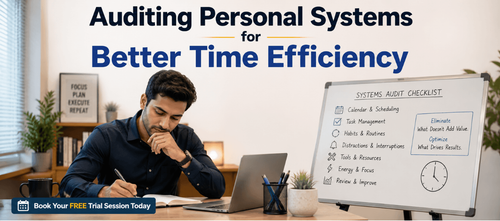

How to Audit Your Personal Systems for Hidden Inefficiencies and Improve Productivity at Work
Most working professionals are not struggling because they lack talent, ambition, or discipline. The real issue is far less visible. The systems they rely on every day to manage work, decisions, communication, and productivity have slowly become inefficient, outdated, or overly complex.
You may not notice the hidden cost immediately. A few minutes spent searching for files, repeatedly checking emails, maintaining multiple task lists, or redoing work may feel insignificant in isolation. But over weeks and months, these small inefficiencies compound into lost productivity, mental fatigue, decision overload, and reduced career performance.
This is why high-performing professionals focus not only on goals but also on systems. Strong systems reduce friction, protect mental energy, and create consistency. Weak systems quietly drain time and attention.
A personal systems audit helps you identify exactly where your workflows are helping you and where they are creating hidden resistance. Instead of working harder, you learn how to work more intentionally. This guide provides a practical framework for auditing your systems, identifying inefficiencies, and redesigning workflows that support long-term professional growth.
Download these resources and apply them alongside your daily work for improved clarity, productivity, and professional growth. You can also book a free trial to gain expert guidance and enhance your communication, problem-solving, and decision-making skills. The materials are designed in a clear, structured format to help professionals learn efficiently and implement insights with confidence.

Who Is This Blog For?
- Working professionals struggling with overwhelm, inconsistency, or burnout
- Managers and team leaders looking to improve workflow efficiency
- Professionals balancing multiple tools, tasks, and communication channels
- Individuals seeking better productivity systems without adding complexity
- Career-focused professionals who want to reduce friction and improve performance
- Knowledge workers managing large amounts of information and responsibilities
Why This Topic Matters Today?
Modern work environments are increasingly fragmented. Professionals manage emails, meetings, collaboration tools, calendars, notes, task managers, and constant communication across multiple platforms.
This creates hidden inefficiencies that often go unnoticed:
- Switching between too many tools reduces focus and productivity
- Constant notifications interrupt deep work and increase stress
- Outdated workflows no longer match changing professional responsibilities
- Repeated manual work wastes valuable time and energy
- Decision fatigue reduces clarity and strategic thinking
The guidebook highlights an important reality: hidden inefficiencies compound silently. The problem is not one large failure but hundreds of small moments of friction repeated every day.
Professionals who regularly audit and optimise their systems gain significant advantages:
- Better focus and time management
- Reduced cognitive overload
- More consistent execution
- Improved decision-making capacity
- Greater clarity and professional confidence
In a fast-changing work environment, system optimisation has become a competitive professional skill.
Core Concept or Framework Explained
The guidebook introduces a structured personal systems audit framework designed to identify inefficiencies across five major areas of professional life.
These five domains include:
- Task and priority management
- Information and knowledge storage
- Communication and collaboration
- Energy and recovery management
- Decision-making and planning
The framework focuses on one key principle: systems should reduce friction, not create it.
The audit process follows five major stages:
- Mapping your current systems
- Diagnosing inefficiencies
- Scoring and prioritising problems
- Identifying hidden workflow issues
- Building a 30-day redesign plan
The guidebook also introduces a powerful idea: professionals do not rise to the level of their goals—they fall to the level of their systems.
This means sustainable productivity depends less on motivation and more on reliable workflows that support consistent action.
How This Blog and Guidebook Help You?
This guide helps you move from reactive work habits to intentional system design.
By applying the audit framework, you can:
- Identify where your time and mental energy are being wasted
- Eliminate redundant or outdated workflows
- Reduce stress caused by fragmented systems
- Create simpler and more sustainable productivity processes
- Improve focus and consistency without relying on willpower
- Recover time for meaningful and high-value work
Most importantly, the framework helps you understand how small workflow improvements create long-term career advantages through compounding efficiency.
Step-by-Step Breakdown
Step 1: Map Your Personal Systems Landscape
The first step is building awareness of the systems you currently use.
A personal system includes any repeatable workflow, habit, tool, or process that helps manage your professional life.
The guidebook recommends auditing systems across five categories.
Task and Priority Management
Review how you:
- Organise tasks
- Decide priorities
- Manage deadlines
- Use productivity tools or calendars
Information and Knowledge Storage
Examine where you store:
- Notes
- Research
- Documents
- Reference materials
- Bookmarks
Communication and Collaboration
Evaluate how you manage:
- Emails
- Messaging platforms
- Meetings
- Follow-ups
- Team collaboration
Energy and Recovery
Review systems related to:
- Sleep
- Breaks
- Focus transitions
- Physical movement
- Mental recovery
Decision-Making and Planning
Assess how you:
- Make daily decisions
- Plan weekly priorities
- Evaluate long-term goals
- Handle recurring choices
The goal is not evaluation yet. It is awareness and inventory creation.
Step 2: Run the Inefficiency Diagnostic
Once your systems are mapped, the next step is evaluating them using four diagnostic questions.
Question 1: Does It Actually Work?
Ask whether the system consistently helps you achieve meaningful outcomes without unnecessary effort.
Question 2: What Does It Cost?
Measure the hidden cost in:
- Time
- Mental energy
- Maintenance effort
- Cognitive load
Question 3: Is It Outdated?
Determine whether the system was designed for an earlier version of your role or lifestyle.
Question 4: Where Does It Break Down?
Identify the exact moment when the system fails and creates chaos, avoidance, or inconsistency.
The guidebook also provides an inefficiency checklist that includes signals such as:
- Relying on memory instead of systems
- Maintaining duplicate tools
- Redoing completed work
- Feeling busy without meaningful progress
- Missing commitments regularly
- Experiencing anxiety from constant inbox checking
These signals help uncover invisible workflow problems.
Step 3: Score and Prioritise Your Systems
Not every inefficiency deserves immediate attention.
The guidebook introduces a prioritisation model using two dimensions:
- Impact if fixed
- Effort required to fix
This creates four priority zones:
- Quick Wins
- Strategic Projects
- Low Priority Improvements
- High-Effort Traps
Quick Wins are systems with high impact and low effort. These should become your first focus area because they create momentum quickly.
For example:
- Consolidating multiple task lists into one system
- Creating communication windows
- Simplifying weekly planning routines
The framework emphasises prioritising leverage over perfection.
Step 4: Identify Common Hidden Inefficiencies
The guidebook highlights several recurring workflow problems seen across professionals.
The Multi-System Fragmentation Trap
This happens when information, tasks, and workflows are spread across multiple tools.
The hidden problem is not confusion—it is the mental effort required to track gaps between systems.
Recommended solution:
- Create one source of truth for each category
Reactive Communication Architecture
Constantly checking email or messaging platforms creates reactive work patterns.
The guidebook recommends:
- Defining communication windows
- Turning off unnecessary notifications
- Protecting deep work blocks
Decision Fatigue from Lack of Defaults
Repeated micro-decisions drain cognitive energy throughout the day.
Examples include:
- Re-deciding priorities weekly
- Constantly choosing what task to start
- Handling repetitive workflow choices manually
The solution is creating default rules and repeatable routines.
Undocumented Recurring Workflows
Many professionals recreate the same outputs repeatedly instead of building reusable templates.
Examples include:
- Weekly reports
- Client proposals
- Follow-up emails
- Meeting structures
Templates reduce friction and improve consistency.
Step 5: Learn from the Real-World Case Study
The guidebook shares the example of Priya, a marketing manager struggling with overwhelm despite strong performance.
Her audit revealed:
- Four separate task management systems
- Constant email and Slack checking
- Hundreds of unread saved articles
- No recovery time between meetings
- Weekly priority planning without structure
Instead of redesigning everything, she focused on three quick wins:
- Consolidating tasks into one system
- Creating communication windows
- Building a Monday priority template
Within 30 days, she recovered approximately 6–8 hours per week without adding new tools or working longer hours.
The key insight was simple:
Simpler systems outperform overly optimised systems.
Step 6: Build Your 30-Day System Redesign Plan
The final step is turning insights into action.
The guidebook recommends creating a redesign plan with:
- The system to improve
- The specific change required
- A start week
- A measurable success indicator Suggested workflow:
- Week 1: Apply quick wins
- Week 2: Stabilise systems and track friction
- Week 3: Review and adjust workflows
- Week 4: Complete the audit cycle and plan next priorities
This creates sustainable system improvement instead of temporary productivity experiments.
Common Mistakes or Pitfalls to Avoid
- Trying to optimise every system simultaneously
- Adding more tools instead of simplifying workflows
- Relying on memory instead of trusted systems
- Ignoring hidden cognitive load caused by fragmented workflows
- Treating communication as constant availability
- Designing systems that require excessive willpower
- Focusing on perfection instead of consistency
The guidebook repeatedly emphasises that simpler systems are often the most effective systems.
How Should You Use This Guidebook Effectively?
To maximise results:
- Complete the audit in one focused 60–90 minute session
- List every system honestly before evaluating it
- Focus only on Quick Wins during the first month
- Use measurable indicators to track progress
- Schedule quarterly audits to maintain system alignment
Recommended implementation process:
- Day 1: Complete systems inventory
- Day 2: Run inefficiency diagnostics
- Day 3: Prioritise systems using the matrix
- Week 1: Implement top Quick Wins
- Week 2–4: Stabilise and refine systems
Consistency matters more than complexity.
Key Takeaways
- Hidden inefficiencies silently reduce productivity and mental clarity
- Personal systems determine long-term professional performance
- Simpler systems often outperform complex productivity workflows
- Fragmented tools create cognitive overload and friction
- Communication boundaries improve focus and reduce stress
- Small workflow improvements compound over time
- Prioritising Quick Wins builds momentum and confidence
- Regular system audits help maintain alignment with changing responsibilities
Your Next Step: Accelerate Your Career with PlanetSpark
Creating an impact-driven resume is not just about landing your next job—it’s about owning your professional story and presenting it with clarity, confidence, and credibility. When your resume clearly communicates value, results, and impact, opportunities follow naturally.
At PlanetSpark, we are committed to empowering working professionals with practical, outcome-focused resources that drive real career growth. From resume building and workplace communication to leadership presence and professional writing, our programs are designed to help you succeed in today’s fast-evolving job market.
Visit https://www.planetspark.in/resources to explore:
- Career and resume-building guides
- Workplace communication and professional writing resources
- Skill-development tools curated for working professionals
Want a deeper, hands-on experience?
You can also book a free trial session to learn more about PlanetSpark’s Working Professional Courses, designed to accelerate your career through personalised coaching, real-world practice, and expert guidance.
Your career deserves more than generic advice.
It deserves clarity, confidence, and measurable impact.
Start building that advantage today—with PlanetSpark.
Personalized Communication Roadmaps
Record a video to get a AI generated personalized communication reports