
Avoid Overconfidence Bias: Smarter Decision-Making Guide
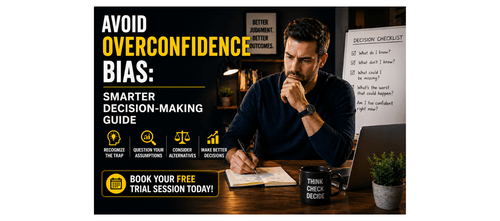

How to Avoid Overconfidence in Decision-Making: A Practical Framework for Smarter, More Grounded Professional Choices
You’ve prepared, researched, and handled similar situations before. You feel confident. The decision seems obvious.
And yet—things don’t go as expected.
This is not incompetence. It is overconfidence.
In professional environments, overconfidence is subtle. It does not look like arrogance—it looks like clarity. It shows up when you stop asking questions too early, rely too heavily on past experience, or feel certain without fully testing your assumptions.
As highlighted in the guide, overconfidence is one of the most costly cognitive biases in decision-making—leading to strategic mistakes, hiring errors, and flawed judgments across industries .
The challenge is that overconfidence feels like expertise while it is happening.
This blog is based on a structured playbook that helps you recognise, calibrate, and correct overconfidence—so your decisions are not just confident, but accurate and reliable.
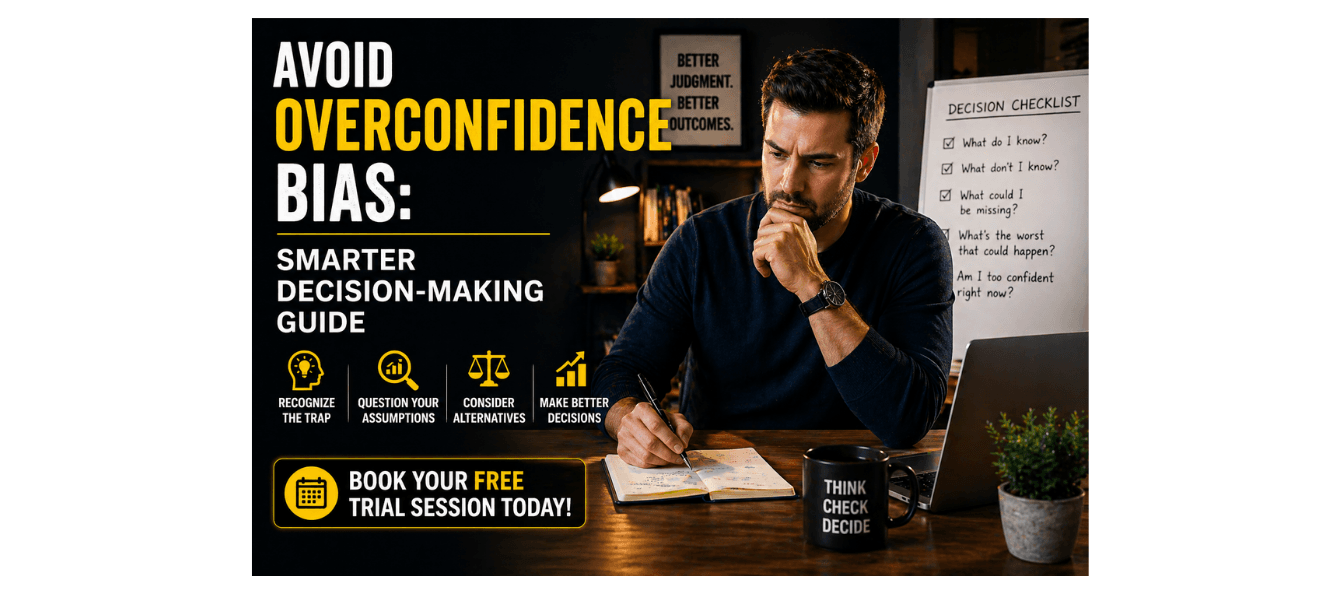
Download these resources and apply them alongside your daily work for improved clarity, productivity, and professional growth. You can also book a free trial to gain expert guidance and enhance your communication, problem-solving, and decision-making skills. The materials are designed in a clear, structured format to help professionals learn efficiently and implement insights with confidence.
Who Is This Blog For?
- Working professionals making high-stakes decisions regularly
- Managers and leaders responsible for strategy and hiring
- Consultants presenting recommendations to clients
- Career switchers evaluating uncertain opportunities
- Individuals who want to improve judgment accuracy
Why This Topic Matters Today?
In fast-paced work environments, confidence is rewarded—but unchecked confidence is risky.
As explained in the guide (page 2), overconfidence leads to:
- Decisions made with incomplete information
- Ignoring dissenting perspectives
- Over-reliance on past experience
- Anchoring on early assumptions
- Poor risk evaluation
A key insight from behavioural research:
The more experienced you are, the more vulnerable you become to overconfidence—because familiarity creates a false sense of certainty.
This makes calibration—not just confidence—a critical professional skill.
Core Concept or Framework Explained
The playbook introduces a structured approach to calibrated confidence, built on three core layers:
- Awareness: Recognise overconfidence signals
- Application: Use checklists and frameworks
- Reflection: Learn from past decisions
As shown across the guide (pages 3–6), the goal is not to reduce confidence—but to align it with reality.
The key idea:
Confidence should be earned through process, not assumed through experience.
How This Blog and Guidebook Help You?
By applying this framework, you can:
- Detect overconfidence before it affects decisions
- Improve accuracy in high-stakes situations
- Strengthen credibility in professional environments
- Make more balanced and informed choices
- Build long-term decision-making reliability
You move from instinct-driven confidence to calibrated judgment.
Step-by-Step Breakdown
Step 1: Recognise Early Warning Signals
The guide (page 3) identifies key signals of overconfidence:
“I already know this”:
- You stop asking questions too early
“I’m sure this will work”:
- You skip risk evaluation
Dismissing disagreement:
- You defend instead of exploring
Seeking confirmation:
- You look for validation, not truth
Key insight:
Overconfidence feels like clarity—but it limits thinking.
Step 2: Apply the Pre-Decision Calibration Checklist
Before making decisions, use the checklist (page 4):
Information Audit:
- Have you considered opposing data?
- Do you know what you don’t know?
Assumption Stress Test:
- Have you listed key assumptions?
- Have you explored failure scenarios?
Stakeholder Check:
- Have you heard diverse perspectives?
Decision Reversibility:
- Can this decision be reversed?
Key insight:
A 5-minute checklist can prevent costly mistakes.
Step 3: Communicate with Calibrated Confidence
The guide (page 5) provides practical scripts:
Instead of:
- “This is definitely the right approach”
Use:
- “Based on current information, this is the best direction, assuming X and Y hold true”
Key insight:
Confidence increases credibility when it acknowledges uncertainty.
Step 4: Use the THINK Framework for High-Stakes Decisions
The THINK Framework (page 6) provides structured rigor:
T — Test assumptions
H — Hunt for disconfirming evidence
I — Invite dissent
N — Name confidence level
K — Know reversal plan
This ensures decisions are thoroughly evaluated.
Key insight:
High-stakes decisions require structured thinking—not intuition alone.
Step 5: Conduct Post-Decision Reviews
The Decision Debrief Worksheet (page 7) includes:
- What was the decision?
- What assumptions were made?
- What actually happened?
- Were you overconfident?
Key insight:
Reflection improves future calibration.
Step 6: Learn from Real-World Scenarios
The guide (page 8) highlights common situations:
Consultant mistake:
- Applying patterns from unrelated contexts
Hiring error:
- Trusting instinct over verification
Career decision:
- Ignoring survivorship bias
Key insight:
Overconfidence appears in different forms—but follows similar patterns.
Step 7: Avoid Common Overconfidence Traps
The guide outlines key traps (page 9):
- Anchoring on first information
- Survivorship bias
- Echo chamber thinking
- Planning fallacy
- Commitment escalation
Better practices include:
- Seeking opposing views
- Using data over intuition
- Defining exit criteria
Step 8: Understand Your Risk Profile
The self-evaluation tool (page 10) identifies five risk areas:
- Domain expertise bias
- Time pressure decisions
- Social proof influence
- Past success bias
- Emotional attachment
Key insight:
Your overconfidence is context-specific.
Common Mistakes or Pitfalls to Avoid
The guide highlights:
- Confusing confidence with accuracy
- Skipping structured evaluation
- Ignoring dissenting opinions
- Over-relying on past success
- Avoiding reflection
Better approach:
- Use structured frameworks consistently
- Seek opposing viewpoints
- Assign confidence levels explicitly
- Review decisions regularly
How Should You Use This Guidebook Effectively?
To maximise results:
- Use the checklist before major decisions
- Apply THINK framework for high-stakes situations
- Track decisions using debrief worksheets
- Identify your top overconfidence triggers
Suggested workflow:
- 5 minutes pre-decision
- 15–30 minutes for major decisions
- 20 minutes post-decision review
Consistency builds calibrated judgment.
Key Takeaways
- Overconfidence is a calibration error, not arrogance
- Experience increases risk of overconfidence
- Early signals help detect bias in real time
- Structured checklists improve decision quality
- The THINK framework ensures rigorous evaluation
- Communication should reflect uncertainty and logic
- Reflection builds long-term accuracy
- Calibrated confidence is a critical professional skill
Your Next Step: Accelerate Your Career with PlanetSpark
Creating an impact-driven resume is not just about landing your next job—it’s about owning your professional story and presenting it with clarity, confidence, and credibility. When your resume clearly communicates value, results, and impact, opportunities follow naturally.
At PlanetSpark, we are committed to empowering working professionals with practical, outcome-focused resources that drive real career growth. From resume building and workplace communication to leadership presence and professional writing, our programs are designed to help you succeed in today’s fast-evolving job market.
Visit https://www.planetspark.in/resources to explore:
- Career and resume-building guides
- Workplace communication and professional writing resources
- Skill-development tools curated for working professionals
Want a deeper, hands-on experience?
You can also book a free trial session to learn more about PlanetSpark’s Working Professional Courses, designed to accelerate your career through personalised coaching, real-world practice, and expert guidance.
Your career deserves more than generic advice.
It deserves clarity, confidence, and measurable impact.
Start building that advantage today—with PlanetSpark.
Personalized Communication Roadmaps
Record a video to get a AI generated personalized communication reports