
Balancing Results and Growth: Manager’s Guide 2026
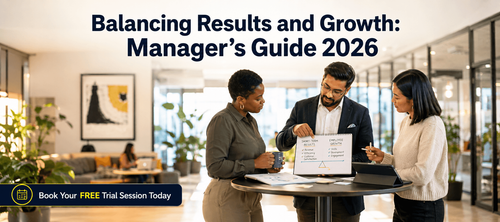

Balance Short-Term Results With Long-Term Team Growth: A Practical Guide for Modern Managers
In today’s fast-paced work environment, managers are constantly caught between two competing demands: delivering immediate results and building a team that can sustain success over time. Prioritizing only one side creates problems—either burnout and stagnation, or missed targets and stakeholder dissatisfaction.
The real challenge is not choosing between results and growth—it is learning how to manage both simultaneously.
This guide breaks down a structured, template-driven system that helps managers deliver today while building for tomorrow.
Download these resources and apply them alongside your daily work for improved clarity, productivity, and professional growth. You can also book a free trial to gain expert guidance and enhance your communication, problem-solving, and leadership skills.
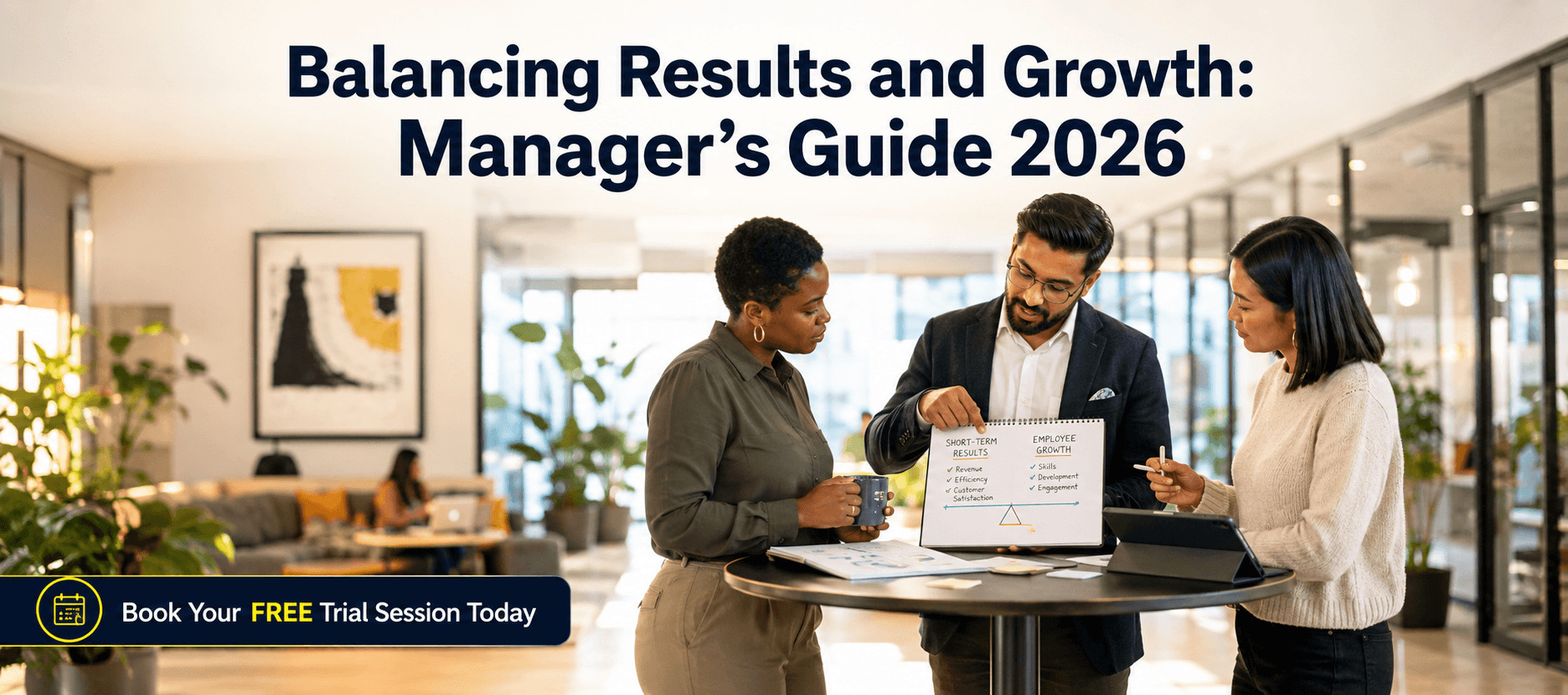
Who Is This Blog For?
- Team leaders managing high-pressure delivery cycles
- Managers balancing performance reviews and development plans
- Consultants working with client expectations and team capacity
- HR professionals focused on sustainable team growth
- Professionals transitioning into leadership roles
Why This Topic Matters Today?
The tension between short-term output and long-term growth is one of the most common leadership challenges. As highlighted in the resource, prioritizing only immediate results can lead to burnout, reduced innovation, and dependency on a few key individuals.
On the other hand, over-investing in development without delivering results erodes stakeholder trust.
The best leaders treat this not as a trade-off—but as a system that can be managed with structure and intention.
Core Concept or Framework Explained
The framework is built on three core principles (explained on page 15 of the document):
1. Make both tracks visible
Delivery goals are always tracked. Growth goals often are not. The key is to make both equally visible and measurable.
2. Embed growth into work
Development should not happen outside work—it should happen through work. Every task becomes a learning opportunity.
3. Protect sustainability
Burnout is not just a wellbeing issue—it is a delivery risk. Sustainable teams deliver better over time.
These principles transform leadership from reactive to intentional.
How This Blog and Guide Help You?
This system helps you:
- Deliver consistent results without exhausting your team
- Build skills while working on real projects
- Reduce dependency on a few high performers
- Increase team ownership and autonomy
- Create a long-term capability roadmap
Step-by-Step Breakdown
Quarterly Dual-Track Planning
Plan delivery and growth together:
- Define business goals
- Define team capability goals
- Track both monthly
This ensures development is never “forgotten” under pressure.
Stretch Assignments
Instead of separate training:
- Assign real tasks that push team members
- Define both business and growth outcomes
- Provide structured support
This is one of the fastest ways to build capability.
Sprint-Embedded Learning
Reserve 5–10% of team capacity for learning:
- Short sessions within sprint cycles
- Peer teaching or skill-building moments
- Reviewed in retrospectives
This keeps growth continuous without disrupting delivery.
Capacity vs Growth Audit
As shown in the table on page 7, track:
- Hours spent on delivery vs learning
- Stress levels
- Missed development opportunities
This helps identify when growth is being squeezed out.
Individual Development Alignment
Link each team member’s growth to their current work:
- Assign tasks that build required skills
- Provide coaching and feedback
- Set measurable milestones
Growth becomes part of daily execution.
Stakeholder Communication
When questioned about development time:
- Show how it improves delivery quality
- Link skills to reduced future risks
- Demonstrate long-term efficiency gains
This builds trust instead of resistance.
Delegation Decision Matrix
The visual matrix on page 10 shows four actions:
- Delegate with support (high growth potential)
- Co-own (high risk tasks)
- Retain (urgent tasks)
- Drop or batch (low value work)
This ensures delegation supports both speed and development.
Post-Project Growth Debrief
After every project:
- Capture lessons learned
- Identify capability gaps
- Convert insights into future actions
Without this, teams repeat mistakes.
Burnout Risk Planning
Monitor signs like:
- Reduced output quality
- Missed deadlines
- Low engagement
Create recovery plans and rebalance workload proactively.
6-Month Growth Roadmap
Plan:
- Business milestones
- Team capability goals
- Individual growth focus
- Sustainability metrics
This ensures long-term direction is never lost.
Common Mistakes to Avoid
- Treating development as optional
- Delegating only low-risk tasks
- Ignoring burnout signals
- Measuring only output, not learning
- Disconnecting growth from real work
These mistakes gradually weaken both performance and culture.
How Should You Use This Guide Effectively?
Follow a simple rhythm:
Month 1:
- Run capacity audit
- Set dual-track goals
Month 2:
- Embed learning into work
- Assign stretch tasks
Month 3:
- Review progress
- Capture learnings
- Adjust strategy
Start with one template based on your biggest challenge. Consistency matters more than using everything at once.
Key Takeaways
- Results and growth are not opposites—they are interdependent
- Growth must be built into daily work, not treated separately
- Sustainable teams outperform over time
- Structured tools make balance measurable and repeatable
- Leadership is about managing systems, not just tasks
Your Next Step: Accelerate Your Career with PlanetSpark
Creating an impact-driven career is not just about delivering results—it’s about building the skills and leadership mindset that sustain success over time. When you learn how to balance performance with growth, you position yourself as a strategic leader, not just an executor.
At PlanetSpark, we help working professionals develop the skills that matter—communication, leadership, structured thinking, and career growth strategies. Our programs are designed to be practical, outcome-driven, and immediately applicable in real workplace scenarios.
Visit https://www.planetspark.in/resources to explore:
- Career and leadership development guides
- Workplace communication frameworks
- Practical tools for managers and professionals
You can also book a free trial session to experience our Working Professional Courses, where you’ll receive personalized coaching, real-world practice, and expert feedback to accelerate your career.
Your growth is your greatest competitive advantage.
Start building it today—with PlanetSpark.
Personalized Communication Roadmaps
Record a video to get a AI generated personalized communication reports