
Behavioral Interview Frameworks Guide for Professionals 2026
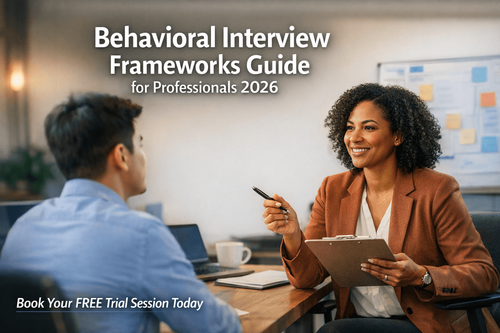

Mastering Behavioral Interviews: How to Use the Behavioral Question Frameworks Guide
Behavioral interview questions—the classic “Tell me about a time when…” prompts—are not a formality. They are the interviewer’s most reliable signal of how you will actually perform on the job. Unlike technical questions, which test knowledge, behavioral questions test judgment, resilience, communication, and self-awareness. The Behavioral Question Frameworks Guide by PlanetSpark provides a structured playbook to answer these questions with clarity, confidence, and impact.
Download these resources and apply them alongside your daily work for improved clarity, productivity, and professional growth. You can also book a free trial to gain expert guidance and enhance your communication, problem-solving, and decision-making skills. The materials are designed in a clear, structured format to help professionals learn efficiently and implement insights with confidence.

Who Is This Blog For?
- Working professionals preparing for interviews
in consulting, corporate, or leadership roles
- Career changers seeking to reframe their experiences with credibility
- Mid-career professionals aiming for promotions or new opportunities
- Anyone who struggles with behavioral questions despite strong experience
Why This Topic Matters Today?
Behavioral questions are difficult to fake. They force candidates to reveal how they think under pressure, handle ambiguity, and interact with others. The difference between a candidate who gets an offer and one who does not often comes down to how well they organise and deliver their stories—not the stories themselves. Structured frameworks ensure your answers land with impact.
Core Concept or Framework Explained
The guide introduces three proven frameworks:
- STAR (Situation, Task, Action, Result): The gold standard for clarity and completeness.
- SOAR (Situation, Obstacle, Action, Result): Best for resilience and problem-solving questions.
- CAR (Challenge, Action, Result): Concise and effective for follow-ups or time-limited formats.
It also emphasises the Specificity Upgrade Formula: quantify results, name tools/teams, and describe steps to transform vague answers into credible evidence.
How This Blog and Guidebook Help You?
By using the guide, you will:
- Build a personal story bank mapped to seven core competencies
- Deliver answers with structure, ownership, and measurable results
- Handle difficult behavioral questions (failure, conflict, ambiguity, influence) with confidence
- Adapt frameworks to different formats (panel, video, written, hybrid)
- Avoid common mistakes like rambling, vague outcomes, or overusing “we”
Step-by-Step Breakdown
Step 1: Understand Behavioral Question Categories
Competency-based, values-alignment, stress & resilience, and collaboration. Map your stories to these categories before interviews.
Step 2: Build STAR Stories
Draft stories with Situation, Task, Action, and Result. Spend 60%+ of your time on Action and Result.
Step 3: Create a Story Bank
Prepare 6–8 strong stories mapped to competencies like leadership, adaptability, communication, teamwork, problem-solving, prioritisation, and values.
Step 4: Apply the Specificity Upgrade Formula
Quantify outcomes, name tools/teams, and describe steps to sharpen credibility.
Step 5: Master Difficult Question Types
Own failures, frame conflicts professionally, show clarity in ambiguity, and demonstrate influence without authority.
Step 6: Use Frameworks in Different Formats
Adapt STAR, SOAR, and CAR for panel interviews, asynchronous video, written assessments, or hybrid case interviews.
Step 7: Debrief After Every Interview
Use a structured debrief sheet to refine stories, identify weak points, and improve continuously.
Common Mistakes or Pitfalls to Avoid
- Answering in the plural (“we did…”) instead of owning your role
- Choosing stories with no real challenge
- Failing to quantify results
- Rambling beyond 3 minutes
- Ending without reflection or learning
- Repeating the same story for multiple questions
How Should You Use This Guidebook Effectively?
- Read sequentially for context, then jump to worksheets for practice
- Build and rehearse your story bank aloud, not silently
- Use the Quick Reference card before interviews for rapid recall
- Debrief after each interview to refine and strengthen your answers
Key Takeaways
- Behavioral questions are the real test of judgment and resilience
- STAR, SOAR, and CAR frameworks provide structure and clarity
- Specificity wins—quantify, name, and describe steps
- Build a story bank mapped to core competencies
- Adapt delivery to different formats and contexts
- Treat every interview as practice—debrief and improve continuously
Your Next Step: Accelerate Your Career with PlanetSpark
Creating an impact-driven resume is not just about landing your next job—it’s about owning your professional story and presenting it with clarity, confidence, and credibility. When your resume clearly communicates value, results, and impact, opportunities follow naturally.
At PlanetSpark, we are committed to empowering working professionals with practical, outcome-focused resources that drive real career growth. From resume building and workplace communication to leadership presence and professional writing, our programs are designed to help you succeed in today’s fast-evolving job market.
Visit https://www.planetspark.in/resources to explore:
- Career and resume-building guides
- Workplace communication and professional writing resources
- Skill-development tools curated for working professionals
Want a deeper, hands-on experience?
You can also book a free trial session to learn more about PlanetSpark’s Working Professional Courses, designed to accelerate your career through personalised coaching, real-world practice, and expert guidance.
Your career deserves more than generic advice.
It deserves clarity, confidence, and measurable impact.
Start building that advantage today—with PlanetSpark.
Personalized Communication Roadmaps
Record a video to get a AI generated personalized communication reports