
Build a Personal Leadership Flywheel for Continuous Growth
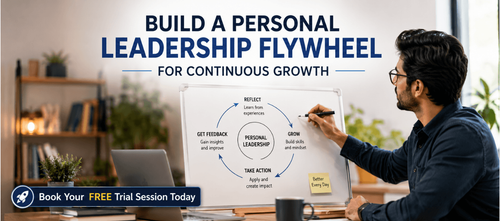

Designing a Personal Leadership Flywheel for Continuous Growth, Better Decision-Making, and Long-Term Career Momentum
Many professionals work incredibly hard to improve themselves. They attend leadership workshops, save productivity frameworks, listen to podcasts during commutes, and complete online courses with genuine enthusiasm. Yet months later, their communication patterns, decision-making habits, and leadership behaviors often remain unchanged.
This disconnect creates frustration because the problem is rarely effort or ambition. Instead, the issue is that most professionals approach growth inconsistently. They consume ideas without building systems that turn those ideas into repeatable action. As a result, growth becomes temporary and reactive rather than structured and compounding.
The “Building a Personal Leadership Flywheel for Continuous Improvement” toolkit solves this challenge through a practical self-development framework designed specifically for working professionals. Instead of focusing on motivation alone, the resource introduces a repeatable four-stage flywheel system that helps professionals reflect, learn, experiment, gather feedback, and improve continuously over time. Through reflection prompts, leadership experiments, feedback systems, habit anchors, and monthly tracking tools, the toolkit transforms professional growth into an ongoing leadership operating system.
Download these resources and apply them alongside your daily work for improved clarity, productivity, and professional growth. You can also book a free trial to gain expert guidance and enhance your communication, problem-solving, and decision-making skills. The materials are designed in a clear, structured format to help professionals learn efficiently and implement insights with confidence.
Who Is This Blog For?
- Working professionals seeking structured leadership growth
- Managers aiming to improve communication and team leadership
- Consultants developing stronger client-facing leadership skills
- Career changers building long-term professional momentum
- Emerging leaders focused on self-awareness and improvement
- Mid-level professionals preparing for larger leadership roles
- Individuals frustrated with inconsistent personal development progress
Why This Topic Matters Today?
Modern professionals are surrounded by endless learning opportunities. Leadership content is more accessible than ever through:
- Online courses
- Books and podcasts
- Workshops and certifications
- Social media insights
- Mentorship conversations
However, according to the toolkit, most professionals remain stuck despite consuming large amounts of growth-related content.
The guide explains that the problem is not motivation.
The real issue is the absence of a structured growth architecture.
Without a repeatable development system:
- Insights disappear quickly
- Reflection becomes inconsistent
- Growth remains reactive
- Leadership behaviors fail to evolve sustainably
The toolkit uses the metaphor of a flywheel borrowed from physics.
A flywheel is difficult to move initially, but once momentum builds, it becomes self-sustaining.
The same principle applies to leadership growth:
- Small, consistent actions compound into major long-term transformation
In today’s workplace, professionals who continuously improve their communication, self-awareness, and leadership adaptability gain significant career advantages.
Core Concept or Framework Explained
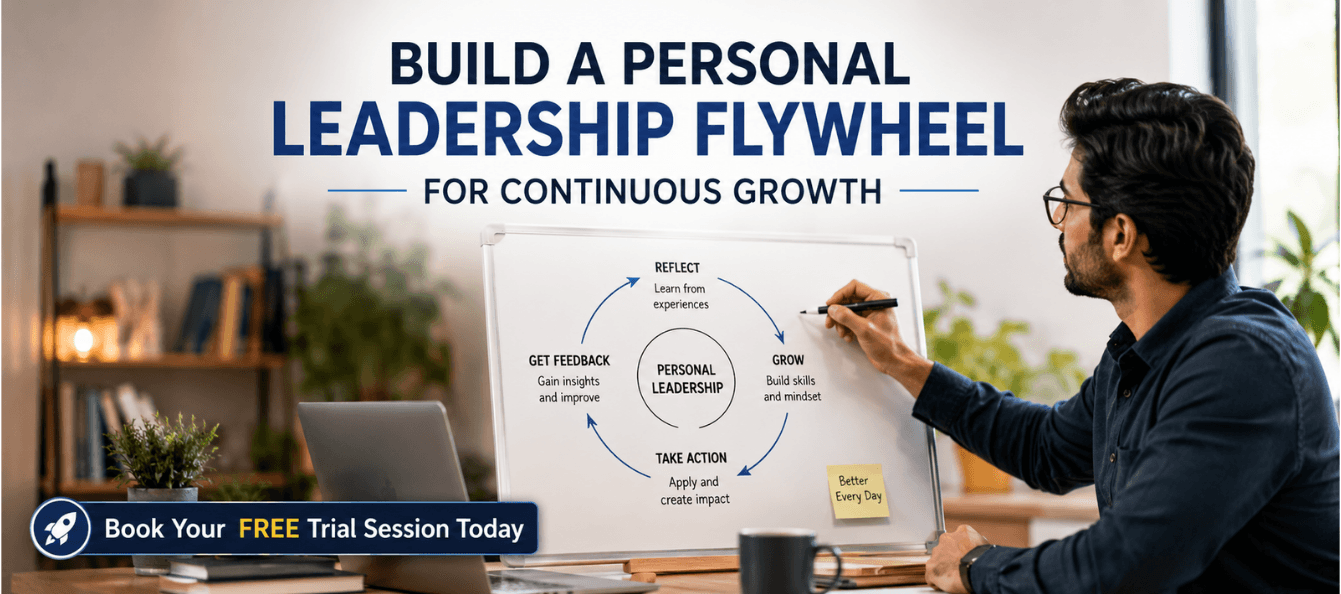
The toolkit introduces a four-stage Leadership Flywheel designed to create compounding leadership growth over time.
The four stages are:
- Reflect
- Learn
- Apply
- Observe
The guide explains that the power of the flywheel comes from the loop itself rather than any individual stage.
Reflect
Professionals examine experiences honestly and identify leadership patterns.
Learn
They extract transferable insights from those experiences.
Apply
They design deliberate leadership experiments.
Observe
They gather feedback and measure results.
Each cycle creates stronger self-awareness, sharper leadership instincts, and more intentional behavior.
The resource strongly warns that skipping the Observe stage is one of the biggest reasons growth efforts fail.
The toolkit also highlights the efficiency of the system:
- Weekly flywheel cycle: approximately 20 minutes
- Monthly deep review: 60–90 minutes
This makes the framework sustainable even for busy professionals.
How This Blog and Guidebook Help You?
This blog and toolkit provide professionals with a practical leadership growth system that fits into real workplace routines.
The resource helps professionals:
- Build stronger self-awareness
- Improve leadership consistency
- Turn experience into actionable insight
- Develop high-impact habits gradually
- Build momentum through small experiments
- Improve communication and decision-making
- Create sustainable professional growth systems
Unlike passive self-help content, the toolkit focuses heavily on action, experimentation, and measurable behavioral change.
Step-by-Step Breakdown
Step 1: Understand Why Growth Often Stalls
The toolkit begins by explaining why professionals struggle to improve consistently.
Common causes include:
- Stagnant routines
- Limiting beliefs
- Skill gaps
- Lack of reflection systems
- Reactive development habits
The guide emphasizes that effort without structure creates exhaustion rather than momentum.
The solution is not consuming more information.
The solution is creating a repeatable leadership operating system.
Step 2: Build the Reflect Habit
The first flywheel stage focuses on reflection.
The guide explains that experience alone does not create growth.
Reflected experience creates growth.
Most professionals move rapidly from one task or meeting to another without analyzing what actually happened.
The toolkit introduces a 5-question weekly reflection ritual:
- What leadership moment am I most proud of this week?
- Where did I fall short of my standard?
- Who did I influence positively?
- What feedback did I receive?
- What interaction would I handle differently now?
The guide recommends spending approximately 15 minutes every Friday answering these questions in writing.
This creates structured self-awareness over time.
Step 3: Avoid Common Reflection Traps
The toolkit identifies several reflection mistakes.
Surface-Level Reflection
Example:
- “The meeting went fine.”
Problem:
No actionable insight emerges.
Better approach:
Identify specific behaviors and outcomes.
Reflecting Only on Failures
Problem:
Professionals ignore what actually works.
Better approach:
Study successful behaviors equally.
Skipping Root Causes
Problem:
Patterns remain hidden.
Better approach:
Ask why behaviors happened repeatedly.
Reflection Without Action
Problem:
Insights disappear quickly.
Better approach:
Connect every insight to a next step.
The guide emphasizes that reflection must create movement.
Step 4: Extract Transferable Leadership Insights
The Learn stage converts reflection into reusable leadership intelligence.
The toolkit explains that professionals should identify:
- The broader leadership pattern underneath each situation
Examples include:
- Delegation problems
- Influence challenges
- Communication gaps
- Feedback issues
- Conflict patterns
The guide introduces the Insight Capture Worksheet with three columns:
- Situation
- Leadership Insight
- Broader Pattern
Example:
Situation
- Team meeting lost momentum
Insight
- No clear context-setting at the beginning
Broader Pattern
- Teams disengage without understanding the “why”
The toolkit explains that this process builds a personal leadership intelligence library over time.
Step 5: Write Leadership Principles
The guide encourages professionals to turn insights into one-sentence leadership principles.
Example:
- “When I skip context-setting, people lose focus quickly.”
The toolkit strongly emphasizes specificity over vague self-help language.
This makes insights easier to apply consistently.
Step 6: Design Small Leadership Experiments
The Apply stage transforms insight into deliberate action.
The toolkit explains that experiments should follow a simple IF-THEN structure.
Example:
IF I ask more clarifying questions during meetings, THEN I expect stronger team participation.
The guide explains that leadership experiments should be:
- Small
- Specific
- Time-bound
- Observable
The Experiment Design Template includes:
- Current gap
- IF-THEN experiment
- Real-world opportunity
- Success signal
This structure makes growth measurable.
Step 7: Run One Experiment at a Time
One of the strongest recommendations in the toolkit is limiting experiments intentionally.
The guide warns against trying to improve too many behaviors simultaneously.
Better approach:
- One focused experiment per week
The resource explains that depth creates stronger behavioral change than breadth.
Step 8: Observe Results and Gather Feedback
The Observe stage closes the loop.
The guide explains that professionals often apply new behaviors but fail to collect evidence about whether they worked.
The toolkit introduces four feedback methods:
The 3-Question Ask
After interactions, ask:
- What worked well?
- What could improve?
- What should I continue doing?
Peer Check-In
Ask trusted peers about leadership patterns they observe.
Team Pulse
Request anonymous feedback quarterly.
Self-Scoring
Rate leadership behaviors weekly from 1–10.
The Monthly Flywheel Tracker then helps professionals identify recurring patterns across experiments and feedback.
Step 9: Build Weekly Habit Anchors
The toolkit emphasizes attaching flywheel behaviors to existing routines.
Recommended habit anchors include:
Monday Morning
- Define one leadership experiment
After Key Meetings
- Note one thing done well and one improvement area
Friday Evening
- Complete weekly reflection prompts
Weekly
- Send one feedback request
Monthly
- Review pattern trends and set priorities
The guide explains that habit anchoring increases consistency significantly.
Step 10: Learn From Priya’s Flywheel Example
The toolkit includes the example of Priya, a Senior Consultant struggling with rushed communication and weak listening habits.
Her flywheel process included:
Reflect
She reviewed client calls and noticed she interrupted frequently.
Learn
She identified the broader pattern:
- “I listen to respond, not to understand.”
Apply
Her experiment:
- Pause and paraphrase before answering clients.
Observe
Clients responded more positively and conversations improved significantly.
Her self-score improved from 3/10 to 7/10 over one cycle.
The guide explains that intentional repetition gradually transformed her default communication style.
Common Mistakes or Pitfalls to Avoid
The toolkit identifies several common flywheel mistakes.
Reflecting Without Writing
Problem:
Insights disappear quickly.
Better approach:
Write at least one sentence per reflection question.
Running Too Many Experiments
Problem:
Progress becomes scattered.
Better approach:
Focus on one experiment weekly.
Waiting for Formal Feedback
Problem:
Growth cycles become slow.
Better approach:
Ask for informal feedback regularly.
Treating Insight as the End Goal
Problem:
Awareness never becomes behavior.
Better approach:
Connect every insight to a next experiment.
Stopping After a Difficult Week
Problem:
Momentum disappears.
Better approach:
Use difficult weeks as reflection opportunities.
How Should You Use This Guidebook Effectively?
The toolkit works best as a recurring leadership development system rather than a one-time exercise.
Recommended workflow:
- Run weekly reflection sessions
- Capture one transferable insight weekly
- Design one leadership experiment
- Gather informal feedback consistently
- Track monthly patterns
- Review flywheel momentum every 30 days
Suggested implementation plan:
Week 1
- Build the reflection habit
Week 2
- Capture transferable leadership patterns
Week 3
- Run the first IF-THEN experiment
Week 4
- Gather feedback and identify trends
The guide emphasizes that momentum is the true objective.
Small consistent actions create major long-term transformation.
Key Takeaways
- Leadership growth requires systems, not just motivation
- The Reflect–Learn–Apply–Observe loop creates compounding improvement
- Reflection without action produces little long-term change
- Small experiments create faster growth than vague intentions
- Feedback is essential for identifying blind spots
- Writing insights improves retention and clarity
- One focused experiment weekly is more effective than multiple scattered goals
- Habit anchors improve consistency significantly
- Difficult experiences often contain the most valuable leadership lessons
- Sustainable momentum matters more than intensity in professional growth
Your Next Step: Accelerate Your Career with PlanetSpark
Creating an impact-driven resume is not just about landing your next job—it’s about owning your professional story and presenting it with clarity, confidence, and credibility. When your resume clearly communicates value, results, and impact, opportunities follow naturally.
At PlanetSpark, we are committed to empowering working professionals with practical, outcome-focused resources that drive real career growth. From resume building and workplace communication to leadership presence and professional writing, our programs are designed to help you succeed in today’s fast-evolving job market.
Visit https://www.planetspark.in/resources to explore:
- Career and resume-building guides
- Workplace communication and professional writing resources
- Skill-development tools curated for working professionals
Want a deeper, hands-on experience?
You can also book a free trial session to learn more about PlanetSpark’s Working Professional Courses, designed to accelerate your career through personalised coaching, real-world practice, and expert guidance.
Your career deserves more than generic advice.
It deserves clarity, confidence, and measurable impact.
Personalized Communication Roadmaps
Record a video to get a AI generated personalized communication reports