
Build a Personal Systems Flywheel for Long-Term Productivity
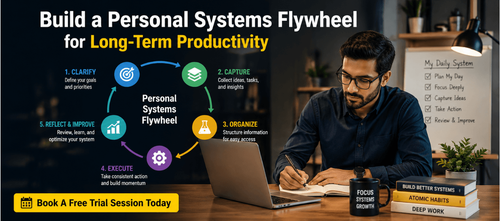

Build a Personal Systems Flywheel for Continuous Life Optimisation and Long-Term Career Growth
Most professionals spend their lives reacting instead of compounding. They complete projects, hit deadlines, and manage responsibilities, yet still feel stuck in the same cycle of stress, inconsistency, and limited progress. Productivity becomes a series of disconnected bursts rather than a sustainable system that drives long-term growth.
The problem is not a lack of ambition. It is the absence of a structured personal operating system.
Many people rely on motivation, willpower, or rigid productivity routines that collapse within weeks. Goals are created but rarely revisited. Habits begin with enthusiasm but disappear when life becomes busy. Without a system that creates momentum, every week feels like starting from zero again.
The Personal Systems Flywheel changes this approach entirely. Instead of depending on temporary motivation, it creates a repeatable framework that connects clarity, habits, execution, reflection, and optimisation into one self-reinforcing cycle. Over time, small consistent actions compound into meaningful personal and professional transformation.
Download these resources and apply them alongside your daily work for improved clarity, productivity, and professional growth. You can also book a free trial to gain expert guidance and enhance your communication, problem-solving, and decision-making skills. The materials are designed in a clear, structured format to help professionals learn efficiently and implement insights with confidence.
Who Is This Blog For?
- Working professionals struggling with inconsistency and overwhelm
- Managers and leaders seeking sustainable productivity systems
- Professionals balancing career growth, health, and relationships
- Individuals looking to build long-term habits that actually stick
- Career-focused professionals who want consistent personal growth
- People frustrated with traditional productivity systems and goal-setting methods
Why This Topic Matters Today?
Modern professional life is filled with constant distractions, fragmented priorities, and reactive work patterns. Most professionals operate in survival mode, moving from task to task without building systems that create momentum over time.
Common challenges include:
- Constant busyness without meaningful progress
- Productivity systems that collapse after a few weeks
- Goals that are forgotten shortly after being set
- Overwhelm caused by disconnected routines and priorities
- Lack of reflection and feedback loops for improvement
The Personal Systems Flywheel addresses these issues by creating a lightweight yet powerful framework that works in real-world conditions. Instead of chasing perfection, it focuses on consistency and gradual optimisation.
In today’s competitive environment, professionals who can build sustainable systems gain a major advantage. They create momentum, improve decision-making, and develop long-term resilience without burning out.
Core Concept or Framework Explained
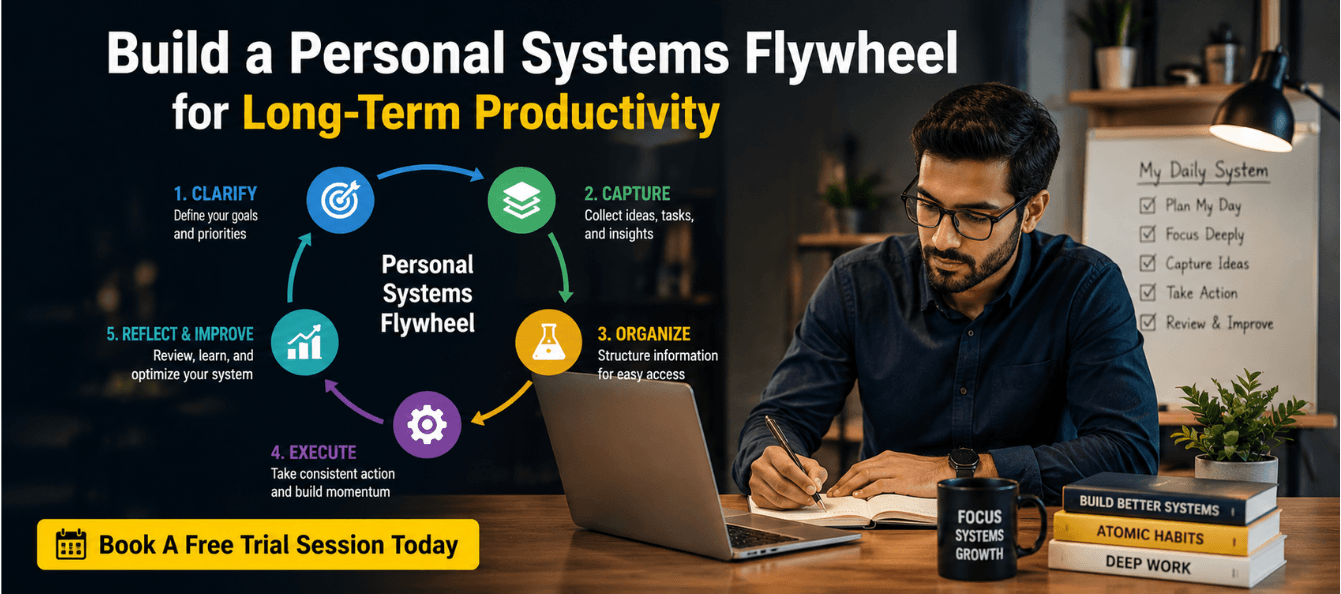
The Personal Systems Flywheel is a five-phase framework designed to create continuous personal optimisation.
Unlike traditional goal-setting systems, the Flywheel is cyclical rather than linear. There is no finish line. Each cycle builds additional momentum, making future progress easier and more sustainable.
The five interconnected phases are:
- Clarify
- Design
- Execute
- Reflect
- Optimise
Each phase supports the next. Together, they create a self-sustaining personal operating system.
The key principle behind the Flywheel is compounding. Small, consistent actions create momentum over time. Instead of relying on motivation, the system creates automatic progress through repetition and reflection.
The framework also emphasises realistic system design. It is built for actual working professionals with limited time and unpredictable schedules—not idealised versions of productivity.
How This Blog and Guidebook Help You?
This guide helps you move from reactive living to intentional system-driven growth.
By implementing the Personal Systems Flywheel, you can:
- Build sustainable habits that fit your real lifestyle
- Improve productivity without relying on willpower
- Create momentum across career, health, and personal growth
- Develop systems that evolve with your changing priorities
- Reduce overwhelm through clarity and structured execution
- Build confidence through consistent progress and reflection
Most importantly, the framework helps you stop restarting from zero every week and begin compounding your efforts over time.
Step-by-Step Breakdown
Phase 1: Clarify — Define What Actually Matters
Most personal systems fail because they are built around goals that were never consciously chosen.
The Clarify phase focuses on identifying what genuinely matters in your life.
Three key questions guide this process:
- What does a genuinely good life look like in three years?
- Which 2–3 life domains would improve everything else if strengthened?
- What current tolerations are quietly draining your energy?
Common domains include:
- Career
- Health
- Relationships
- Finance
- Learning
- Creativity
This phase creates alignment before action. Without clarity, even highly productive systems lead to misdirected effort.
Phase 2: Design — Build Systems That Work in Real Life
Once priorities are clear, the next step is designing systems that survive real-world conditions.
The framework introduces the principle of minimum effective dose—the smallest consistent action that creates progress.
Key design strategies include:
Time Architecture
Protect time for your priority domains before other tasks consume your calendar.
Habit Stacking
Attach new behaviours to existing routines to reduce friction.
Friction Engineering
Make positive habits easier and distractions harder.
System Layering
Start with one simple system per domain before adding complexity.
The goal is not intensity. It is sustainability.
Phase 3: Execute — Focus on Consistency, Not Perfection
Execution is where most systems fail because professionals adopt an all-or-nothing mindset.
The Flywheel encourages flexible consistency through five execution principles:
- Start with two-minute actions
- Never miss twice in a row
- Protect system time like important meetings
- Use visual tracking for accountability
- Design environments that support your habits
The framework also introduces a simple weekly rhythm:
- Sunday weekly preview and planning
- Daily morning priorities and evening reflections
- Friday weekly close and review
This structure keeps the system running even during chaotic weeks.
Phase 4: Reflect — Learn From Your System
Reflection transforms action into growth.
The Monthly Reflect Protocol includes:
- Reviewing your habit and calendar data
- Scoring each life domain honestly
- Extracting key lessons from the month
- Celebrating one meaningful win
This process helps identify what is working and what needs adjustment.
Without reflection, systems become outdated and disconnected from reality.
Phase 5: Optimise — Upgrade the System Continuously
Optimisation ensures your Flywheel evolves with your life.
The Quarterly Optimise Review focuses on:
- Auditing which systems are effective
- Re-evaluating life priorities
- Upgrading one successful habit or action
- Setting fresh intentions for the next quarter
The framework treats skipped habits as design problems rather than personal failures.
This mindset creates long-term adaptability and resilience.
Real-World Example: Priya’s Flywheel
The guidebook shares the example of Priya, a product manager who felt stagnant despite performing well professionally.
She identified three focus domains:
- Career growth
- Physical health
- Deep relationships
Instead of building a complicated system, she started with:
- 15 minutes of reading after lunch
- Three weekly 20-minute walks
- One no-phone dinner per week
By using habit stacking, visual tracking, and regular reflection, she achieved:
- 85% system consistency by month two
- Promotion to Senior Product Manager
- Improved health and stronger personal relationships
Her success came from consistency and system design—not extreme effort.
Common Mistakes or Pitfalls to Avoid
- Building overly ambitious systems that are impossible to sustain
- Depending on motivation instead of structured routines
- Adding too many habits at once
- Abandoning the system after missing a day
- Skipping monthly and quarterly reflection reviews
- Optimising for external expectations instead of personal priorities
These mistakes prevent systems from compounding over time.
How Should You Use This Guidebook Effectively?
To apply this framework successfully:
- Spend 20 minutes completing the Life Compass exercise
- Choose only 2–3 priority domains initially
- Start with minimum viable actions that fit within your schedule
- Use a simple paper or digital habit tracker
- Schedule monthly and quarterly reviews in advance
Suggested implementation timeline:
- Days 1–2: Clarify priorities and vision
- Day 3: Design your minimum viable system
- Days 4–7: Begin execution and track actions
- Day 7: Conduct a mini reflection and make one adjustment
The framework works best when revisited consistently rather than treated as a one-time exercise.
Key Takeaways
- Systems create sustainable progress better than isolated goals
- Clarity should come before productivity design
- Small consistent actions outperform ambitious short-term efforts
- Habit systems should fit real life, not ideal circumstances
- Reflection and optimisation drive long-term growth
- Missing one day is normal—missing twice creates negative momentum
- Personal systems should evolve as your priorities change
- Compounding happens through consistency, not perfection
Your Next Step: Accelerate Your Career with PlanetSpark
Creating an impact-driven resume is not just about landing your next job—it’s about owning your professional story and presenting it with clarity, confidence, and credibility. When your resume clearly communicates value, results, and impact, opportunities follow naturally.
At PlanetSpark, we are committed to empowering working professionals with practical, outcome-focused resources that drive real career growth. From resume building and workplace communication to leadership presence and professional writing, our programs are designed to help you succeed in today’s fast-evolving job market.
Visit https://www.planetspark.in/resources to explore:
- Career and resume-building guides
- Workplace communication and professional writing resources
- Skill-development tools curated for working professionals
Want a deeper, hands-on experience?
You can also book a free trial session to learn more about PlanetSpark’s Working Professional Courses, designed to accelerate your career through personalised coaching, real-world practice, and expert guidance.
Your career deserves more than generic advice.
It deserves clarity, confidence, and measurable impact.
Start building that advantage today—with PlanetSpark.
Personalized Communication Roadmaps
Record a video to get a AI generated personalized communication reports