
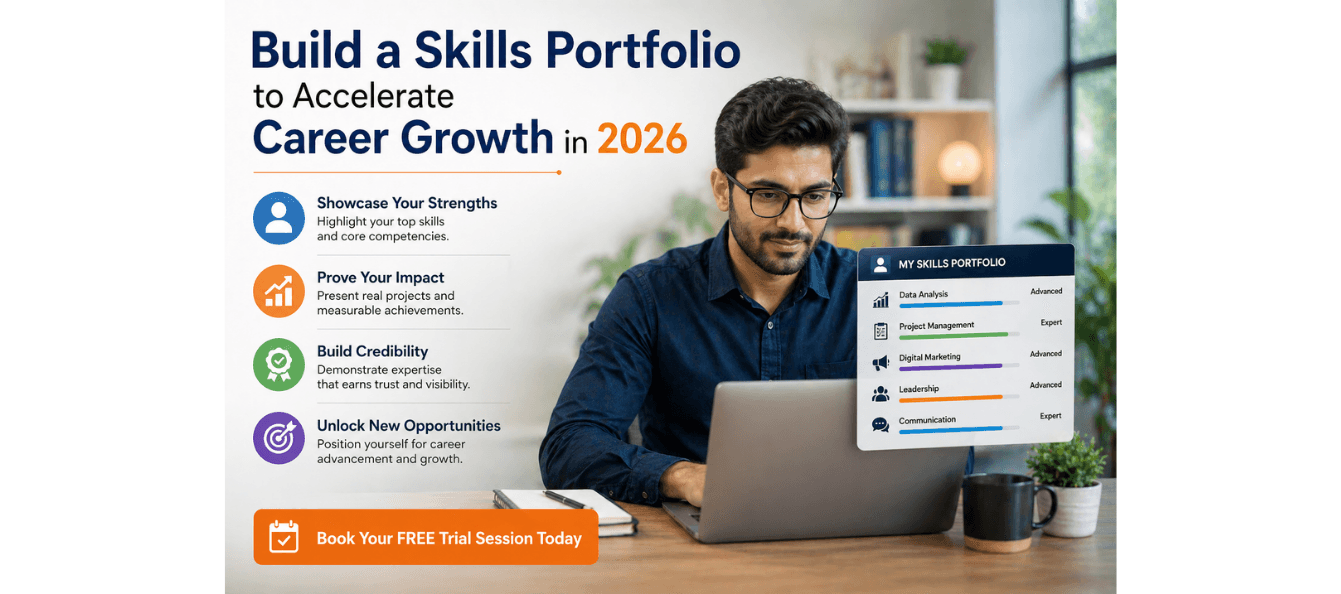
Build a Skills Portfolio to Accelerate Career Growth in 2026


Your Personal Asset Inventory: A Guide to Recording Skills, Achievements, and Proof for Career Growth
Most professionals don’t struggle because they lack experience. They struggle because they cannot clearly explain their value.
You might have worked on multiple projects, handled responsibilities across roles, and built skills over time. But when it comes to answering a simple question like “What do you bring to the table?”, the response often becomes vague, scattered, or incomplete.
This is not a confidence issue. It is a clarity issue.
Without a structured way to capture your skills, work, and achievements, your professional value remains invisible—even to you. Important projects get forgotten, skills go unnamed, and achievements lose their impact because they are not documented with evidence.
This is exactly why creating a Personal Asset Inventory is critical. It helps you systematically surface, organise, and articulate everything you already bring to the table, so you can use it across your resume, LinkedIn profile, interviews, and professional conversations.
Download these resources and apply them alongside your daily work for improved clarity, productivity, and professional growth. You can also book a free trial to gain expert guidance and enhance your communication, problem-solving, and decision-making skills. The materials are designed in a clear, structured format to help professionals learn efficiently and implement insights with confidence.
Who Is This Blog For?
- Early to mid-career professionals who want to position themselves better for growth
- Job seekers preparing for interviews, resume updates, or role transitions
- Career switchers trying to identify and present transferable skills
- Consultants and freelancers who need to showcase credibility quickly
- Managers preparing for performance reviews or promotion discussions
- Professionals who feel their experience is strong but difficult to articulate
Why This Topic Matters Today?
In today’s competitive job market, having experience is no longer enough. You must be able to clearly demonstrate your value with evidence.
Many professionals rely on job titles or responsibilities to define themselves. However, recruiters, hiring managers, and clients are increasingly focused on outcomes, measurable impact, and proof of capability.
The reality is that most professionals:
- Undersell their skills because they feel “too basic”
- Forget key achievements because they were never documented
- Struggle to quantify results or provide evidence
- Rely on vague statements instead of precise value communication
This creates a gap between actual capability and perceived value. A Personal Asset Inventory closes that gap by turning your experience into a structured, evidence-backed narrative.
Core Concept
At the heart of this guidebook is a simple but powerful framework built on three pillars: Skills, Work, and Proof.
Skills represent what you know and can do. These include technical skills, interpersonal abilities, cognitive strengths, and domain knowledge. Most professionals underestimate their skills because they fail to define them precisely.
Work represents what you have actually done. This includes projects, initiatives, deliverables, and contributions across your career. Even smaller improvements or responsibilities count as valuable work.
Proof represents evidence that your work created results. This includes numbers, metrics, testimonials, artefacts, and recognition. Proof transforms your claims from opinions into facts.
When combined, these three pillars create a complete picture of your professional value. Skills show capability, work shows application, and proof shows impact.
One of the most powerful tools introduced in the guide is the STAR-P method, which helps structure your work experiences:
- Situation explains the context or problem
- Task defines your responsibility
- Action describes what you did
- Result highlights measurable outcomes
- Proof provides evidence to support the result
This method turns vague experiences into clear, compelling, and reusable professional stories.
How This Blog and Guidebook Help You?
This blog and the underlying guidebook help you move from scattered experience to structured clarity.
By using this system, you will be able to:
- Identify and articulate your strongest skills with precision
- Build a portfolio of your most impactful work
- Back your claims with measurable and credible proof
- Prepare faster for interviews, proposals, and performance reviews
- Create stronger resumes and LinkedIn profiles
- Present yourself with confidence in any professional setting
Instead of starting from scratch every time you need to communicate your value, you will have a single source of truth that you can reuse and adapt.
Step-by-Step Breakdown
Step 1: Mapping Your Skills from Vague to Precise
The first step is conducting a complete skills audit. Most professionals underestimate their abilities because they only think in broad terms.
This guide breaks skills into four categories:
- Technical skills such as tools, platforms, and domain expertise
- Interpersonal skills such as communication, leadership, and collaboration
- Cognitive skills such as problem-solving, strategic thinking, and analysis
- Industry knowledge specific to sectors or functions
The key is to move from vague descriptions to precise ones. For example, instead of saying “communication skills,” you define it as “presenting financial results to senior leadership within a fixed time frame.”
You then assess proficiency levels and identify your top transferable skills, which become the foundation of your professional positioning.
Step 2: Cataloguing Your Work
The second step focuses on documenting your work output.
You are guided to look across:
- Your current role
- Previous roles
- Freelance or side work
- Academic or training projects
Each work item is then structured using the STAR-P method. This ensures that every experience is captured with clarity, ownership, and measurable impact.
For example, instead of saying you worked on a project, you define what problem existed, what you did, what changed, and how it can be proven.
Step 3: Collecting Your Proof
This step emphasises building evidence for your claims.
The guide identifies four types of proof:
- Quantitative proof such as numbers, percentages, and measurable outcomes
- Artefact proof such as reports, presentations, or deliverables
- Social proof such as testimonials or feedback
- Recognition proof such as awards or certifications
You also complete a proof audit to identify gaps and plan how to build stronger evidence over time.
Step 4: Organising Your Inventory
Once you have raw data, the next step is structuring it into a usable format.
The guide recommends creating a Master Inventory Document with:
- A skills register
- A work portfolio
- A proof library
- A section for achievement highlights
This transforms scattered information into a strategic asset that can be easily accessed and reused.
Step 5: Activating Your Inventory
The final step focuses on applying your inventory in real-world situations.
You use your documented assets to:
- Upgrade your resume with achievement-based content
- Optimise your LinkedIn profile
- Strengthen consulting proposals
- Prepare structured interview answers
- Present evidence during performance reviews
- Communicate clearly during networking conversations
This is where the inventory becomes a competitive advantage rather than just a document.
Common Mistakes
Many professionals make predictable mistakes when building their inventory:
- Listing responsibilities instead of outcomes, which weakens impact
- Ignoring transferable skills because they seem too basic
- Building the inventory once and never updating it
- Making strong claims without supporting proof
- Mixing strong and weak experiences without prioritisation
- Waiting until a job search to start documenting
The better approach is to focus on measurable results, include all relevant skills, update regularly, and always support claims with evidence.
How Should You Use This Guidebook Effectively?
This guidebook is designed for flexibility based on your schedule.
You can use it in three ways:
- Deep Dive Mode where you complete everything in a focused 2 to 3 hour session
- Sprint Mode where you break the work into smaller sessions across a few days
- Reference Mode where you use specific sections as needed
The most effective approach is to treat your inventory as a living document. Schedule a quarterly review to update skills, add new work, and capture fresh proof.
Even a small, consistent effort can significantly improve your career readiness over time.
Key Takeaways
- Your professional value becomes clear only when it is documented and structured
- Skills, work, and proof together create a complete and credible profile
- The STAR-P method transforms experiences into compelling career stories
- Proof is essential to convert claims into believable, measurable impact
- A structured inventory saves time and improves all career communication
- Regular updates ensure your inventory stays relevant and powerful
- Clarity and evidence are the biggest differentiators in today’s job market
Your Next Step: Accelerate Your Career with PlanetSpark
Creating an impact-driven resume is not just about landing your next job—it’s about owning your professional story and presenting it with clarity, confidence, and credibility. When your resume clearly communicates value, results, and impact, opportunities follow naturally.
At PlanetSpark, we are committed to empowering working professionals with practical, outcome-focused resources that drive real career growth. From resume building and workplace communication to leadership presence and professional writing, our programs are designed to help you succeed in today’s fast-evolving job market.
Visit https://www.planetspark.in/resources to explore:
- Career and resume-building guides
- Workplace communication and professional writing resources
- Skill-development tools curated for working professionals
Want a deeper, hands-on experience?
You can also book a free trial session to learn more about PlanetSpark’s Working Professional Courses, designed to accelerate your career through personalised coaching, real-world practice, and expert guidance.
Your career deserves more than generic advice.
It deserves clarity, confidence, and measurable impact.
Personalized Communication Roadmaps
Record a video to get a AI generated personalized communication reports