
Build Career Moats That Last Through Industry Changes 2026
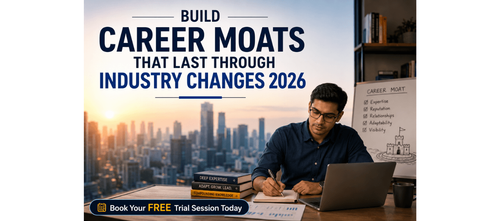

How to Establish Long-Term Professional Value That Endures Change
The idea of a stable career has changed dramatically. Technical skills become outdated faster than ever, industries transform overnight, and automation continues reshaping how businesses operate. Professionals who once relied on job titles, degrees, or years of experience as long-term security are discovering that those advantages alone no longer guarantee career resilience.
Today, the professionals who continue growing despite economic shifts and technological disruption are the ones who build durable career moats. A career moat is a set of long-term professional advantages that are difficult to replace, automate, or replicate. It combines expertise, reputation, relationships, adaptability, and strategic visibility into a system that compounds over time.
This guidebook provides a practical roadmap for working professionals who want to remain relevant, visible, and in demand regardless of market uncertainty. Instead of reacting to disruption after it happens, professionals can proactively build career resilience that strengthens year after year.
Download these resources and apply them alongside your daily work for improved clarity, productivity, and professional growth. You can also book a free trial to gain expert guidance and enhance your communication, problem-solving, and decision-making skills. The materials are designed in a clear, structured format to help professionals learn efficiently and implement insights with confidence.
Who Is This Blog For?
This blog and guidebook are designed for:
- Working professionals with 0–15 years of experience
- Career changers preparing for industry transitions
- Managers building leadership readiness
- Consultants developing long-term client credibility
- Professionals worried about automation and skill obsolescence
- Specialists seeking stronger market differentiation
- Job seekers who want sustainable career advantages
- Ambitious professionals focused on long-term growth and adaptability
Why This Topic Matters Today?
The modern professional landscape is more unpredictable than ever. According to the guidebook, automation, AI, economic volatility, and the rapid obsolescence of technical skills have permanently changed the rules of career survival.
Many professionals still approach career growth reactively:
- Upskilling only after layoffs happen
- Networking only when job searching
- Building visibility only during promotions
- Learning passively without long-term strategy
This reactive approach creates vulnerability.
The guidebook explains that relying solely on a current role or industry credential is no longer enough. What truly protects professionals is a career moat — a defensible set of advantages that competitors and technological disruption cannot easily replicate.
Professionals without durable moats often struggle with:
- Skill obsolescence anxiety
- Invisible professional branding
- Weak networks
- Reactive job searching
- Limited market differentiation
Meanwhile, professionals who intentionally build long-term career moats create stronger positioning, greater adaptability, and more consistent opportunities across changing markets.
Core Concept or Framework Explained
The guidebook introduces the Career Moat Framework, a six-phase roadmap designed to help professionals build adaptive, visible, and resilient careers.
The six phases are:
- Self-Audit
- Moat Architecture
- Compounding Knowledge
- Reputation Capital
- Relationship Infrastructure
- Adaptive Systems
Each phase builds on the previous one to create long-term professional leverage. The guidebook borrows the concept of a moat from Warren Buffett’s investment philosophy. In investing, a moat protects businesses from competitors. In careers, a moat protects professionals from disruption and commoditization.
The framework emphasizes that career resilience is not built through isolated actions. It comes from combining:
- Rare and valuable expertise
- Adjacent high-leverage skills
- Human-centered capabilities
- Visible reputation
- Strong professional relationships
- Continuous adaptation systems
Together, these elements create career durability that compounds over time.
How This Blog and Guidebook Help You?
This blog and guidebook help professionals move from reactive career management to long-term strategic career building.
You will learn how to:
- Identify your current professional strengths and vulnerabilities
- Build a durable skill stack that compounds in value
- Create knowledge systems that deepen expertise
- Build a visible professional reputation
- Develop relationship infrastructure that survives disruption
- Create routines for continuous adaptation and reinvention
- Position yourself for future opportunities instead of reacting to crises
Most importantly, the guidebook helps professionals think beyond immediate job security and focus on long-term professional resilience.
Step-by-Step Breakdown
Step 1: Conduct a Career Moat Self-Audit
The first phase focuses on radical honesty.
The guidebook explains that professionals cannot build strong career moats without understanding where they currently stand. Many professionals skip this step and later waste years pursuing misaligned goals or irrelevant skills.
The framework introduces the 4-Quadrant Skill Inventory.
Skills are categorized into four zones:
Signature Strengths
Skills where you are highly capable and energized. These become the core of your moat.
Learned Competencies
Skills you perform well but find draining. Maintain competence but avoid building your identity around them.
Growth Edges
Emerging capabilities that align with future opportunity areas.
Skill Gaps
Weak but strategically important skills that require improvement or partnership support.
The guidebook also includes reflection prompts such as:
- What do people consistently ask you for?
- What would be hardest to replace about you?
- Where do you feel professionally exposed?
- Which capabilities is the market increasingly rewarding?
These exercises help professionals identify both strengths and vulnerabilities clearly.
Step 2: Design Your Durable Skill Stack
Once professionals understand their current position, the next step is building intentional career architecture.
The guidebook emphasizes that resilient professionals do not simply collect skills randomly. They design strategic skill stacks that compound over time. :contentReference[oaicite:7]{index=7}
The framework includes three layers:
The Depth Layer
Choose one signature domain for deep long-term investment over three to five years.
Deep expertise creates:
- Premium positioning
- Referral opportunities
- Thought leadership credibility
- Higher compensation potential
The Breadth Layer
Pair deep expertise with adjacent power skills.
Examples include:
- Data analysis + executive communication
- Project management + behavioral psychology
- Technical expertise + storytelling
These combinations multiply professional value dramatically.
The Meta Layer
Develop durable human capabilities such as:
- Critical thinking
- Ethical judgment
- Leadership
- Creative problem framing
- Empathy-driven communication
The guidebook explains that these skills remain valuable even when technical categories shift.
One of the most important principles introduced is:
Aim to be top 10% in one domain, top 25% in adjacent capabilities, and genuinely excellent at human connection.
This combination is extremely difficult to replace.
Step 3: Build Knowledge That Compounds
Many professionals consume endless content but struggle to retain or apply what they learn.
The guidebook calls this the passive learning trap.
Instead, it introduces the Encode–Apply–Share Loop:
Encode
Actively process information through notes, frameworks, and reflection.
Apply
Use new ideas quickly in real-world work.
Share
Teach, write, mentor, or explain concepts publicly.
This cycle transforms learning into durable expertise.
The guidebook also includes a Knowledge Compounding Checklist:
- Read one deep book monthly
- Follow thinkers outside your industry
- Write reflections after learning
- Teach concepts weekly
- Maintain an insight journal
- Study cross-industry trends
- Complete structured certifications yearly
- Schedule monthly thinking sessions
- Build a personal resource library
- Review knowledge against market demand every six months
Professionals who consistently run this loop build stronger judgment, pattern recognition, and original thinking over time.
Step 4: Build Reputation Capital
The guidebook explains a powerful truth:
Expertise without visibility is a career half-built.
Many capable professionals remain invisible because they hesitate to share their thinking publicly.
The framework introduces four reputation-building channels:
Write Publicly
Publish LinkedIn posts, articles, case studies, or reflections consistently.
Speak Strategically
Participate in internal sessions, webinars, panels, or industry events.
Mentor Visibly
Teaching others reinforces expertise and builds trust organically.
Curate Insights
Share useful resources with original commentary and perspective.
The guidebook strongly encourages professionals to stop waiting for perfection before sharing knowledge.
Sharing thoughtful insights consistently over years creates professional authority naturally.
The guidebook reframes visibility in an important way:
Building visibility is not self-promotion. It is service-oriented contribution.
Step 5: Build Relationship Infrastructure
One of the strongest sections of the guidebook focuses on professional relationships.
The guidebook argues that most professionals treat networking transactionally, only reaching out during crises or job searches. This creates weak and unreliable networks.
Instead, professionals should build relationship infrastructure intentionally.
Strong networks share three qualities:
Diversity
Connections across industries, functions, geographies, and seniority levels.
Reciprocity
Giving value consistently without keeping score.
Proactive Maintenance
Investing in relationships before opportunities or crises arise.
The guidebook introduces five relationship tiers:
- Inner Circle
- Strategic Connectors
- Inspirational Mentors
- Emerging Allies
- Dormant High-Value Ties
Professionals are encouraged to map their relationships into these categories and strengthen each area intentionally.
One particularly valuable insight involves dormant ties.
The guidebook explains that former colleagues and inactive professional relationships often become highly valuable during career transitions because they provide access to entirely different information networks.
Step 6: Build Adaptive Systems for Reinvention
The final layer of the Career Moat Framework focuses on continuous adaptation.
Industries will continue evolving. Technologies will continue disrupting. The professionals who survive long-term are not necessarily those who predict every change perfectly. They are the professionals who build systems for detecting and responding to change early.
The guidebook recommends building routines across four timelines:
Weekly
- Review one industry trend
- Add one insight journal entry
- Strengthen one relationship
Monthly
- Complete the knowledge compounding checklist
- Share one original insight
- Review skill movement
Quarterly
- Conduct a mini moat audit
- Reconnect with dormant ties
- Review reputation evidence
Annually
- Complete a full skill audit
- Identify new growth edges
- Reassess professional relationships
- Set a 12-month moat-building intention
These routines create long-term adaptability without overwhelm.
Common Mistakes or Pitfalls to Avoid
The guidebook identifies several career mistakes that weaken long-term professional resilience.
Chasing Every Trend
Fear-driven learning creates scattered expertise.
Networking Only When Desperate
Transactional relationships rarely create durable support systems.
Keeping Expertise Private
Perfectionism and imposter syndrome limit visibility and credibility.
Skipping Self-Audits
Professionals avoid honest evaluation because it feels uncomfortable.
Optimizing Only for Current Roles
Focusing only on immediate responsibilities reduces future readiness.
The guidebook emphasizes that awareness of these patterns alone can significantly improve career decision-making.
How Should You Use This Guidebook Effectively?
The guidebook is designed for ongoing strategic use rather than one-time reading.
Recommended workflow:
- Read the full roadmap first
- Complete the 4-Quadrant Skill Inventory
- Identify your moat strengths and vulnerabilities
- Choose one signature domain for deep investment
- Build a monthly knowledge compounding routine
- Create a visibility habit
- Map your relationship infrastructure
- Schedule quarterly moat reviews
The guidebook recommends spending two to four weeks actively working through each phase while gradually integrating the systems together.
The key principle is consistency.
Small, repeated investments compound far more effectively than short bursts of intense effort.
Key Takeaways
- Career stability now depends on adaptability and strategic positioning
- A career moat protects professionals from disruption and commoditization
- Deep expertise combined with adjacent skills creates exponential value
- Human-centered capabilities remain durable long-term assets
- Passive learning creates the illusion of growth
- Knowledge compounds through encoding, application, and sharing
- Visibility is a strategic professional advantage
- Strong professional relationships require proactive maintenance
- Consistent systems outperform motivation and willpower
- Quarterly career audits help professionals stay aligned with market changes
- Small weekly actions create significant long-term career resilience
- Career moats strengthen gradually through repeated intentional investments
Your Next Step: Accelerate Your Career with PlanetSpark
Creating an impact-driven resume is not just about landing your next job—it’s about owning your professional story and presenting it with clarity, confidence, and credibility. When your resume clearly communicates value, results, and impact, opportunities follow naturally.
At PlanetSpark, we are committed to empowering working professionals with practical, outcome-focused resources that drive real career growth. From resume building and workplace communication to leadership presence and professional writing, our programs are designed to help you succeed in today’s fast-evolving job market.
Visit https://www.planetspark.in/resources to explore:
- Career and resume-building guides
- Workplace communication and professional writing resources
- Skill-development tools curated for working professionals
Want a deeper, hands-on experience?
You can also book a free trial session to learn more about PlanetSpark’s Working Professional Courses, designed to accelerate your career through personalised coaching, real-world practice, and expert guidance.
Your career deserves more than generic advice.
It deserves clarity, confidence, and measurable impact.
Start building that advantage today—with PlanetSpark.
Personalized Communication Roadmaps
Record a video to get a AI generated personalized communication reports