
Build Flexible Systems for Changing Priorities at Work

Building Systems That Adapt to Changing Priorities in a Fast-Paced Workplace
Most professionals do not struggle because they lack discipline.
They struggle because their systems collapse the moment priorities change.
One week, everything feels organised.
The next week, leadership changes direction, urgent requests pile up, a stakeholder escalates an issue, and carefully planned schedules become irrelevant overnight.
The result is exhausting:
- Constant reprioritisation
- Reactive work patterns
- Overloaded calendars
- Strategic work getting postponed repeatedly
- Stress caused by uncertainty and shifting expectations
According to the guidebook “How to Build Systems That Adapt to Changing Priorities,” this is not a personal failure. It is a systems design problem.
Most productivity systems are designed for stable environments.
Modern workplaces are not stable environments.
Today’s professionals operate in environments shaped by:
- Rapid pivots
- Competing stakeholder demands
- Constant operational shifts
- Team restructuring
- Evolving business goals
This guidebook introduces a practical framework helping professionals create adaptive systems that remain effective even when priorities shift constantly.
Rather than rebuilding workflows every week, professionals learn how to create systems capable of absorbing disruption without collapsing.
For managers, consultants, project leaders, and ambitious working professionals, this framework offers a sustainable approach to navigating uncertainty while protecting focus, performance, and long-term growth.
Download these resources and apply them alongside your daily work for improved clarity, productivity, and professional growth. You can also book a free trial to gain expert guidance and enhance your communication, problem-solving, and decision-making skills. The materials are designed in a clear, structured format to help professionals learn efficiently and implement insights with confidence.
Who Is This Blog For?
- Managers handling constantly shifting priorities
- Consultants balancing multiple stakeholders and deadlines
- Project managers operating in fast-changing environments
- Early and mid-career professionals facing overload
- Team leads managing strategic and operational demands
- Professionals frustrated with reactive productivity systems
- Career changers navigating uncertain work environments
- Professionals wanting sustainable systems instead of constant firefighting
Why This Topic Matters Today?
The workplace has changed dramatically.
Most professionals no longer operate in predictable environments with stable priorities and clear execution paths.
Instead, modern work is shaped by:
- Rapid business pivots
- Continuous interruptions
- Cross-functional dependencies
- Multiple competing stakeholders
- Shortened planning cycles
- Increasing operational complexity
The guidebook strongly explains that many traditional productivity systems fail because they were designed for predictable inputs.
That assumption no longer reflects reality.
As a result, many professionals experience:
- Weekly system breakdowns
- Constant task-list rebuilding
- Endless reactive work
- Difficulty protecting strategic priorities
- High stress and cognitive fatigue
One of the most powerful insights from the guidebook is this:
A system that cannot flex is not truly a system.
It is a rigid structure waiting to break.
This is why adaptive systems have become essential professional infrastructure rather than optional productivity tools.
Core Concept or Framework Explained
The guidebook introduces the ADAPT Framework.
This five-part model is specifically designed for professionals operating in high-change environments.
The ADAPT Framework includes:
A — Audit
D — Define
A — Allocate
P — Protect
T — Tune
Each layer addresses a different dimension of adaptive performance.
Audit
Assess current systems, failure patterns, risks, and hidden workflow dependencies.
Define
Clarify anchors, priorities, and non-negotiable commitments.
Allocate
Distribute time, energy, and attention intentionally.
Protect
Build safeguards, decision rules, and structural boundaries.
Tune
Continuously review, recalibrate, and improve the system.
The framework strongly emphasises that adaptability is not improvisation.
It is intentional system design.
How This Blog and Guidebook Help You?
This blog and the original resource help professionals shift from reactive work management toward adaptive operating systems.
The framework helps you:
- Identify hidden workflow failure points
- Build flexible systems instead of rigid schedules
- Prioritise strategic work effectively
- Create stronger decision-making structures
- Protect focus and operational capacity
- Manage competing stakeholder demands
- Handle strategic pivots without losing momentum
- Build sustainable adaptability over time
Most importantly, the framework helps professionals stop rebuilding systems repeatedly and start designing systems capable of surviving change.
Step-by-Step Breakdown
Step 1: Audit Your Existing System Honestly
The guidebook strongly explains:
You cannot fix what you have not diagnosed.
Most professionals immediately search for new productivity methods without understanding why current systems fail.
The Audit Phase focuses on identifying operational breakdowns.
The guidebook highlights several common failure patterns.
Rebuilding Task Lists Constantly
Many professionals restart systems every Monday because existing systems cannot absorb change.
Reactive Priority Decisions
Urgency often replaces strategic thinking.
Lack of Review Mechanisms
Without reviews, workload drift goes unnoticed.
No Capacity Signals
Professionals operate beyond sustainable limits without recognising overload early.
The guidebook also introduces a System Audit Worksheet helping professionals identify:
- Current workflow structures
- Trigger points for breakdowns
- Costs of system failure
- Existing strengths during chaotic periods
This creates operational clarity before redesign begins.
Step 2: Define Anchors That Do Not Move
One of the most important concepts in the framework is the idea of anchors.
The guidebook explains:
Without anchors, flexibility becomes chaos.
Anchors are commitments remaining stable even when priorities shift.
The framework introduces three anchor categories.
Strategic Anchors
Examples include:
- Long-term goals
- Key OKRs
- Career direction
Relational Anchors
These include critical professional relationships such as:
- Direct reports
- Clients
- Mentors
- Stakeholders
Operational Anchors
Recurring activities protecting work quality, such as:
- Weekly reviews
- Deep work sessions
- Strategic planning blocks
The guidebook strongly explains:
If anchors are frequently dropped, they are not truly protected by the system.
This insight helps professionals distinguish between intentions and operational realities.
Step 3: Replace Rigid Scheduling with Flexible Allocation
One of the strongest ideas in the guidebook is the shift from rigid scheduling toward flexible budgeting.
Rigid schedules collapse easily during disruption.
Flexible allocation systems absorb change more effectively.
The framework introduces three budget types.
Time Budgets
Professionals allocate percentages of weekly focus time across categories rather than over-planning specific hours.
Energy Budgets
Deep cognitive work is matched to peak energy periods.
Attention Budgets
The framework strongly recommends limiting active priorities to 3–5.
Beyond this threshold, focus quality deteriorates significantly.
The guidebook strongly explains:
Budgets survive disruption better than rigid schedules.
This approach reduces the need for constant system rebuilding.
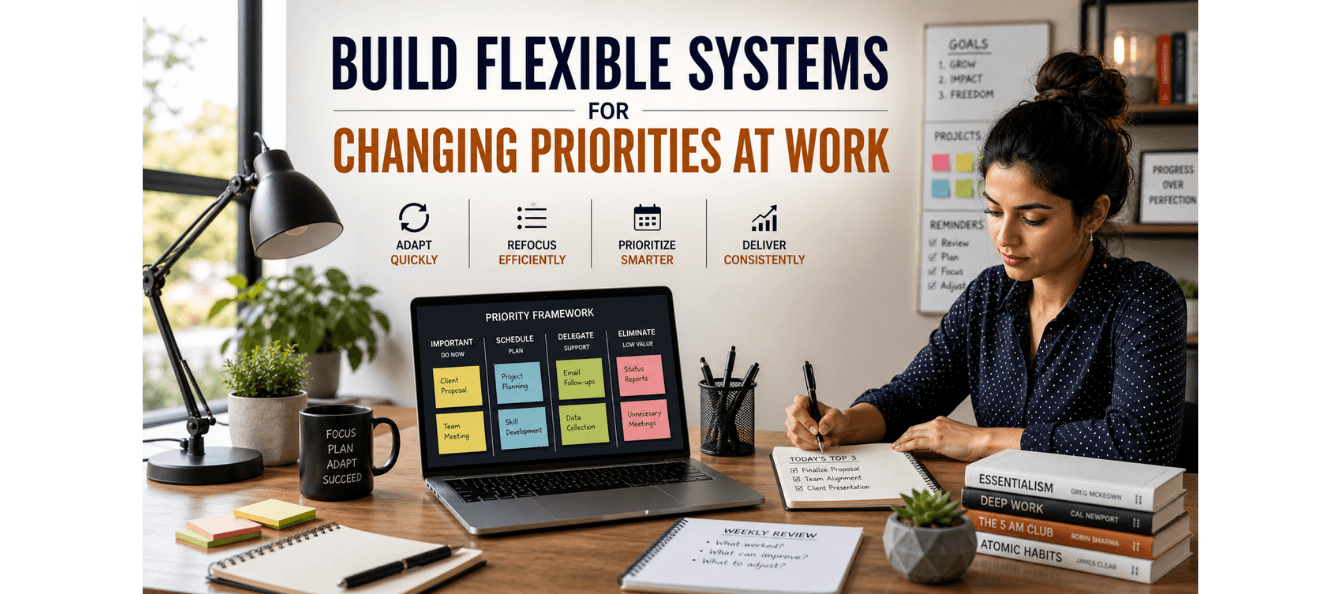
Step 4: Use the Priority Triage Matrix
The guidebook introduces a highly practical decision-making framework called the Priority Triage Matrix.
Every new request is evaluated using two dimensions:
- Strategic impact
- Time sensitivity
The matrix includes four responses.
Do Now
Strategic deliverables with deadlines.
Schedule
High-impact but lower-urgency work such as:
- Learning
- Relationship building
- Deep work
Delegate
Reactive low-impact tasks and operational admin.
Drop
Busywork and low-value commitments.
The guidebook strongly emphasises protecting high-impact, low-urgency work because this is where long-term career growth happens.
One particularly powerful warning from the framework states:
If more than 50% of your week is spent on high-urgency tasks, your system has no slack and therefore no adaptability.
Step 5: Protect the System with Decision Rules
The Protect Phase focuses on reducing decision fatigue through pre-made rules.
The guidebook strongly explains:
Professionals make poor decisions when overloaded or pressured.
Decision rules eliminate unnecessary real-time deliberation.
Examples include:
- If a new request arrives during a focus block, review it later instead of immediately
- If workload exceeds attention budget, delegate or defer work
- If strategic work is threatened, escalate the trade-off explicitly
The framework introduces three protection layers.
Structural Protection
Examples include:
- Calendar blocks
- Auto-responders
- Workspace design
Social Protection
Communicated norms with teams and stakeholders.
Cognitive Protection
Pre-made “if-then” decision rules.
The guidebook strongly emphasises that vague intentions collapse under pressure.
Specific policies survive.
Step 6: Build Review and Recalibration Rhythms
Adaptive systems require continuous tuning.
The framework introduces four review layers.
Daily Review
Quick priority alignment and carry-over assessment.
Weekly Review
20-minute recalibration including:
- Allocation reviews
- Anchor checks
- Priority updates
- Risk identification
Monthly Review
Strategic reflection on whether current systems still match evolving goals.
Quarterly Reset
Full system recalibration based on future priorities and changing realities.
The guidebook repeatedly emphasises:
The weekly review is the heartbeat of the system.
Without review loops, systems drift gradually until they collapse.
Step 7: Learn from Priya’s Real-World Example
The guidebook includes a detailed case study involving Priya, a Senior Product Manager at a fast-growing startup.
Before implementing the ADAPT framework, she faced:
- Constant roadmap changes
- Exhausting reactive workflows
- No strategic focus protection
- Overloaded operational work
After six weeks using the framework, she established:
- Clear strategic anchors
- Flexible budget-based planning
- Structured decision rules
- Protected roadmap sessions
- Better workload visibility
One of her strongest insights was:
The biggest improvement came not from better tools, but from trusting that her system could survive future pivots.
This illustrates the core value of adaptive system design.
Common Mistakes or Pitfalls to Avoid
The guidebook identifies seven major mistakes destroying adaptive systems.
Building for Perfect Weeks
Most systems assume zero disruption.
Better approach:
- Build 20% operational buffer
Treating All Tasks Equally
Flat task lists destroy prioritisation quality.
Better approach:
- Use the Triage Matrix consistently
Skipping Weekly Reviews
Without reviews, systems decay quickly.
Better approach:
- Protect weekly recalibration time
Too Many Anchors
Too many “non-negotiables” create confusion.
Better approach:
- Limit anchors intentionally
No Intake Protocol
Processing every request immediately creates overload.
Better approach:
- Maintain structured intake logs
Rebuilding Instead of Adjusting
Minor drift leads professionals to abandon entire systems.
Better approach:
- Tune systems instead of restarting
Ignoring Energy Cycles
Strategic work scheduled during low-energy periods performs poorly.
Better approach:
- Match work type to energy availability
How Should You Use This Guidebook Effectively?
The guidebook is most effective when implemented gradually.
Recommended workflow:
- Complete the System Audit first
- Define strategic, relational, and operational anchors
- Build flexible weekly allocation budgets
- Create five initial decision rules
- Install a weekly review ritual
- Apply the Priority Triage Matrix consistently
- Build intake systems for new requests
- Conduct quarterly recalibrations
Suggested implementation timeline:
Days 1–14
Install foundational systems.
Days 15–30
Stress-test the framework during real disruptions.
Days 31–60
Strengthen boundaries and protections.
Days 61–90
Tune and recalibrate for mastery.
The guidebook strongly emphasises:
Mastery is not having a perfect system.
It is having a system you trust and know how to repair.
Key Takeaways
- Modern workplaces require adaptive systems, not rigid productivity methods
- The ADAPT Framework provides a structured model for handling shifting priorities
- Strong systems begin with honest operational audits
- Anchors create stability during uncertainty
- Flexible budgets outperform rigid schedules
- Decision rules reduce cognitive overload
- Priority triage helps professionals focus on strategic work
- Review cadences keep systems aligned with changing realities
- Buffer and slack are essential for adaptability
- Sustainable adaptability is a learnable professional skill
Your Next Step: Accelerate Your Career with PlanetSpark
Creating an impact-driven resume is not just about landing your next job—it’s about owning your professional story and presenting it with clarity, confidence, and credibility. When your resume clearly communicates value, results, and impact, opportunities follow naturally.
At PlanetSpark, we are committed to empowering working professionals with practical, outcome-focused resources that drive real career growth. From resume building and workplace communication to leadership presence and professional writing, our programs are designed to help you succeed in today’s fast-evolving job market.
Visit https://www.planetspark.in/resources to explore:
- Career and resume-building guides
- Workplace communication and professional writing resources
- Skill-development tools curated for working professionals
Want a deeper, hands-on experience?
You can also book a free trial session to learn more about PlanetSpark’s Working Professional Courses, designed to accelerate your career through personalised coaching, real-world practice, and expert guidance.
Your career deserves more than generic advice.
It deserves clarity, confidence, and measurable impact.
Start building that advantage today—with PlanetSpark.
Personalized Communication Roadmaps
Record a video to get a AI generated personalized communication reports