
Build Repeatable Systems for High-Impact Team Management
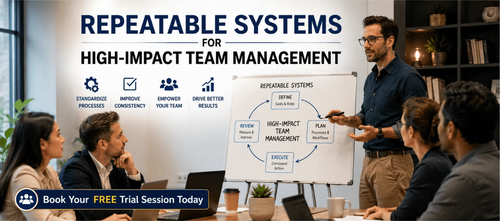

How to Build Repeatable Systems for High-Impact Team Management That Improve Clarity, Accountability, and Team Performance
Great teams are rarely built through talent alone. In most workplaces, managers spend enormous amounts of time solving recurring problems, clarifying confusion, chasing updates, and fixing preventable mistakes. Teams become dependent on the manager for every decision, priorities constantly shift, and performance becomes inconsistent under pressure.
The problem is not usually a lack of effort. Most managers work incredibly hard. The real issue is that many teams operate without repeatable systems. Communication depends on memory, accountability depends on constant follow-ups, feedback happens inconsistently, and workflows change depending on urgency. Over time, this creates operational chaos, burnout, and declining team performance.
The “Building Repeatable Systems for High-Impact Team Management” toolkit provides a practical framework for solving these challenges systematically. Instead of relying on personality, improvisation, or endless oversight, the guide helps managers create scalable systems for role clarity, operating rhythms, feedback, accountability, and team coordination. Through templates, frameworks, meeting structures, and real-world examples, the toolkit shows how repeatable systems create stronger performance, reduced confusion, and more sustainable leadership.
Download these resources and apply them alongside your daily work for improved clarity, productivity, and professional growth. You can also book a free trial to gain expert guidance and enhance your communication, problem-solving, and decision-making skills. The materials are designed in a clear, structured format to help professionals learn efficiently and implement insights with confidence.
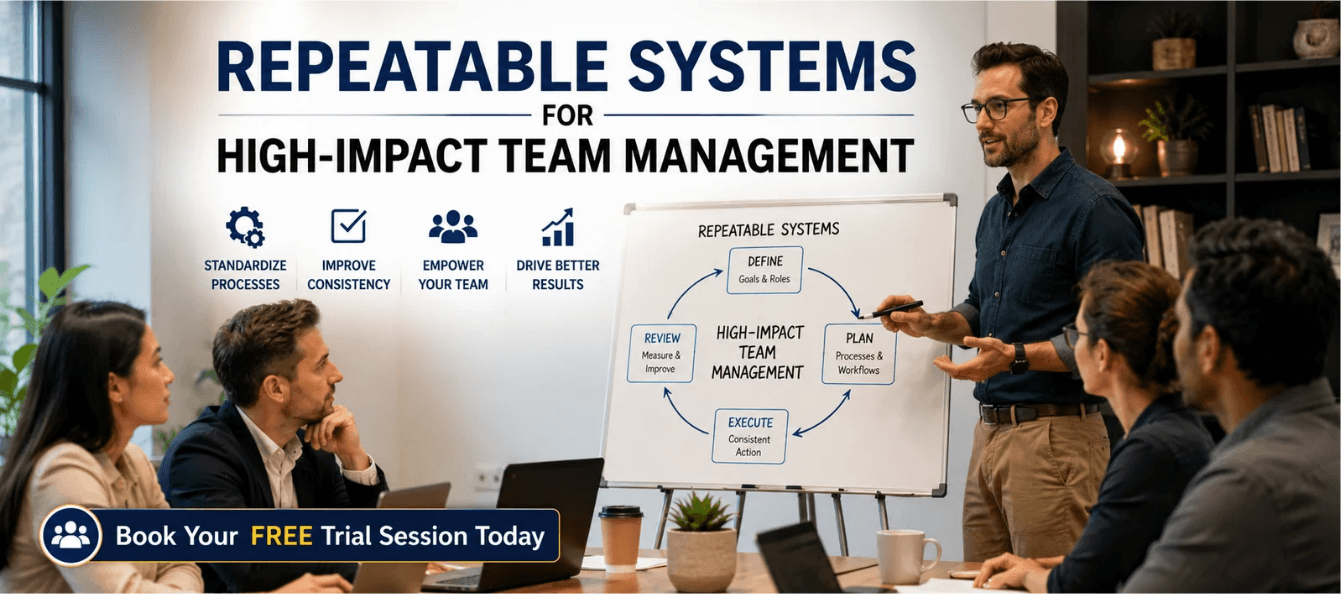
Who Is This Blog For?
- First-time managers building team leadership systems
- Team leads managing growing workloads and responsibilities
- Startup leaders creating scalable operations
- Consultants managing project-based teams
- Professionals struggling with unclear team roles
- Managers looking to improve accountability without micromanaging
- Leaders seeking predictable team performance and communication systems
Why This Topic Matters Today?
Modern teams operate in increasingly complex work environments. Hybrid work, fast-changing priorities, cross-functional collaboration, and growing workloads have made consistency more important than ever before.
The toolkit explains that many managers are promoted because they were excellent individual contributors, not because they were trained to build scalable team systems.
As a result, leadership often becomes dependent on:
- Instinct
- Improvisation
- Constant supervision
- Personal effort
- Reactive management
While this may work temporarily in small teams, it becomes unsustainable as complexity grows.
The guide highlights several major problems that emerge without repeatable systems:
- Role confusion
- Decision bottlenecks
- Feedback inconsistency
- Accountability gaps
- Meeting overload
- Team dependency on managers
The professionals who consistently lead high-performing teams are not necessarily the smartest or most experienced.
According to the guide, they are the ones who build systems that reduce guesswork and create operational consistency.
Core Concept or Framework Explained
The toolkit introduces a repeatable team management framework built around four foundational pillars.
These four pillars form the architecture behind sustainable team performance:
- Clarity
- Rhythm
- Feedback
- Accountability
The guide explains that high-performing teams consistently operate across all four pillars simultaneously.
Clarity
Team members understand their role, priorities, and connection to broader goals.
Rhythm
Consistent operating cadences create predictability and reduce confusion.
Feedback
Growth conversations become structured, timely, and normalized.
Accountability
Ownership focuses on outcomes rather than task supervision.
The toolkit emphasizes that weakness in even one pillar can significantly reduce overall team effectiveness.
How This Blog and Guidebook Help You?
This blog and toolkit help managers build repeatable systems that reduce operational friction and improve team execution.
The guide supports professionals by helping them:
- Eliminate role confusion
- Build predictable team workflows
- Improve communication systems
- Create scalable feedback structures
- Strengthen accountability without micromanaging
- Improve decision-making consistency
- Reduce team dependency on managers
Unlike generic management advice, the toolkit focuses on systems that can be implemented immediately and refined over time.
Step-by-Step Breakdown
Step 1: Build Role Clarity First
The guide explains that role confusion is one of the most expensive hidden problems in team management.
When responsibilities are unclear:
- Work gets duplicated
- Important tasks are missed
- Teams waste energy on low-priority activities
- Decision-making slows down
To solve this, the toolkit introduces the RACI+ Framework.
The framework defines:
Responsible
The person doing the work.
Accountable
The single person owning the outcome.
Consulted
People whose input is required before decisions.
Informed
People who need updates after decisions.
Revisit
Quarterly reviews to update role clarity as teams evolve.
The guide emphasizes that many managers make a major mistake by defining roles only from their own perspective.
Instead, role clarity should be co-created collaboratively with team members.
The Role Clarity Worksheet includes questions such as:
- What are your top three priorities this month?
- Where do you have decision-making authority?
- Which decisions should be escalated?
- Where do you feel unclear or overloaded?
This process helps uncover hidden confusion before it damages performance.
Step 2: Design a Consistent Team Operating Rhythm
The toolkit explains that strong teams run on predictable cadences rather than reactive communication.
The guide introduces four operating rhythm levels:
- Daily
- Weekly
- Monthly
- Quarterly
The goal is not to increase meetings.
The goal is to create the right meetings with the right structure and purpose.
The Weekly Team Sync template includes:
Wins & Updates
Celebrate progress and share context.
Priority Alignment
Clarify top weekly priorities.
Blockers & Support
Identify obstacles and assign help.
Decisions Needed
Resolve urgent decisions efficiently.
Wrap & Actions
Confirm next steps and accountability.
The toolkit also introduces a structured 1:1 meeting format:
- Their agenda first
- Progress on priorities
- Feedback exchange
- Growth discussion
- Manager updates
One powerful recommendation is sending async pre-reads before 1:1 meetings so team members can prepare thoughtfully.
This dramatically improves conversation quality.
Step 3: Build a Feedback System That Sticks
The guide explains that many managers give feedback only when problems occur or during annual reviews.
This creates defensiveness and weakens growth culture.
The toolkit introduces a repeatable four-week feedback implementation process:
Week 1
Introduce the SBI feedback model.
Week 2
Deliver structured feedback to direct reports.
Week 3
Add feedback moments into recurring meetings.
Week 4
Normalize peer-to-peer feedback.
The SBI Feedback Model includes:
Situation
Describe when the behavior occurred.
Behavior
Describe observable actions.
Impact
Explain the consequences or outcomes.
The guide strongly emphasizes avoiding vague or emotionally charged language.
Effective feedback should be:
- Specific
- Observable
- Timely
- Behavior-focused
The toolkit also introduces monthly reflection questions such as:
- What went well this month?
- What would you change?
- How can your manager support you better?
- Which skill do you want to develop next?
These systems normalize growth conversations across the team.
Step 4: Create Accountability Without Micromanaging
The guide explains that accountability is often misunderstood as tight supervision.
True accountability focuses on ownership of outcomes rather than monitoring every task.
The toolkit introduces several accountability principles:
Define Outcomes Clearly
Explain what successful results look like.
Use the Accountability Anchor
Confirm:
- What will be delivered
- When it will be completed
- How success will be measured
Shift From Progress Reports to Progress Reviews
Instead of asking:
“Where are you?”
Managers should ask:
- What’s working?
- What’s blocked?
- What support is needed?
This shifts leadership from inspection to coaching.
The guide also emphasizes normalizing course correction.
Teams should feel safe raising problems early rather than hiding issues until deadlines fail.
Step 5: Apply Systems Like Priya’s Team Transformation
The toolkit includes a real-world case study involving Priya, a marketing manager leading a struggling six-person team.
Her team experienced:
- Missed deadlines
- Low morale
- Duplicate work
- Decision bottlenecks
- Reactive management
The systems she implemented included:
- A collaborative RACI+ map
- Structured weekly team syncs
- Consistent bi-weekly 1:1 meetings
- Weekly SBI feedback systems
- Accountability Anchors for every initiative
Within 60 days:
- Escalations dropped significantly
- Decision speed doubled
- Team satisfaction improved dramatically
The guide explains that Priya’s transformation came from building systems rather than simply working harder.
Step 6: Avoid Common System Failures
The toolkit highlights several common management mistakes that undermine team systems.
Building Systems Alone
Problem:
Managers create processes without team input.
Better approach:
Co-create systems collaboratively.
Abandoning Systems Under Pressure
Problem:
Managers cancel structure during busy periods.
Better approach:
Shorten systems rather than removing them.
Measuring Activity Instead of Outcomes
Problem:
Managers track hours and tasks instead of results.
Better approach:
Define meaningful impact-based KPIs.
Creating One-Way Feedback
Problem:
Managers only give feedback downward.
Better approach:
Actively request upward feedback.
Never Revisiting Systems
Problem:
Processes remain outdated as teams evolve.
Better approach:
Run quarterly “System Health Checks.”
How Should You Use This Guidebook Effectively?
The toolkit works best when implemented gradually instead of all at once.
Recommended rollout process:
Week 1
- Run a role clarity session using the RACI+ framework
Week 2
- Launch recurring operating rhythms and meeting structures
Week 3
- Introduce the SBI feedback system
Week 4
- Start using Accountability Anchors consistently
Day 90
- Conduct a full System Health Check
The guide strongly encourages managers to revisit systems regularly as team structures and priorities evolve.
Key Takeaways
- High-performing teams rely on repeatable systems, not constant improvisation
- Role clarity eliminates hidden confusion and duplicated work
- Consistent operating rhythms improve predictability and trust
- Structured feedback systems normalize growth conversations
- Accountability works best when focused on outcomes instead of surveillance
- Teams perform better when systems are collaborative and transparent
- Predictable communication reduces operational friction
- Managers should coach progress rather than inspect tasks constantly
- System health should be reviewed regularly as teams evolve
- Strong management is built through structure, consistency, and intentional leadership
Your Next Step: Accelerate Your Career with PlanetSpark
Creating an impact-driven resume is not just about landing your next job—it’s about owning your professional story and presenting it with clarity, confidence, and credibility. When your resume clearly communicates value, results, and impact, opportunities follow naturally.
At PlanetSpark, we are committed to empowering working professionals with practical, outcome-focused resources that drive real career growth. From resume building and workplace communication to leadership presence and professional writing, our programs are designed to help you succeed in today’s fast-evolving job market.
Visit https://www.planetspark.in/resources to explore:
- Career and resume-building guides
- Workplace communication and professional writing resources
- Skill-development tools curated for working professionals
Want a deeper, hands-on experience?
You can also book a free trial session to learn more about PlanetSpark’s Working Professional Courses, designed to accelerate your career through personalised coaching, real-world practice, and expert guidance.
Your career deserves more than generic advice.
It deserves clarity, confidence, and measurable impact.
Personalized Communication Roadmaps
Record a video to get a AI generated personalized communication reports