
Building Repeatable Systems for Personal Productivity
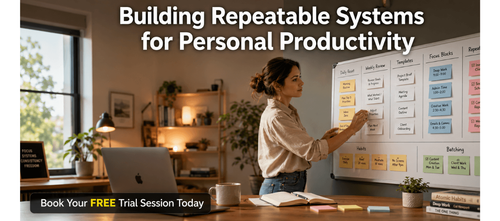

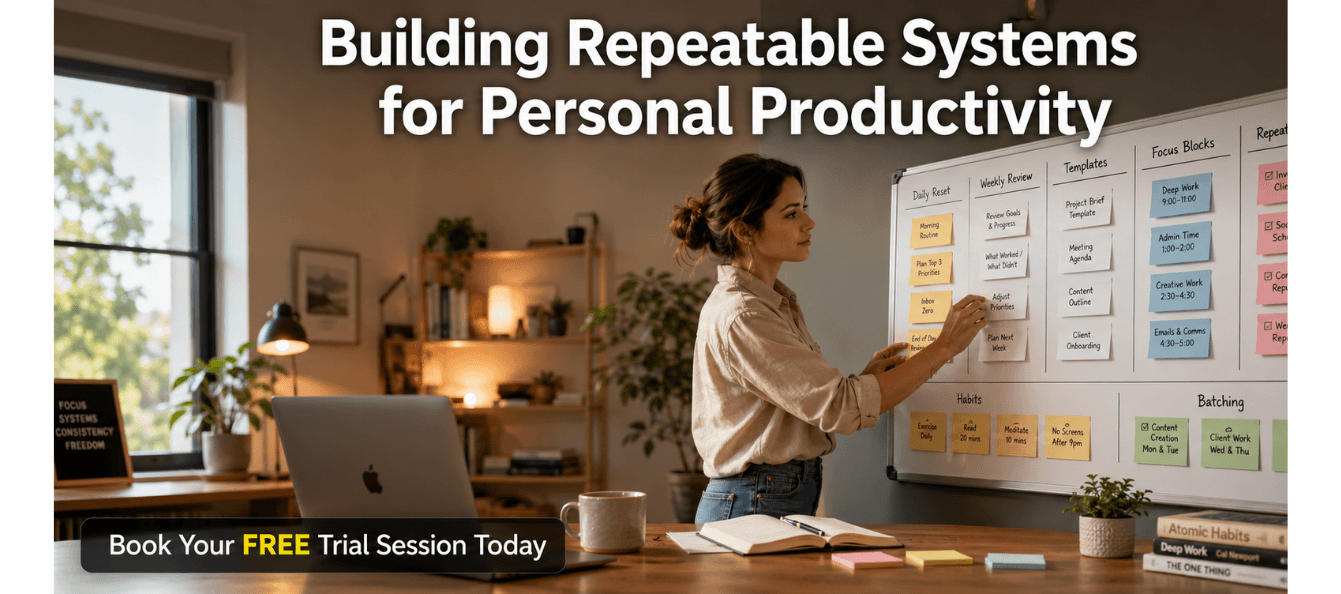
Build Repeatable Systems for Personal Productivity and Stay Consistent Every Day
In the fast-paced professional world, it’s easy to get caught up in reactive work habits. You find yourself constantly putting out fires, tackling urgent tasks, and shifting priorities without a clear, consistent approach. As the week progresses, it feels like you’re scrambling, losing momentum, and burning out.
The key to overcoming this cycle is creating repeatable systems for personal productivity that ensure consistency, even during chaotic or low-motivation days. By designing systems that work automatically, you reduce the mental burden of decision-making, allowing you to focus on high-impact tasks and sustain your momentum in the long run.
Download these resources and apply them alongside your daily work for improved clarity, productivity, and professional growth. You can also book a free trial to gain expert guidance and enhance your communication, problem-solving, and decision-making skills. The materials are designed in a clear, structured format to help professionals learn efficiently and implement insights with confidence.
Who Is This Blog For?
- Busy professionals who want a more structured, intentional approach to their work
- Managers or consultants who juggle multiple priorities and need consistent productivity
- Anyone struggling to maintain focus and motivation throughout the week
- Early- to mid-career professionals looking to transition from reactive work habits to intentional systems
Why This Topic Matters Today?
Most professionals aren’t lacking ambition or capability—they’re lacking systems that can help them manage their work in a predictable, repeatable way. Without systems in place, work becomes reactive, disjointed, and stressful, leaving professionals constantly playing catch-up.
Repeatable systems for personal productivity offer a solution by reducing decision fatigue and minimizing wasted time. With a clear plan, defined tasks, and pre-set routines, you can reclaim control over your work, stay on top of priorities, and achieve better outcomes—consistently.
This blog will walk you through the process of building repeatable productivity systems that can carry you through your workweek, no matter how hectic or draining it gets.
Core Concept or Framework Explained
The key to creating sustainable productivity systems lies in designing processes that work for you, even when your energy is low. The guidebook introduces four core pillars that form the foundation of a repeatable system:
1. Anchors: Fixed routines that trigger productive actions automatically, even when motivation is low.
2. Defaults: Pre-set decisions that eliminate the need to make choices in a low-energy state.
3. Guardrails: Boundaries that prevent spirals of procrastination and help you maintain focus on difficult days.
4. Recovery Loops: Built-in mechanisms to reset and re-engage after periods of low productivity.
These pillars work together to create a self-reinforcing structure that enables productivity, even under pressure.
How This Blog and Guidebook Help You?
This blog and accompanying guide help you design systems that operate with little to no decision fatigue. By following the steps laid out, you will be able to:
- Design a structured planning rhythm that ensures consistency
- Build an effective task architecture to capture, organize, and prioritize tasks
- Implement time blocking to protect your best cognitive hours for the most valuable work
- Use a weekly review process to assess your system’s effectiveness and make necessary adjustments
- Streamline your decision-making and reduce friction in your daily workflow
Step-by-Step Breakdown
Step 1: Audit Before You Build
Before you create a new system, it’s essential to understand what’s currently working—and what’s not. A productivity audit allows you to gather honest data about your existing workflows and pinpoint areas that need improvement.
Ask yourself these questions:
- What tasks do I repeat every week?
- Where do I lose the most time?
- Which tasks consistently feel effortful despite being repeated?
- When do I make decisions that drain my mental energy?
- What consistently falls through the cracks?
Once you have gathered the answers, you will know exactly which areas need systematizing for the highest impact.
Step 2: Build Your Planning Rhythm & Task Architecture
A consistent planning rhythm is essential for maintaining focus and direction. This involves setting aside time each week, day, and month to plan and prioritize.
- Weekly: At the start of each week, identify your top 3 outcomes and block time for deep work sessions. Use a weekly planning template to keep things structured.
- Daily: Each morning, identify your Most Important Task (MIT) and set your schedule for the day. Include any meetings and ensure your energy levels align with your tasks.
- Monthly: Review your goals, assess your progress, and define the top priorities for the upcoming month.
Your task architecture helps you organize everything you need to do. Use tools like task managers, checklists, or simple notebooks to capture, clarify, and categorize all tasks. Keep your list organized into categories such as “Today,” “This Week,” and “Someday,” so you can focus on what matters most at any given time.
Step 3: Time Blocking & Deep Work
Time blocking is the habit of scheduling specific tasks into your calendar rather than leaving your day open-ended. By blocking deep work, shallow work, and recovery time, you protect your most valuable cognitive hours for deep work.
- Block deep work first: Schedule uninterrupted work during your peak energy hours, typically in the morning.
- Batch similar tasks: Group tasks like emails, meetings, and administrative work into dedicated time blocks to reduce task switching.
- Build in buffer time: Leave 20–30% of your day unscheduled to accommodate unexpected tasks or overrun activities.
Step 4: Implement Weekly Review & Reset
The weekly review is critical to preventing your system from drifting. It allows you to reflect on the week, close any open loops, and set up the next week. A 30–45 minute review can close out the week and allow you to prepare for the next.
Key steps in your review process:
1. Clear your inbox: Process emails, tasks, and notes, making decisions about what’s done, delegated, or deferred.
2. Reflect on the week: What did you accomplish? What didn’t go as planned? Look for patterns and recurring blockers.
3. Review active projects: Ensure all projects have a next action step.
4. Set priorities for the next week: Identify top priorities and block time for deep work. Plan ahead for meetings and commitments.
5. Reflect & Adjust: After reviewing, reflect on your system’s performance and make any necessary adjustments.
Real-World Application – Priya’s Success Story
Priya, a marketing manager at a tech company, was overwhelmed by her reactive workday. She spent too much time on low-value tasks and rarely felt in control. After completing her productivity audit, Priya discovered that 40% of her tasks were recurring—status updates, campaign reports, and stakeholder meetings. She created simple templates for these tasks and set up a task inbox using one app. Over the next four weeks, she implemented time blocking for deep work and started a weekly review routine. By the end of week 4, Priya reduced her workweek by 6 hours, delivered her highest-rated quarterly campaign, and felt more in control.
Key Takeaways
- Systems reduce the need for willpower and create consistent results.
- Start by auditing your current system to understand your time and task patterns.
- Build a planning rhythm and task architecture to ensure your workday is predictable.
- Use time blocking to protect your cognitive energy for high-priority tasks.
- The weekly review and reset is essential to ensure your system evolves and stays aligned with your goals.
Your Next Step: Accelerate Your Career with PlanetSpark
Creating an impact-driven resume is not just about landing your next job—it’s about owning your professional story and presenting it with clarity, confidence, and credibility. When your resume clearly communicates value, results, and impact, opportunities follow naturally.
At PlanetSpark, we are committed to empowering working professionals with practical, outcome-focused resources that drive real career growth. From resume building and workplace communication to leadership presence and professional writing, our programs are designed to help you succeed in today’s fast-evolving job market.
Visit https://www.planetspark.in/resources to explore:
- Career and resume-building guides
- Workplace communication and professional writing resources
- Skill-development tools curated for working professionals
Want a deeper, hands-on experience?
You can also book a free trial session to learn more about PlanetSpark’s Working Professional Courses, designed to accelerate your career through personalized coaching, real-world practice, and expert guidance.
Your career deserves more than generic advice.
It deserves clarity, confidence, and measurable impact.
Personalized Communication Roadmaps
Record a video to get a AI generated personalized communication reports