
Building Respect in Complex Work Environments: Practical Guide
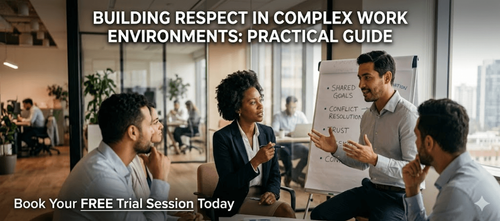

Building Respect in Politically Complex Workplaces A Practical Guide for Professionals
Every workplace has politics. Different agendas, hidden priorities, shifting alliances, and unspoken rules shape how decisions are made and how influence flows. Yet most professionals are not trained to navigate this complexity.
They rely on hard work, hoping results alone will earn recognition. But over time, they notice something frustrating—others with similar or even lower performance seem to gain more visibility, influence, and opportunities.
The difference is not always skill. It is how effectively they build and sustain respect within complex environments.
Respect is not about being liked. It is not about being the loudest voice or winning every argument. True professional respect is built on trust in your judgment, consistency in your actions, and clarity in how you operate—especially under pressure.
This guide provides a structured approach to help you navigate workplace complexity without compromising your integrity. Instead of reacting to office politics, you learn to understand, interpret, and operate within them strategically.
Download these resources and apply them alongside your daily work for improved clarity, productivity, and professional growth. You can also book a free trial to gain expert guidance and enhance your communication, problem-solving, and decision-making skills. The materials are designed in a clear, structured format to help professionals learn efficiently and implement insights with confidence.
Who Is This Blog For
- Professionals working in politically complex organisations
- Managers influencing without direct authority
- Consultants navigating stakeholder dynamics
- Early-career professionals building credibility
- Mid-level professionals aiming for leadership roles
- Anyone who wants to build respect without compromising values
Why This Topic Matters Today
Workplace complexity is increasing due to:
- Cross-functional teams
- Multiple stakeholders with competing priorities
- Faster decision-making cycles
- Increased visibility and accountability
In such environments, technical performance alone is not enough.
Common challenges include:
- Feeling overlooked despite strong work
- Being unaware of hidden agendas
- Struggling to influence decisions
- Losing credibility during conflicts
- Speaking up and facing resistance
Without understanding workplace dynamics, professionals often misinterpret situations and make ineffective decisions.
Core Concept or Framework Explained
The foundation of this approach is the RESPECT framework.
It defines seven key dimensions required to build and sustain respect:
- Reading the environment
Understanding what is happening beneath the surface - Earning trust
Delivering consistently and reliably - Strategic communication
Speaking with clarity and intent - Positioning
Managing how you are perceived - Engagement
Building strong relationships - Consistency
Aligning actions with words - Trust reinforcement
Maintaining credibility over time
This framework provides a structured way to navigate complex environments effectively.
How This Blog and Guidebook Help You
This framework helps you move from confusion to clarity in complex situations.
By applying it, you will:
- Understand workplace dynamics more accurately
- Build credibility and trust
- Improve your ability to influence decisions
- Navigate conflicts without losing respect
- Strengthen your professional presence
Instead of reacting to politics, you learn to operate strategically.
Step-by-Step Breakdown
Step 1: Read the Room Effectively
Before acting, understand the environment.
Observe:
- Who influences decisions
- How conversations unfold
- What priorities drive actions
- Where alignment or conflict exists
Situational awareness is the foundation.
Step 2: Identify Stakeholders and Their Interests
Not all stakeholders have the same goals.
Understand:
- What each person values
- Their priorities and concerns
- Their influence level
This helps you align your approach.
Step 3: Communicate with Precision
Clear communication builds respect.
Focus on:
- Structured messaging
- Relevant information
- Audience-specific language
Avoid unnecessary complexity or ambiguity.
Step 4: Build Strategic Relationships
Influence depends on relationships.
Actions include:
- Engaging regularly with key stakeholders
- Supporting others’ goals
- Building trust through consistency
Relationships amplify your impact.
Step 5: Maintain Consistency
Respect is built over time.
Ensure:
- Your actions match your words
- Your behaviour remains stable under pressure
- Your decisions align with your values
Inconsistency reduces credibility.
Step 6: Handle Conflict Strategically
Conflict is inevitable in complex environments.
Approach it by:
- Staying calm and objective
- Focusing on outcomes, not emotions
- Addressing issues directly but respectfully
This maintains respect even in difficult situations.
Step 7: Strengthen Your Position Over Time
Respect grows through repeated behaviour.
Focus on:
- Delivering results consistently
- Communicating effectively
- Building trust continuously
Long-term consistency creates strong professional positioning.
Common Mistakes or Pitfalls to Avoid
- Ignoring workplace dynamics
- Relying only on hard work for recognition
- Speaking without understanding the context
- Reacting emotionally in complex situations
- Neglecting relationship-building
- Inconsistent behaviour under pressure
These mistakes reduce influence and credibility.
How Should You Use This Guidebook Effectively
To apply this framework:
- Daily
Observe workplace dynamics - Weekly
Reflect on interactions and decisions - Monthly
Evaluate your influence and relationships
You can also:
- Map key stakeholders
- Track communication effectiveness
- Adjust your approach based on feedback
Consistency is key to building respect.
Key Takeaways
- Workplace politics are unavoidable
- Respect is built through trust and consistency
- Understanding the environment is critical
- Communication and relationships drive influence
- Consistency strengthens credibility
- Strategic thinking improves outcomes
- Long-term behaviour determines professional success
Your Next Step: Accelerate Your Career with PlanetSpark
Creating an impact-driven resume is not just about landing your next job—it’s about owning your professional story and presenting it with clarity, confidence, and credibility. When your resume clearly communicates value, results, and impact, opportunities follow naturally.
At PlanetSpark, we are committed to empowering working professionals with practical, outcome-focused resources that drive real career growth. From resume building and workplace communication to leadership presence and professional writing, our programs are designed to help you succeed in today’s fast-evolving job market.
Visit https://www.planetspark.in/resources to explore:
- Career and resume-building guides
- Workplace communication and professional writing resources
- Skill-development tools curated for working professionals
Want a deeper, hands-on experience?
You can also book a free trial session to learn more about PlanetSpark’s Working Professional Courses, designed to accelerate your career through personalised coaching, real-world practice, and expert guidance.
Your career deserves more than generic advice.
It deserves clarity, confidence, and measurable impact.
Personalized Communication Roadmaps
Record a video to get a AI generated personalized communication reports