
Business Process Optimization Resume Guide for Professionals
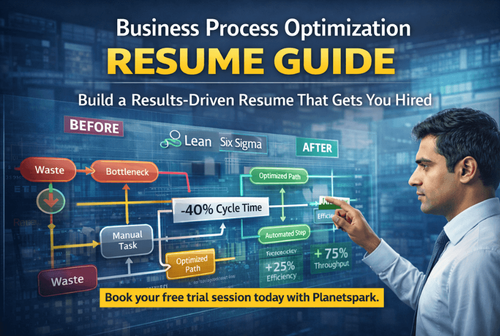

Business Process Optimization Resume Guide: Build a Results-Driven Resume That Gets You Hired
Business process optimization is one of the most valuable skills in today’s job market—yet it is also one of the most poorly communicated on resumes. Many professionals who have successfully reduced cycle times, eliminated inefficiencies, or automated workflows fail to showcase their true impact. Instead, they rely on vague descriptions that fail to capture measurable results.
This guide is built from a structured template pack designed specifically to solve that problem. It helps professionals translate process improvement work into clear, quantified, and recruiter-friendly resume content that stands out in competitive hiring environments.
Book your free trial session today with Planetspark.
Download for more details or PDF file.
Who Is This Blog For?
- Process analysts and BPM specialists aiming to showcase measurable impact
- Operations managers leading process redesign or transformation initiatives
- Continuous improvement professionals using Lean, Six Sigma, or Agile
- Consultants delivering process transformation engagements
- Career switchers moving into business process optimisation roles
- Professionals at any stage looking to improve resume clarity and ATS performance
Why This Topic Matters Today?
Business process optimisation is no longer a niche capability—it is a core requirement across industries. Organisations are actively seeking professionals who can:
- Reduce inefficiencies
- Improve throughput
- Automate repetitive tasks
- Deliver measurable business outcomes
However, the challenge lies in how these achievements are communicated.
According to the resource, many professionals:
- List tasks instead of outcomes
- Use jargon that ATS systems cannot interpret
- Fail to quantify their impact
- Hide key certifications like Lean or Six Sigma
These gaps make even strong candidates appear average on paper.
In a hiring landscape driven by metrics and automation, resumes must clearly demonstrate value, precision, and measurable results.
Core Concept or Framework Explained
The central framework of this guide is outcome-driven resume design for business process optimisation professionals.
Instead of generic resume structures, the templates are:
- Scenario-based
- ATS-friendly
- Built around real-world process optimisation roles
Each template aligns with a specific career situation, such as:
- Entry-level process analyst
- Lean Six Sigma practitioner
- RPA and automation specialist
- Operations manager leading process overhaul
- Business transformation consultant
This scenario-driven approach ensures that your resume communicates exactly what hiring managers expect for your target role.
The framework is built on three essential principles:
Outcome Over Activity
Replace generic statements with measurable results.
Methodology Visibility
Highlight tools and frameworks like Lean, Six Sigma, BPMN, and Agile prominently.
Structured Storytelling
Organise your resume to clearly show problem, approach, and outcome.
How This Blog and Guidebook Help You?
This blog and the underlying resource help you transform your resume into a powerful professional narrative.
You will learn how to:
- Translate process improvement work into measurable achievements
- Structure your resume for maximum clarity and impact
- Align your resume with ATS systems and recruiter expectations
- Highlight methodologies and tools effectively
- Position yourself for roles in process excellence and transformation
The result is a resume that not only gets noticed but also communicates strategic value.
Step-by-Step Breakdown
Select the Right Template
The resource offers 10 templates, each tailored to a specific process optimisation scenario.
Examples include:
- Entry-level process analyst
- Lean Six Sigma Black Belt
- RPA and automation specialist
- Business transformation consultant
- Agile process improvement lead
Choosing the right template ensures your resume aligns with your career direction and job goals.
Replace Placeholders with Real Data
Each template includes structured placeholders designed to guide your input.
You must replace them with:
- Specific process improvements
- Quantified results
- Tools and methodologies used
For example:
- “Reduced process cycle time by 40%”
- “Automated workflows saving 1,000+ hours annually”
Quantification is essential in this field.
Highlight Process Improvement Engagements
Instead of listing generic work experience, highlight specific engagements or initiatives.
Each should include:
- Problem statement
- Methodology used
- Actions taken
- Measurable outcome
This structure demonstrates both analytical and execution capability.
Showcase Tools and Methodologies
The guide strongly emphasises visibility of frameworks and tools.
Include:
- Lean Six Sigma
- BPMN process mapping
- RPA platforms like UiPath
- Agile frameworks
Avoid burying these in a generic skills section.
Customise Section Headers
Generic headings like “Work Experience” can dilute your positioning.
Instead, use targeted headers such as:
- Process Improvement Engagements
- Transformation Initiatives
- Automation Projects
This immediately signals expertise to recruiters.
Align With Job Descriptions
Before applying, match your resume language with the job description.
For example:
- If the role mentions “process re-engineering,” use that phrase
- If it highlights “value stream mapping,” include it explicitly
This improves ATS compatibility and relevance.
Maintain a Clean, ATS-Friendly Structure
The guide recommends:
- Simple layouts
- Clear headings
- No complex formatting
- Consistent date formats
This ensures your resume is readable by both humans and systems.
Common Mistakes or Pitfalls to Avoid
Avoid these critical mistakes highlighted in the guide:
- Listing tasks instead of outcomes
- Using vague language without measurable impact
- Hiding certifications and methodologies
- Failing to quantify achievements
- Using generic section headings
- Not aligning with job descriptions
For example:
Instead of:
- Managed process documentation
Write:
- Standardised SOP templates, reducing documentation cycle time by 40%
This shift makes your contribution clear and valuable.
How Should You Use This Guidebook Effectively?
To maximise results, follow this structured approach:
Step 1: Choose the Right Scenario
Select a template based on your career goal, not just your current job.
Step 2: Gather Key Information
List:
- Process improvements
- Metrics
- Tools used
- Outcomes achieved
Step 3: Fill and Customise
Replace placeholders with real, quantified achievements.
Step 4: Tailor for Each Role
Adjust your resume for every job application.
Step 5: Maintain a Master Version
Keep one complete version and customise copies for specific roles.
Time Investment
- Initial setup: 2–4 hours
- Customisation per application: 15–25 minutes
This investment significantly improves interview conversion rates.
Key Takeaways
- Business process resumes must focus on measurable outcomes
- Scenario-based templates improve positioning and relevance
- Quantification is essential in every bullet point
- Methodologies like Lean and Six Sigma must be visible
- Custom section headers strengthen professional branding
- ATS-friendly structure is critical for shortlisting
- Tailoring resumes for each job increases success rate
- Strong resumes combine action, process, and measurable impact
Your Next Step: Accelerate Your Career with PlanetSpark
Creating an impact-driven resume is not just about landing your next job—it’s about owning your professional story and presenting it with clarity, confidence, and credibility. When your resume clearly communicates value, results, and impact, opportunities follow naturally.
At PlanetSpark, we are committed to empowering working professionals with practical, outcome-focused resources that drive real career growth. From resume building and workplace communication to leadership presence and professional writing, our programs are designed to help you succeed in today’s fast-evolving job market.
Visit https://www.planetspark.in/resources to explore:
- Career and resume-building guides
- Workplace communication and professional writing resources
- Skill-development tools curated for working professionals
Want a deeper, hands-on experience?
You can also book a free trial session to learn more about PlanetSpark’s Working Professional Courses, designed to accelerate your career through personalised coaching, real-world practice, and expert guidance.
Your career deserves more than generic advice.
It deserves clarity, confidence, and measurable impact.
Personalized Communication Roadmaps
Record a video to get a AI generated personalized communication reports