
Career Decision Checklist for Working Professionals (2026)
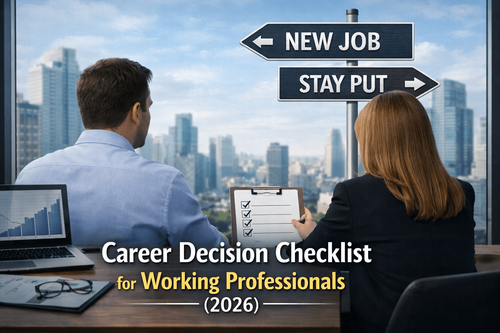

Guiding Career Decisions Through Structured Thinking with a Systematic Framework for Confident and Well-Informed Professional Progression
Most professionals don’t struggle because they
lack opportunities—they struggle because they make decisions too quickly, emotionally, or without a clear framework. A new offer appears, a frustrating situation builds up, or comparison with peers creates urgency. The result? Career moves that feel right in the moment but fail to create long-term growth.
In today’s fast-moving job market, making the right career decision is no longer optional—it is a strategic skill. Without a structured approach, even high-potential professionals can drift between roles without building meaningful momentum.
This blog, based on a proven Strategic Career Decision Checklist, gives you a clear, repeatable framework to evaluate opportunities, reduce risk, and make confident, well-informed career moves.
Who Is This Blog For?
This blog and the accompanying guidebook are designed for:
- Working professionals at any stage considering a job change, promotion, or pivot
- Career switchers exploring new industries or roles
- Mid-career professionals seeking clarity before making high-stakes decisions
- Consultants, freelancers, or entrepreneurs evaluating new opportunities
- Professionals feeling stuck, confused, or pressured into making quick career moves
Why This Topic Matters Today?
Career decisions today are more complex than ever. Opportunities are abundant, but clarity is rare. Professionals are constantly influenced by external triggers—higher salaries, peer success, workplace dissatisfaction, or market trends.
The problem is not lack of options—it is lack of structured thinking.
Without a clear decision-making framework:
- Career moves become reactive instead of intentional
- Short-term gains override long-term growth
- Professionals confuse escaping a bad situation with making a good decision
- Emotional triggers like frustration or fear lead to poor choices
Strategic decision-making ensures that every move contributes to your long-term career trajectory, not just immediate relief.
Core Concept or Framework Explained
At the heart of this guide is a powerful idea: career decisions should be made using a repeatable, structured framework—not guesswork.
The guide introduces a multi-layered decision system that includes:
- Self-Audit to understand your current reality
- Clarity Framework to define your career direction
- CLEAR Framework to evaluate opportunities consistently
- Risk and Timing Filter to assess readiness and external factors
- Decision Council to gather high-quality perspectives
- Master Checklist to validate your final decision
This approach transforms decision-making from reactive behavior into a disciplined process. Instead of asking “Should I take this job?”, you learn to ask “Does this opportunity meet my defined criteria and long-term goals?”
How This Blog and Guidebook Help You?
This blog and guidebook help you move from confusion to clarity by enabling you to: - Understand your strengths, motivations, and career gaps
- Define what you truly want from your career
- Evaluate opportunities objectively instead of emotionally
- Avoid common decision-making traps
- Build confidence in high-stakes career choices
- Create a repeatable system for future decisions
The outcome is not just one good decision—but a lifetime of better career choices.
Step-by-Step Breakdown
Step 1: Start with a Deep Self-Audit
Before evaluating any opportunity, you must understand your current position. Skipping this step leads to solving the wrong problem.
The self-audit focuses on two key areas:
Energy and Engagement
- Identify tasks that energise you
- Recognise work that consistently drains you
- Observe whether you look forward to or dread your workweek
- Understand patterns behind your satisfaction
Skills and Value
- Define your top transferable skills with evidence
- Identify gaps between current and desired roles
- Understand your unique strengths compared to peers
- Gather external feedback for accuracy
This step ensures your decisions are grounded in reality, not assumptions.
Step 2: Clarify What You Actually Want
Clarity is the foundation of confident decision-making. Without it, every opportunity feels both attractive and uncertain.
The guide defines four key dimensions:
Role and Purpose Fit
- What kind of work do you want daily?
- Do you prefer depth or variety?
- Do you want to lead, manage, or contribute individually?
Lifestyle Design
- What does your ideal workweek look like?
- How important are flexibility, travel, or remote work?
Financial Clarity
- Define your minimum acceptable compensation
- Understand long-term financial goals
Long-Term Trajectory
- Where do you want to be in 3 to 5 years?
- Does this move support or block that path?
Clear answers to these questions create a strong decision filter.
Step 3: Evaluate Opportunities Using the CLEAR Framework
Most professionals evaluate each opportunity differently, leading to inconsistent decisions. The CLEAR Framework solves this problem.
It evaluates opportunities across five dimensions:
- Culture and People
- Learning and Growth
- Economics and Compensation
- Alignment with goals
- Role Reality and expectations
Each opportunity is rated objectively, ensuring decisions are based on structured comparison—not emotional bias.
Step 4: Apply the Risk and Timing Filter
Even the best opportunity can fail if the timing is wrong.
This step evaluates three critical factors:
Personal Readiness
- Are you making this decision from clarity or frustration?
- Does your current life situation support this change?
Financial Runway
- Do you have 3–6 months of savings?
- Can you handle income fluctuations?
Market Timing
- Is your target industry growing or shrinking?
- Are your skills in demand?
This filter ensures your decision is practical, not just aspirational.
Step 5: Build Your Decision Council
Career decisions should not be made in isolation—but not all advice is useful.
The guide recommends building a “decision council” with five types of perspectives:
- Insider who understands the role or industry
- Challenger who questions your assumptions
- Sponsor who knows your work and potential
- Mirror who understands your personality
- Strategist who provides long-term perspective
The goal is not validation—it is clarity through diverse viewpoints.
Step 6: Use the Master Decision Checklist
Before finalising any decision, use a structured checklist as your final filter.
The checklist covers four key areas:
Self and Clarity
- Have you defined your priorities and goals?
Opportunity Evaluation
- Does the role align with your long-term path?
Risk and Readiness
- Are you financially and mentally prepared?
Confidence and Commitment
- Are you ready to fully commit to the decision?
A simple rule helps guide action:
- Strong alignment across most factors means proceed confidently
- Moderate alignment requires risk mitigation
- Low alignment signals the need to pause and reassess
Common Mistakes or Pitfalls to Avoid
Even experienced professionals make avoidable mistakes when making career decisions.
Key pitfalls include:
- Making decisions under emotional pressure or frustration
- Evaluating opportunities without clear criteria
- Prioritising short-term benefits over long-term growth
- Seeking validation instead of honest feedback
- Ignoring financial and timing realities
- Relying on incomplete or biased information
Avoiding these mistakes significantly improves decision quality.
How Should You Use This Guidebook Effectively?
To get the best results, follow a structured approach:
- First, read the entire guide to understand the framework
- Then, apply each module to a real career decision
- Use the checklists actively, not passively
- Allocate focused time to think and reflect deeply
- Revisit the framework for future decisions
For best outcomes, spend 2–3 focused hours completing the process for one decision. Over time, this becomes faster and more intuitive.
Key Takeaways
- Strategic career decisions require structure, not impulse
- Start with self-awareness before evaluating opportunities
- Define clear career criteria before exploring options
- Use consistent frameworks like CLEAR for evaluation
- Assess risk, timing, and financial readiness carefully
- Seek diverse, high-quality perspectives—not just validation
- Commit fully once a well-informed decision is made
Your Next Step: Accelerate Your Career with PlanetSpark
Creating an impact-driven resume is not just about landing your next job—it’s about owning your professional story and presenting it with clarity, confidence, and credibility. When your resume clearly communicates value, results, and impact, opportunities follow naturally.
At PlanetSpark, we are committed to empowering working professionals with practical, outcome-focused resources that drive real career growth. From resume building and workplace communication to leadership presence and professional writing, our programs are designed to help you succeed in today’s fast-evolving job market.
Visit https://www.planetspark.in/resources to explore:
- Career and resume-building guides
- Workplace communication and professional writing resources
- Skill-development tools curated for working professionals
Want a deeper, hands-on experience?
You can also book a free trial session to learn more about PlanetSpark’s Working Professional Courses, designed to accelerate your career through personalised coaching, real-world practice, and expert guidance.
Your career deserves more than generic advice.
It deserves clarity, confidence, and measurable impact.
Start building that advantage today—with PlanetSpark.
Personalized Communication Roadmaps
Record a video to get a AI generated personalized communication reports