
Career Risk Decision Framework for Smarter Growth Moves
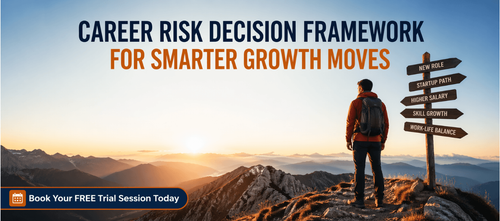

Master Career Decisions with Confidence: A Practical Framework to Evaluate Risk and Unlock Growth Opportunities
In today’s fast-evolving professional world, making the right career move has become more complex than ever. Opportunities are abundant, but clarity is rare. Should you accept that new offer? Switch industries? Stay in your current role for stability? Or take a bold leap into something completely new?
Most professionals struggle at this exact crossroads. They either overanalyse every option and delay decisions indefinitely, or they make quick, emotionally driven choices that lack proper evaluation. In many cases, decisions are influenced by external pressure—market trends, peer success, or dissatisfaction with a current role—rather than a clear understanding of long-term impact.
The cost of these decisions is significant. A poorly evaluated career move can result in lost time, financial setbacks, stalled growth, and a decline in professional confidence. On the other hand, staying in a role without evaluating its long-term consequences can be equally damaging, quietly limiting your potential over time.
What’s missing for most professionals is not ambition or intelligence—it is a structured decision-making system. Without a framework, it becomes difficult to separate real opportunities from distractions, or calculated risks from impulsive decisions.
This is where a career risk decision framework becomes essential. Instead of relying on guesswork, it helps you break down complex career choices into clear, manageable steps. It enables you to evaluate your current situation objectively, understand the nature of the risk you are taking, and prepare for both success and setbacks.
With the right structure in place, you can move from uncertainty to clarity, from hesitation to confident action, and from reactive decisions to intentional career growth.
Download these resources and apply them alongside your daily work for improved clarity, productivity, and professional growth. You can also book a free trial to gain expert guidance and enhance your communication, problem-solving, and decision-making skills. The materials are designed in a clear, structured format to help professionals learn efficiently and implement insights with confidence.

Who Is This Blog For?
- Working professionals evaluating job changes or promotions
- Career switchers planning a transition into a new industry or function
- Mid-level managers seeking clarity in career direction
- Consultants and freelancers making strategic business decisions
- Early-career professionals building a long-term growth roadmap
Why This Topic Matters Today?
Modern careers are no longer defined by stability—they are defined by adaptability and decision-making. Professionals today face constant choices, from switching roles to upskilling or entering new industries.
However, most career decisions are still made without a structured process. This leads to common challenges:
- Overestimating the benefits of new opportunities
- Underestimating the risks involved
- Staying too long in stagnant roles due to fear of change
- Making reactive decisions instead of strategic ones
The reality is simple: inaction carries risk, and so does action. The key is not to avoid risk but to evaluate it intelligently.
A structured decision-making framework helps professionals move from emotional reactions to evidence-based decisions—ensuring that every move contributes to long-term career growth.
Core Concept or Framework Explained
The Career Risk Decision Framework is built on a five-stage system designed to bring clarity, structure, and confidence to career decisions.
Instead of relying on intuition alone, the framework guides you through a logical progression:
- Mapping your current position to establish a baseline
- Identifying the type of risk involved
- Scoring the opportunity across multiple dimensions
- Building a safety net to reduce downside risk
- Making a clear decision to commit or defer
This approach ensures that you are not reacting impulsively but evaluating opportunities with a balanced perspective.
At its core, the framework introduces three powerful ideas:
Structured Thinking Over Emotional Decisions
Career decisions are often clouded by excitement or fear. The framework introduces worksheets and scoring systems to bring objectivity into the process.
Different Risks Require Different Strategies
Not all career moves carry the same level of risk. Understanding the type of transition helps you prepare appropriately.
Reversibility Reduces Risk
The ability to recover from a decision significantly lowers its impact. Building a safety net makes bold moves more manageable.
How This Blog and Guidebook Help You?
This blog and the underlying framework equip you with:
- A repeatable system to evaluate career decisions
- Tools to reduce uncertainty and emotional bias
- A structured way to compare opportunities objectively
- Practical worksheets for real-world application
- A strategy to build confidence before making bold moves
The outcome is simple but powerful: better decisions, stronger career momentum, and reduced regret.
Step-by-Step Breakdown
Step 1: Map Your Current Position
Before evaluating any opportunity, you need a clear understanding of where you stand.
Focus on:
- Your career trajectory over the past 12–24 months
- Your current leverage, including skills and network
- The real cost of staying in your current role
- What you would give up if you moved
This step ensures that you are comparing opportunities against reality—not assumptions.
Step 2: Identify the Risk Type
Every career move falls into a specific category of risk, and each requires a different level of preparation.
The framework identifies five key types:
- Role Risk: Same industry and function
- Function Risk: Same industry, new role type
- Industry Risk: New industry, same function
- Domain Risk: New industry and new function
- Entrepreneurial Risk: Moving into self-employment
Understanding your risk type helps you align your preparation with the actual challenge.
Step 3: Score the Opportunity
To avoid emotional decision-making, the framework introduces a structured scorecard based on six dimensions:
- Financial impact
- Growth potential
- Identity alignment
- Reversibility
- Network leverage
- Timing
Each dimension is scored from 1 to 5, creating a total score that indicates:
- Green Light: Strong opportunity
- Amber Light: Needs improvement
- Red Light: High risk or uncertainty
This method helps you evaluate opportunities objectively rather than relying on excitement alone.
Step 4: Build a Reversibility Safety Net
One of the most overlooked aspects of career decisions is reversibility.
Instead of focusing only on success or failure, ask:
- How easily can I recover if this move does not work?
To strengthen your safety net, focus on:
- Maintaining strong professional relationships
- Documenting your achievements
- Building financial runway
- Identifying fallback roles
- Keeping your skills current
A strong safety net allows you to take calculated risks without jeopardising long-term stability.
Step 5: Commit or Defer with Clarity
After completing the previous steps, you reach the decision stage.
Commit when:
- Your scorecard shows strong results
- Your risk type is clearly understood
- Your safety net is in place
- You can explain your decision logically
Defer when:
- Key uncertainties remain unresolved
- Your preparation is incomplete
- The decision is driven by frustration rather than opportunity
Deferring is not failure—it is a strategic pause to improve readiness.
Step 6: Plan Your First 90 Days
Execution matters as much as decision-making.
A strong 90-day plan should include:
- Building relationships with key stakeholders
- Identifying quick wins
- Aligning with expectations
- Delivering measurable results
Early performance sets the tone for long-term success.
Step 7: Follow a 30-Day Action Sprint
To implement the framework effectively:
- Week 1: Map your current position and assess readiness
- Week 2: Evaluate opportunities and identify risk types
- Week 3: Strengthen your safety net
- Week 4: Validate your decision with trusted advisors
Consistency in applying this process builds long-term career clarity.
Common Mistakes or Pitfalls to Avoid
Many professionals make predictable errors when evaluating career decisions.
Common mistakes include:
- Comparing opportunities to ideal scenarios instead of current reality
- Treating all risks as equal
- Making decisions to escape rather than to grow
- Ignoring the importance of reversibility
- Waiting for complete certainty before acting
- Making decisions in isolation without feedback
A better approach is to:
- Use structured evaluation tools
- Seek external perspectives
- Focus on preparation as much as decision-making
How Should You Use This Guidebook Effectively?
To get the most value from this framework:
- Start with the position mapping worksheet
- Work through each stage sequentially
- Use the scorecard for every major decision
- Revisit the safety net regularly
- Apply the framework even when not actively switching roles
Suggested time investment:
- 60–90 minutes per stage for deep clarity
- A 30-day structured sprint for full implementation
Treat this framework as a reusable system rather than a one-time exercise.
Key Takeaways
- Career decisions should be structured, not impulsive
- Staying in your current role is also a decision with risks
- Different types of career moves require different preparation
- A multi-dimensional scorecard improves decision clarity
- Reversibility significantly reduces career risk
- Deferring a decision can be a strategic advantage
- Consistent preparation leads to better long-term outcomes
Your Next Step: Accelerate Your Career with PlanetSpark
Creating an impact-driven resume is not just about landing your next job—it’s about owning your professional story and presenting it with clarity, confidence, and credibility. When your resume clearly communicates value, results, and impact, opportunities follow naturally.
At PlanetSpark, we are committed to empowering working professionals with practical, outcome-focused resources that drive real career growth. From resume building and workplace communication to leadership presence and professional writing, our programs are designed to help you succeed in today’s fast-evolving job market.
Visit https://www.planetspark.in/resources to explore:
- Career and resume-building guides
- Workplace communication and professional writing resources
- Skill-development tools curated for working professionals
Want a deeper, hands-on experience?
You can also book a free trial session to learn more about PlanetSpark’s Working Professional Courses, designed to accelerate your career through personalised coaching, real-world practice, and expert guidance.
Your career deserves more than generic advice.
It deserves clarity, confidence, and measurable impact.
Start building that advantage today—with PlanetSpark.
Personalized Communication Roadmaps
Record a video to get a AI generated personalized communication reports