
Career Transition Learning Plan Guide for Working Professionals
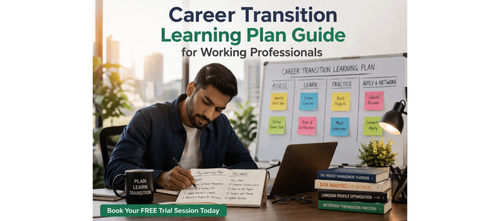

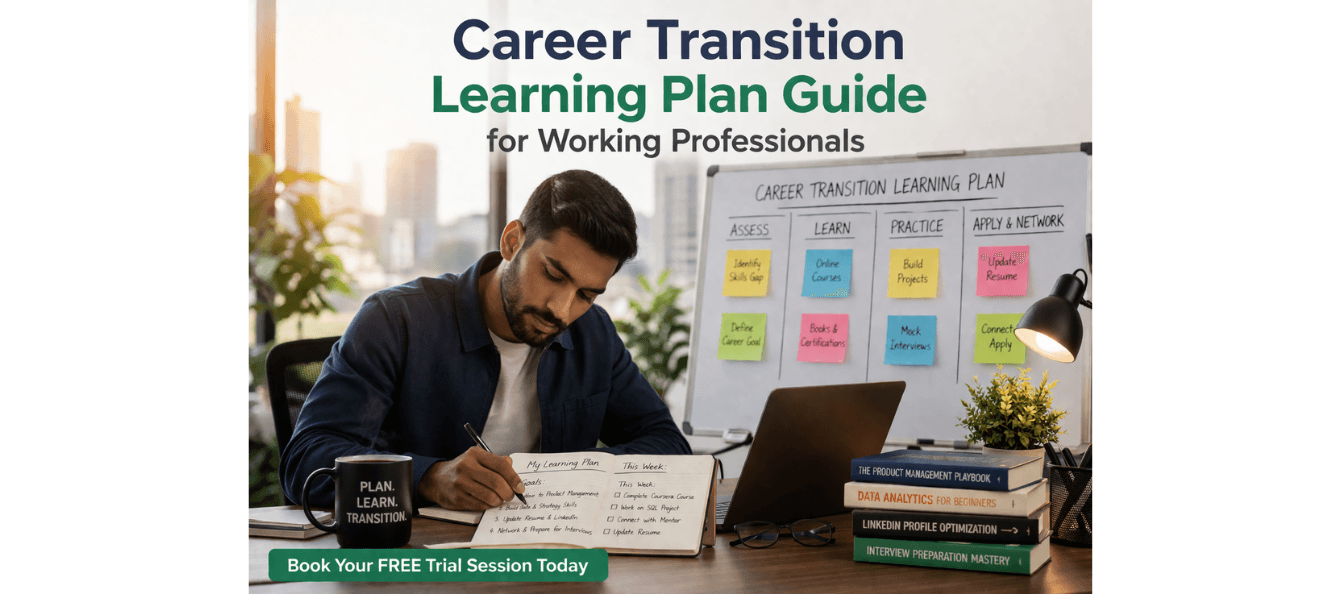
Transition Learning Plan Template: A Structured Career Transition Framework for Working Professionals
Most career transitions don’t fail because professionals lack ambition or capability—they fail because there is no clear, structured plan behind the effort. You may know where you want to go, but without a defined roadmap, the journey quickly becomes scattered. You sign up for courses, consume content, and stay busy, yet progress feels slow and uncertain.
This is the exact gap the Transition Learning Plan Template is designed to solve. Instead of relying on guesswork, it gives you a practical, step-by-step system to identify what truly matters, focus your efforts, and move forward with clarity and consistency. Whether you are switching industries, stepping into leadership, or redefining your career direction, this framework turns a vague goal into a structured, achievable process.
Download these resources and apply them alongside your daily work for improved clarity, productivity, and professional growth. You can also book a free trial to gain expert guidance and enhance your communication, problem-solving, and decision-making skills. The materials are designed in a clear, structured format to help professionals learn efficiently and implement insights with confidence.
Who Is This Blog For?
- Working professionals with 0–15 years
of experience planning a career move
- Career switchers moving across industries or functions
- Early–mid career professionals stepping into management roles
- Consultants and specialists repositioning their expertise
- Professionals returning to work after a career break
- Individuals feeling stuck despite continuous learning efforts
Why This Topic Matters Today?
The modern job market is evolving faster than ever. Roles are becoming more specialised, expectations are rising, and hiring managers are prioritising job-ready skills over theoretical knowledge.
Yet most professionals approach career transitions in an unstructured way:
- Learning without a clear destination
- Consuming multiple courses without application
- Missing the actual skills that hiring managers value
- Losing momentum due to unrealistic plans
The result is frustration, wasted time, and delayed career progress. The real challenge is not talent—it is clarity and execution. A structured learning plan bridges this gap by aligning effort with outcomes.
Core Concept
At the heart of this resource is the 5-Phase Transition Learning Framework. This framework breaks down a complex career transition into manageable, sequential stages that build on each other.
Audit
This phase focuses on understanding your current position. Instead of guessing your strengths, you systematically identify all your skills and rate your proficiency.
Map
Once you understand your starting point, you analyse your target role. This phase helps you identify the exact skills required and categorise them into strengths, bridge skills, and true gaps.
Plan
Here, you create a realistic learning roadmap. Instead of overcommitting, you design a plan that fits your actual weekly schedule and prioritises high-impact skills.
Apply
Learning without application does not translate into performance. This phase ensures that every skill is practised in real or simulated environments.
Integrate
The final phase focuses on transitioning into your new role effectively. It emphasises learning on the job, building relationships, and demonstrating value over time.
This framework ensures that your transition is not random but structured, intentional, and outcome-driven.
How This Blog and Guidebook Help You?
This blog and the underlying resource help you move from confusion to clarity and from intention to execution.
You will be able to:
- Identify your real strengths and hidden transferable skills
- Focus only on the skills that truly matter for your target role
- Build a structured and realistic learning plan
- Apply knowledge in real-world contexts for faster growth
- Maintain momentum throughout your transition journey
- Enter your new role with confidence and a clear strategy
Instead of feeling overwhelmed, you gain a clear path forward.
Step-by-Step Breakdown
Phase 1: Audit – Know Where You Stand
The first step is a complete Skills Inventory. You list every skill you have built across your career, including technical, functional, and interpersonal skills.
Each skill is rated across four levels:
- Foundational
- Developing
- Proficient
- Expert
You also identify transferable assets such as problem-solving, stakeholder management, and communication. These skills often give you a head start in a new role but are frequently overlooked.
This phase creates clarity and confidence by showing you what you already bring to the table.
Phase 2: Map – Identify What Actually Matters
In this phase, you shift focus from yourself to your target role.
You analyse multiple job descriptions to identify recurring requirements. You also gather insights from professionals already in the role to understand real-world expectations.
Using this information, you build a Gap Analysis Grid:
- Strengths: Skills you already have
- Bridge Skills: Skills that need refinement
- True Gaps: Skills you need to build from scratch
Your focus should be on True Gaps and critical Bridge Skills, not on polishing existing strengths.
Phase 3: Plan – Build a Realistic Learning Roadmap
This phase transforms insight into action.
You define your weekly learning budget, typically between 3 to 7 hours, and build a structured plan around it.
The roadmap is divided into phases:
- Initial weeks focus on core gaps
- Middle phase focuses on developing bridge skills
- Final phase focuses on integration and application
You also choose learning formats strategically:
- Courses and books for conceptual understanding
- Projects and simulations for practical skills
- Coaching and communities for interpersonal growth
The goal is not to learn more, but to learn effectively.
Phase 4: Apply – Turn Learning into Performance
This is where real progress happens.
Every skill you learn should be applied within a short timeframe. Application can include:
- Side projects
- Freelance or volunteer work
- Stretch assignments in your current role
- Simulated real-world scenarios
You also maintain a Proof of Learning Journal where you document:
- What you practised
- What happened
- What you learned
- What you will do differently next time
This not only reinforces learning but also creates strong evidence for interviews.
Phase 5: Integrate – Perform in Your New Role
Transitioning into a new role requires a different strategy.
The first 90 days are critical:
- First 30 days focus on observation and relationship building
- Next 30 days focus on applying skills in low-risk situations
- Final 30 days focus on delivering visible outcomes
Instead of trying to prove yourself immediately, you focus on understanding context and building credibility gradually.
Common Mistakes
- Learning without a clear goal leads to wasted effort and slow progress
- Waiting until you feel fully ready delays opportunities unnecessarily
- Lack of accountability results in inconsistent execution
- Ignoring networking limits real-world opportunities
The better approach is to focus on clarity, start before perfection, build accountability, and actively engage with your target professional community.
How Should You Use This Guidebook Effectively?
Start by reading the entire resource to understand the full framework.
Then follow a structured workflow:
- Spend 60–90 minutes completing your Skills Inventory
- Dedicate time to researching your target role thoroughly
- Build your Gap Analysis before starting any learning
- Create a realistic 16-week roadmap aligned with your schedule
- Apply every new skill within a short timeframe
- Review your progress at regular checkpoints
Treat this as a living document. Revisit and refine it as your understanding evolves.
Consistency is more important than intensity. A few focused hours each week can create significant long-term results.
Key Takeaways
- Career transitions succeed with structure, not just effort
- Start with a clear understanding of your current skills
- Focus only on skills that matter for your target role
- Build a realistic and sustainable learning plan
- Apply knowledge quickly to reinforce learning
- Track progress through a Proof of Learning Journal
- Prioritise consistency and accountability
- Integrate thoughtfully into your new role for long-term success
Your Next Step: Accelerate Your Career with PlanetSpark
Creating an impact-driven resume is not just about landing your next job—it’s about owning your professional story and presenting it with clarity, confidence, and credibility. When your resume clearly communicates value, results, and impact, opportunities follow naturally.
At PlanetSpark, we are committed to empowering working professionals with practical, outcome-focused resources that drive real career growth. From resume building and workplace communication to leadership presence and professional writing, our programs are designed to help you succeed in today’s fast-evolving job market.
Visit https://www.planetspark.in/resources to explore:
- Career and resume-building guides
- Workplace communication and professional writing resources
- Skill-development tools curated for working professionals
Want a deeper, hands-on experience?
You can also book a free trial session to learn more about PlanetSpark’s Working Professional Courses, designed to accelerate your career through personalised coaching, real-world practice, and expert guidance.
Your career deserves more than generic advice.
It deserves clarity, confidence, and measurable impact.
Personalized Communication Roadmaps
Record a video to get a AI generated personalized communication reports