
Cold Outreach Message Guide for Career Growth Opportunities
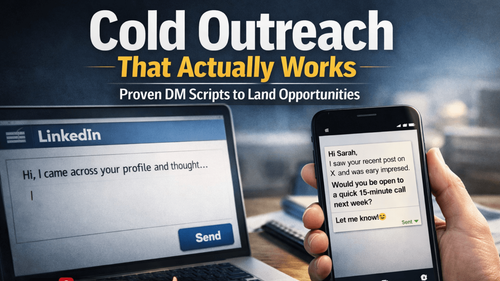

Cold Outreach That Actually Works: Proven DM Scripts to Land Opportunities Without Being Ignored
You open LinkedIn.
You think about messaging someone.
You type something… then delete it.
This happens more often than you think.
The problem isn’t that you don’t have something valuable to say—it’s that you don’t know how to say it in a way that gets a reply.
As highlighted in the Cold Outreach DM Scripts guide, a single well-crafted message can unlock job interviews, mentorships, consulting projects, and career-changing opportunities—without any prior connection.
But most professionals were never taught how to write one that works.
This blog breaks down exactly how to do it—using proven frameworks, real scripts, and practical strategies you can apply immediately.
Who Is This Blog For?
- Job seekers trying to bypass crowded application funnels
- Career changers building connections in a new industry
- Consultants and freelancers pitching clients
- Professionals looking to expand their network
- Anyone who has sent DMs and received no response
Why This Topic Matters Today?
Cold outreach is one of the highest-leverage career skills today.
You no longer need:
- A referral
- A mutual connection
- Years of personal branding
What you need is the ability to send the right message.
The guide explains that most professionals fail not because of lack of experience—but because their messages are:
- Generic
- Too long
- Unclear
- Or overly self-focused
And the result? Silence.
But when done right, cold outreach becomes a repeatable system for creating opportunities on demand.
Core Concept or Framework Explained
The 4-Part Framework of a High-Response DM
Every effective cold message follows a simple structure (explained on page 4):
1. The Hook
Your first line must feel personal and specific
- Reference a post, project, or achievement
- Avoid generic openers
Goal: Make them feel seen, not targeted
2. The Bridge
Connect their work to your reason for reaching out
- Keep it short and relevant
Goal: Establish credibility quickly
3. The Ask
Make one clear, low-effort request
- Example: a 15-minute call
Goal: Make it easy to say yes
4. The Exit
Close politely and give them an easy out
Goal: Show respect and professionalism
As the framework on page 4 emphasizes, every high-performing DM is built on these four layers—remove one, and your response rate drops significantly.
How This Blog and Guidebook Help You?
This blog and the guidebook together help you:
- Stop overthinking what to write
- Use proven templates instead of guessing
- Personalise messages without sounding robotic
- Increase response rates significantly
- Build a repeatable outreach system
Instead of hesitating, you take action.
Step-by-Step Breakdown
Step 1: Start With Specificity (Not Generic Openers)
Avoid:
“Hi, I came across your profile…”
Instead:
“I saw your post on X and your point about Y really stood out…”
This instantly increases your chances of getting a reply.
The guide highlights that personalised messages can achieve up to 27% response rates compared to just 3% for generic ones (page 13 chart).
Step 2: Keep It Short and Focused
Your DM should:
- Be under 120–150 words
- Take less than 45 seconds to read
Long messages signal effort—but reduce response rates.
Short messages signal clarity and confidence.
Step 3: Make One Clear Ask
This is where most people fail.
Avoid:
“I’d love to connect and learn more about your journey…”
Instead:
“Would you be open to a 15-minute chat in the next couple of weeks?”
Small, specific asks get more yeses.
Step 4: Use Proven Templates
The guide provides ready-to-use scripts for different scenarios.
Example: Job Seeker DM (page 5)
- Reference something specific
- Show genuine interest in the company
- Ask for a short conversation
Example: Career Changer DM (page 6)
- Acknowledge your transition honestly
- Highlight transferable skills
- Ask one focused question
Example: Consultant Pitch (page 7)
- Start with their business, not your credentials
- Identify a specific problem
- Offer a short call
These templates remove guesswork and improve quality instantly.
Step 5: Always Personalise Before Sending
Never copy-paste.
The worksheet on page 10 helps you prepare:
- Why this person specifically?
- What do you know about their work?
- What is your single ask?
This step turns a template into a real conversation.
Step 6: Use the 10-Point DM Audit
Before sending, check:
- Is the first line specific?
- Is the ask clear?
- Is the message concise?
- Does it sound human?
- Is there an easy exit?
This simple checklist (page 9) can dramatically improve results.
Step 7: Follow Up (Most People Don’t)
If you don’t get a reply in 7–10 days—follow up.
But don’t just say “checking in.”
Add new value.
The guide shows that a single follow-up can increase response rates by up to 60% (page 13).
Step 8: Build a Weekly Outreach System
Cold outreach is not a one-time activity.
The visual workflow on page 14 outlines a simple system:
- Monday → Research targets
- Tuesday → Draft messages
- Wednesday → Send DMs
- Friday → Track responses
- Monthly → Improve approach
Consistency turns outreach into opportunity.
Common Mistakes or Pitfalls to Avoid
- Writing long, overwhelming messages
- Asking multiple questions in one DM
- Being overly formal or robotic
- Sounding desperate or apologetic
- Sending your resume immediately
- Copy-pasting without personalisation
- Not following up
These mistakes reduce credibility—even before a conversation begins.
How Should You Use This Guidebook Effectively?
To get the best results:
- Start by understanding the 4-part framework
- Choose the right template for your goal
- Fill out the planning worksheet before writing
- Personalise every message
- Run the DM audit checklist
- Send within 24 hours (don’t overthink)
- Follow up after 7–10 days
- Track and refine your approach
The key is action, not perfection.
Key Takeaways
- Cold outreach is a high-leverage career skill
- Specificity is the biggest driver of response rates
- Short, focused messages outperform long ones
- One clear ask increases replies
- Templates help—but personalisation wins
- Follow-ups significantly improve outcomes
- Consistency builds a powerful network over time
- Your next opportunity can start with one message
Your Next Step: Accelerate Your Career with PlanetSpark
Opportunities don’t just come from applying—they come from conversations. And the ability to start those conversations confidently can completely change your career trajectory.
At PlanetSpark, we help working professionals master real-world communication skills that drive results—from networking and outreach to interviews, workplace communication, and leadership presence.
Explore more practical, ready-to-use resources at:
https://www.planetspark.in/resources
You can also book a free trial session to experience PlanetSpark’s Working Professional Courses—designed to help you communicate clearly, build meaningful professional relationships, and unlock new opportunities faster.
Your next opportunity is one message away.
Make sure you send the right one.
Personalized Communication Roadmaps
Record a video to get a AI generated personalized communication reports