
Confidence-Building Guide for Freshers Starting Careers
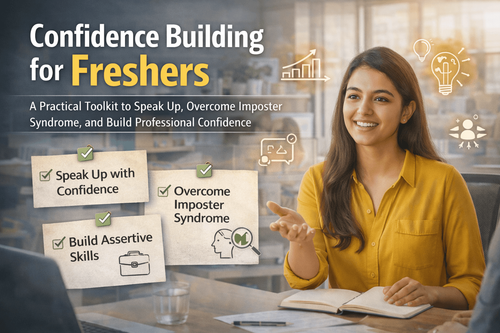

Confidence Building for Freshers: A Practical Toolkit to Speak Up, Overcome Imposter Syndrome, and Build Professional Confidence
You finally landed the job.
After years of studying, internships, and interviews, you are now sitting in your first real team meeting. Everyone seems confident, experienced, and articulate. And suddenly a quiet question appears in your mind: Do I actually belong here?
If this sounds familiar, you are not alone. Research shows that more than 70 percent of early-career professionals experience imposter syndrome during the first years of their careers. The challenge is rarely about ability. Instead, it is about translating knowledge and potential into visible confidence in professional environments.
Many talented freshers struggle with speaking up in meetings, presenting ideas clearly, accepting feedback, or making their work visible. Without the right tools, this gap between competence and confidence can slow down career growth.
That is exactly where a structured confidence framework can help. The Confidence-Building Toolkit for Freshers provides a practical system to help early-career professionals communicate clearly, show up boldly, and develop lasting professional confidence from day one.
Who Is This Blog For?
This guide is designed specifically for professionals who are at the beginning of their careers and want to build confidence in real workplace situations.
- Fresh graduates starting their first job
- Early-career professionals with 0–5 years of experience
- Interns transitioning into full-time roles
- Professionals who struggle with imposter syndrome at work
- Employees who hesitate to speak up in meetings
- Young professionals looking to improve workplace communication
Why This Topic Matters Today?
The modern workplace rewards not only competence but also visibility, communication, and initiative.
Many early-career professionals underestimate how much confidence affects career opportunities. For example, research shows that professionals who actively build visibility inside their organizations are three times more likely to be considered for promotions or stretch assignments in their first two years.
At the same time, workplace dynamics can be intimidating for freshers:
- Senior colleagues often appear more confident and experienced
- Meetings move quickly, leaving little room for hesitation
- Feedback can feel personal instead of developmental
- Self-doubt can grow when mistakes happen early in a career
These challenges create a confidence gap. Professionals may be capable but struggle to demonstrate that capability in real situations.
Confidence, however, is not something you are born with. It is a skill that can be built deliberately through consistent actions, habits, and frameworks.
Core Concept Explained: The Confidence–Competence Loop
One of the most powerful ideas in the toolkit is the Confidence–Competence Loop.
This concept explains how confidence actually develops in real life.
Many freshers believe the process works like this:
First confidence
Then action
Then success
But in reality, the order is reversed.
The real loop looks like this:
- Take action
- Gain experience
- Build competence
- Develop confidence
- Take more action
When professionals act even before they feel fully ready, they gain experience. That experience builds competence, and competence gradually strengthens confidence.
The biggest mistake early-career professionals make is waiting to feel confident before taking action. But confidence is not the starting point. It is the result of consistent action.
Once you understand this loop, the entire confidence-building process becomes more practical and achievable.
How This Blog and Guidebook Help You?
The Confidence-Building Toolkit provides a structured roadmap for developing professional confidence step by step.
Instead of relying on motivational advice, it focuses on practical tools that professionals can apply in everyday work situations.
The framework helps you:
- Identify your current confidence gaps
- Build practical communication skills
- Overcome imposter syndrome using evidence
- Speak up in meetings with clarity
- Receive feedback without losing confidence
- Build professional visibility inside your organization
- Develop daily habits that reinforce confidence
Each module focuses on a specific workplace situation and provides exercises, reflection prompts, and practical strategies.
The goal is simple: turn inner capability into visible professional confidence.
Step-by-Step Breakdown
Assess Your Starting Point with a Confidence Baseline Audit
Before improving confidence, you need to understand where you currently stand.
The toolkit begins with a Confidence Baseline Audit that helps you evaluate key professional behaviors on a scale of 1 to 5.
These areas include:
- Speaking up in meetings
- Introducing yourself professionally
- Presenting ideas to senior stakeholders
- Receiving feedback constructively
- Asking for help or clarification
- Setting boundaries with workload
- Claiming credit for your contributions
- Networking and professional conversations
This assessment helps identify your two biggest confidence gaps. These become your priority focus areas throughout the toolkit.
Step 1: Master Your Professional Introduction
Your professional introduction is one of the most repeated confidence moments in your career.
Whether it is a meeting, networking event, or job interview, how you introduce yourself influences how others perceive you.
A strong introduction typically includes three components:
Name and Role
Clearly state who you are and your role.
Example:
"I’m Priya, and I recently joined the marketing team as a content strategist."
Your Value Angle
Briefly explain what you bring to your work.
Example:
"My background in behavioural psychology helps me understand audience motivation and messaging."
Connection Hook
Invite conversation or curiosity.
Example:
"I’m especially interested in how the team approaches B2B campaigns and would love to learn more."
Practising this introduction builds immediate confidence in professional conversations.
Step 2: Build Your Confidence Anchor Points
Confidence is stronger when it is backed by evidence.
The toolkit introduces the idea of Anchor Points, which are real past experiences that prove your capability.
Examples of anchor points include:
- A time you handled pressure or tight deadlines
- A creative problem you solved
- A moment when you helped someone succeed
- A skill you learned quickly
- Positive feedback you received
These examples form your Evidence File. When self-doubt appears before a meeting or presentation, reviewing these anchor points reminds you that you are capable.
Step 3: Speak Up in Meetings with the 48-Hour Rule
One of the most important habits for early-career professionals is speaking up in meetings.
Professionals who contribute early in meetings are often perceived as more confident and competent.
The toolkit introduces the 48-Hour Meeting Rule.
24 Hours Before the Meeting
- Review the meeting agenda
- Prepare one question or comment
During the Meeting
- Share your prepared contribution within the first 10 minutes
- Maintain open and engaged body language
24 Hours After the Meeting
- Reflect on your contribution
- Identify one improvement for next time
This simple habit builds visibility and gradually strengthens meeting confidence.
Step 4: Reframe Imposter Syndrome Using Evidence vs Story
Imposter syndrome is extremely common among freshers.
However, it is often driven by cognitive distortions rather than facts.
The Evidence vs Story method helps challenge these distortions.
1: Name the Story
Example:
"I got this job by luck."
2: Examine the Evidence
Example:
"I passed interviews, assessments, and was selected over other candidates."
3: Create a Grounded Reframe
Example:
"I was selected because I demonstrated potential and relevant skills."
This exercise replaces emotional assumptions with factual reasoning.
Step 5: Learn to Receive Feedback Constructively
Many professionals struggle with feedback because it feels personal.
However, the ability to handle feedback calmly signals maturity and leadership potential.
A simple four-step feedback protocol helps manage this process.
Listen Without Defending
Allow the other person to finish before responding.
Clarify the Feedback
Ask questions such as:
"Can you give me a specific example?"
Acknowledge the Input
Respond professionally and thank the person.
Extract the Insight
After the conversation, identify one actionable improvement.
Step 6: Build a Daily Confidence Ritual
Confidence grows through consistent practice.
A simple daily ritual can reinforce confidence habits.
Morning Anchor
Review your Evidence File and set one intention for the day.
Power Posture
Before high-stakes moments, stand tall and take deep breaths to calm your nervous system.
Evening Reflection
Ask three questions:
- What did I do well today?
- What could I improve?
- What action will I take tomorrow?
Weekly Review
Update your Evidence File with new wins and set one confidence challenge for the coming week.
Step 7: Build Professional Visibility
Being good at your job is necessary, but it is not enough.
Professionals must also make their contributions visible.
Three visibility habits help achieve this.
Document Your Work
Send short updates summarizing completed tasks and results.
Build Internal Relationships
Connect with experienced colleagues and learn from them.
Develop a Professional Digital Presence
Maintain a clear LinkedIn profile and share industry insights.
Step 8: Set Assertive Boundaries
Many freshers struggle to say no.
This leads to overwork, stress, and reduced performance.
Assertiveness allows professionals to communicate limits respectfully.
Example situations include:
When Your Workload Is Full
"I want to make sure I do this well. I currently have several tasks in progress. Can we discuss priorities or timelines?"
When You Disagree
"I see it slightly differently. My perspective is that..."
When You Need Clarification
"Before I begin, I want to confirm the objective and expected output."
Learning these scripts helps professionals protect their time and maintain quality work.
Common Mistakes to Avoid
Even with the right tools, freshers often fall into predictable confidence traps.
Waiting to Feel Ready
Confidence comes after action, not before.
Over-Qualifying Ideas
Phrases like "This might be a silly question" weaken your message.
Comparing Yourself to Seniors
Your early career should not be measured against someone else's decade of experience.
Treating Mistakes as Personal Failure
Mistakes are data for improvement, not evidence of incompetence.
Staying Silent in Meetings
Silence is often interpreted as disengagement.
Ignoring Small Wins
Small progress builds long-term confidence.
How Should You Use This Guidebook Effectively?
To get the most value from the toolkit, approach it as an ongoing practice rather than a one-time read.
Follow these steps:
- Spend 20–30 minutes reviewing each module
- Complete the worksheets honestly
- Apply one new confidence habit every week
- Track progress using a 30/60/90-day review system
- Update your Evidence File regularly
Consistency matters more than speed. Small actions repeated over weeks create noticeable transformation.
Key Takeaways
- Confidence is built through action, not before it
- Speaking up once in every meeting significantly increases professional visibility
- Your past experiences already contain evidence of your capabilities
- Imposter syndrome can be challenged using the Evidence vs Story framework
- Professional visibility is essential for career growth
- Feedback is a growth tool when handled constructively
- Daily confidence rituals help reinforce positive habits
- Assertiveness and boundary-setting protect both performance and wellbeing
Your Next Step: Accelerate Your Career with PlanetSpark
Creating an impact-driven resume is not just about landing your next job—it’s about owning your professional story and presenting it with clarity, confidence, and credibility. When your resume clearly communicates value, results, and impact, opportunities follow naturally.
At PlanetSpark, we are committed to empowering working professionals with practical, outcome-focused resources that drive real career growth. From resume building and workplace communication to leadership presence and professional writing, our programs are designed to help you succeed in today’s fast-evolving job market.
Visit https://www.planetspark.in/resources to explore:
- Career and resume-building guides
- Workplace communication and professional writing resources
- Skill-development tools curated for working professionals
Want a deeper, hands-on experience?
You can also book a free trial session to learn more about PlanetSpark’s Working Professional Courses, designed to accelerate your career through personalised coaching, real-world practice, and expert guidance.
Your career deserves more than generic advice.
It deserves clarity, confidence, and measurable impact.
Personalized Communication Roadmaps
Record a video to get a AI generated personalized communication reports