
Confidence Rebuilding Guide for Professionals to Boost Career Growth
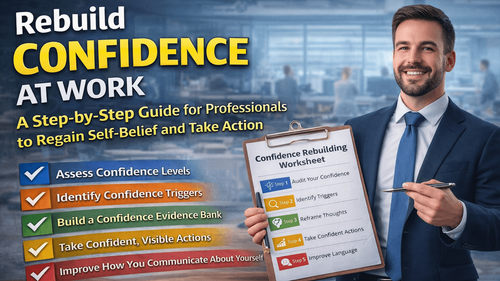

Rebuild Confidence at Work: A Step-by-Step Guide for Professionals to Regain Self-Belief and Take Action
Have you ever walked out of a meeting replaying everything you said — or didn’t say — and wondering if you’re actually as capable as people think you are?
For many working professionals, confidence doesn’t disappear overnight. It fades gradually — after a tough performance review, a failed project, a career transition, or even constant comparison with high-performing peers. The result? You start holding back, second-guessing decisions, and shrinking your voice at work.
The truth is, your capability hasn’t disappeared — your confidence has simply lost alignment with your actual value.
This is exactly where the Confidence Rebuilding Worksheet from PlanetSpark becomes powerful. It is not about motivational advice. It is a structured, practical system to help you assess, rebuild, and strengthen confidence using evidence, behaviour, and consistent action.
Who Is This Blog For?
- Working professionals experiencing self-doubt after setbacks
- Career switchers adjusting to new roles or industries
- Early-to-mid career professionals struggling with visibility
- Consultants and managers navigating high-performance environments
- Professionals who feel stuck despite having strong skills and experience
Why This Topic Matters Today?
In today’s fast-paced, performance-driven workplaces, confidence is often the differentiator between those who grow and those who stay stuck.
Many professionals assume confidence is something you either have or don’t. But in reality, confidence is a skill — one that can be built, lost, and rebuilt over time.
Confidence erosion is more common than most people admit. It often shows up when:
- You are passed over for promotions
- You receive critical feedback
- You enter a new, unfamiliar environment
- You constantly compare yourself to others
Without intervention, this leads to:
- Reduced participation in meetings
- Poor self-advocacy
- Missed opportunities
- Stagnant career growth
Rebuilding confidence is not optional anymore — it is essential for career progression.
Core Concept or Framework Explained
The worksheet introduces a structured, five-phase confidence rebuilding framework designed for real-world application:
1. Awareness
Understanding where your confidence stands across key professional areas like communication, expertise, decision-making, and relationships.
2. Diagnosis
Identifying the root causes of confidence drops through common triggers such as:
- Imposter Trigger
- Comparison Trap
- Narrative Loop
3. Reframing
Replacing negative internal narratives with evidence-based thinking using real career achievements.
4. Skill Building
Developing confidence through repeated action using the cycle:
Act → Reflect → Collect Evidence → Repeat
5. Communication Upgrade
Transforming how you speak about yourself to reflect clarity, ownership, and authority.
This framework ensures confidence is rebuilt from the inside out — not through temporary motivation, but through structured behavioural change.
How This Blog and Guidebook Help You?
This blog and the worksheet together help you:
- Gain clarity on where your confidence currently stands
- Identify specific triggers causing self-doubt
- Replace negative thinking with factual, evidence-based reasoning
- Build confidence through consistent, actionable behaviours
- Improve communication to reflect competence and authority
- Create a personalised, time-bound action plan
The result is not just improved confidence — but measurable career impact in visibility, decision-making, and leadership presence.
Step-by-Step Breakdown
Step 1: Audit Your Current Confidence Levels
Start by assessing your confidence across four key areas:
- Communication confidence
- Expertise confidence
- Decision-making confidence
- Relationship confidence
Rate yourself honestly on a scale from 1 to 5. The goal is accuracy, not perfection.
Then reflect on:
- Where you are strongest
- Where your biggest gap exists
- What experiences contributed to these patterns
This creates your baseline.
Step 2: Identify Your Confidence Triggers
Confidence doesn’t collapse randomly — it follows patterns.
The worksheet highlights three key triggers:
- Imposter Trigger: Feeling unqualified despite evidence
- Comparison Trap: Measuring yourself against others
- Narrative Loop: Replaying past failures repeatedly
Map real situations where your confidence dropped and identify:
- What happened
- What thought followed
- Which trigger it aligns with
This step helps you move from vague self-doubt to specific, actionable insights.
Step 3: Build Your Confidence Evidence Bank
Your brain naturally remembers failures more than successes. This step corrects that bias.
Create a list of at least five real career moments where you:
- Demonstrated skill
- Solved a problem
- Delivered results
- Handled pressure effectively
These don’t need to be major achievements — even small wins matter.
This becomes your “evidence bank” — your strongest tool against self-doubt.
Step 4: Reframe Negative Narratives
For each trigger situation, rewrite your internal narrative using evidence.
Example:
Old thinking:
“My idea was rejected, so I’m not good enough.”
Reframed thinking:
“My idea received feedback, which is normal. I have contributed valuable ideas before. This is one instance, not a pattern.”
This step builds cognitive resilience and balanced thinking.
Step 5: Build Confidence Through Action
Confidence is not built by thinking differently alone — it is built by acting differently.
The worksheet introduces a powerful cycle:
- Act deliberately
- Reflect honestly
- Collect evidence
- Repeat with expansion
Practical weekly actions include:
- Speaking early in meetings
- Sharing your achievements clearly
- Disagreeing respectfully
- Asking for what you need
These small actions create real proof of capability over time.
Step 6: Upgrade Your Communication Style
Many professionals unknowingly weaken their confidence through language.
Examples of low-confidence language vs confident alternatives:
- “I might be wrong, but…” → “My recommendation is…”
- “Sorry to bother you…” → “I would like five minutes…”
- “We got lucky…” → “We delivered X, which resulted in Y”
This shift alone can significantly improve how others perceive your confidence.
Step 7: Follow a Structured 4-Week Plan
The worksheet provides a clear roadmap:
Week 1: Audit and identify triggers
Week 2: Improve language and reframing
Week 3: Take visible, confident actions
Week 4: Review progress and refine approach
Each week builds momentum and accountability.
Common Mistakes or Pitfalls to Avoid
- Waiting to feel confident before acting
Confidence comes after action, not before
- Treating all feedback as absolute truth
One negative comment does not define your ability
- Rebuilding confidence alone
Without feedback or accountability, progress slows
- Ignoring small wins
Confidence grows through accumulation, not big breakthroughs
- Using generic positivity instead of evidence
Facts are more powerful than motivational thinking
How Should You Use This Guidebook Effectively?
To get maximum value from the worksheet:
- Read the entire guide once for context
- Fill each section thoughtfully and honestly
- Revisit it weekly as a progress check-in
- Track small wins consistently
- Share it with a mentor, coach, or trusted colleague
- Commit to at least two confidence-building actions per week
Time investment:
- Initial completion: 60–90 minutes
- Weekly review: 15–20 minutes
Consistency matters more than intensity.
Key Takeaways
- Confidence is a skill that can be rebuilt at any stage
- Self-doubt often comes from identifiable triggers
- Evidence beats negative thinking every time
- Action creates confidence, not the other way around
- Communication plays a critical role in perceived confidence
- Small, consistent behaviours lead to long-term transformation
- Accountability accelerates confidence rebuilding
Your Next Step: Accelerate Your Career with PlanetSpark
Creating an impact-driven resume is not just about landing your next job—it’s about owning your professional story and presenting it with clarity, confidence, and credibility. When your resume clearly communicates value, results, and impact, opportunities follow naturally.
At PlanetSpark, we are committed to empowering working professionals with practical, outcome-focused resources that drive real career growth. From resume building and workplace communication to leadership presence and professional writing, our programs are designed to help you succeed in today’s fast-evolving job market.
Visit https://www.planetspark.in/resources to explore:
- Career and resume-building guides
- Workplace communication and professional writing resources
- Skill-development tools curated for working professionals
Want a deeper, hands-on experience?
You can also book a free trial session to learn more about PlanetSpark’s Working Professional Courses, designed to accelerate your career through personalised coaching, real-world practice, and expert guidance.
Your career deserves more than generic advice.
It deserves clarity, confidence, and measurable impact.
Personalized Communication Roadmaps
Record a video to get a AI generated personalized communication reports