
Conflict Communication Skills Improvement Guide for Professionals
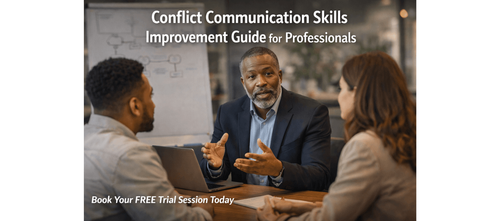

Master Conflict Communication at Work: A Practical Framework to Handle Difficult Conversations with Confidence
In every workplace, conflict is inevitable—but poor communication during conflict is what truly damages careers. A single tense conversation with a colleague, manager, or client can either strengthen trust or quietly erode it, depending on how you handle it.
Most professionals are never formally trained to navigate these moments. As a result, they either avoid difficult conversations, react emotionally, or rely on ineffective communication patterns. Over time, this leads to strained relationships, missed opportunities, and reduced professional credibility.
But here’s the truth: conflict communication is not a personality trait—it is a learnable skill. With the right structure, tools, and habits, you can turn high-pressure conversations into opportunities for clarity, alignment, and long-term trust.
This guide introduces a powerful, action-oriented conflict communication framework designed specifically for working professionals who want to communicate with confidence, even in the most challenging situations.
Download these resources and apply them alongside your daily work for improved clarity, productivity, and professional growth. You can also book a free trial to gain expert guidance and enhance your communication, problem-solving, and decision-making skills. The materials are designed in a clear, structured format to help professionals learn efficiently and implement insights with confidence.
Who Is This Blog For?
- Working professionals dealing with workplace
disagreements and communication challenges
- Managers and team leaders responsible for resolving conflicts effectively
- Job seekers preparing for collaborative and high-pressure roles
- Freelancers and consultants managing client expectations
- Anyone looking to improve emotional intelligence and professional communication
Why This Topic Matters Today?
In modern workplaces, collaboration is constant—but so are differences in opinions, expectations, and working styles.
Research consistently shows that unresolved conflict leads to:
- Reduced productivity and team efficiency
- Increased employee turnover and disengagement
- Breakdown of trust between colleagues and stakeholders
- Missed opportunities for innovation and problem-solving
On an individual level, poorly handled conflict can result in stress, damaged reputation, and stalled career growth.
Professionals who communicate effectively during conflict are seen as:
- Calm and composed under pressure
- Trustworthy and reliable
- Capable of leadership and decision-making
In contrast, those who avoid or mishandle conflict risk long-term professional setbacks.
Core Concept or Framework Explained
The foundation of this guide is a structured, phase-based approach to conflict communication:
Before → During → After
Each phase plays a critical role in achieving successful outcomes.
Before Phase: Focus on self-awareness and preparation
During Phase: Apply structured communication techniques
After Phase: Reinforce trust through follow-up and reflection
Supporting this structure are two powerful frameworks:
The 4-Point Preparation Framework:
- Clarify your intent
- Name your emotions
- Separate facts from assumptions
- Define your minimum acceptable outcome
The LEAD Communication Framework:
- Listen First
- Express Clearly
- Acknowledge the Other Side
- Direct Toward Resolution
These frameworks ensure that your communication remains structured, intentional, and outcome-focused.
How This Blog and Guidebook Help You?
This blog and worksheet provide:
- A complete system to manage conflict from start to finish
- Practical tools you can apply immediately in real conversations
- Proven communication frameworks used in professional environments
- Reflection exercises to improve self-awareness and behaviour
The result is stronger relationships, improved communication clarity, and greater professional confidence.
Step-by-Step Breakdown
Step 1: Build Self-Awareness — What Is Your Conflict Style?
Before improving communication, you need to understand your “conflict signature.”
Key insights:
- Everyone has a default response to conflict
- Common styles include competing, avoiding, accommodating, compromising, and collaborating
- Your effectiveness depends on adapting your style to the situation
Ask yourself:
- Do you react immediately or withdraw?
- What triggers your discomfort in conflict?
- How do you behave after a difficult conversation?
Awareness is the first step toward control.
Step 2: Prepare Strategically Before the Conversation
Preparation is often the difference between resolution and escalation.
Use the 4-point framework:
- Clarify your intent: Are you trying to resolve or just vent?
- Name your emotions: Identify feelings like frustration or disappointment
- Separate facts from stories: Focus on observable reality
- Define your minimum outcome: Know what you need to move forward
Important rule:
- If your emotional intensity is too high, delay the conversation
Preparation shifts you from reactive to intentional communication.
Step 3: Use the LEAD Framework During the Conversation
When the conversation begins, structure is critical.
Listen First:
- Allow the other person to speak without interruption
- Focus on understanding, not responding
Express Clearly:
- Use “I” statements instead of accusations
- Stick to one issue at a time
Acknowledge:
- Validate the other person’s perspective
- Show that you understand their experience
Direct Toward Resolution:
- Suggest clear, actionable next steps
- Ensure both parties agree on outcomes
This sequence prevents defensiveness and encourages collaboration.
Step 4: Use High-Impact Language
The words you choose can either escalate or resolve conflict.
Effective phrases:
- “I want to understand your perspective”
- “I may have misunderstood—can you clarify?”
- “What would a good outcome look like for you?”
Avoid phrases like:
- “You always…”
- “That’s not my problem”
- “Calm down”
Prepared language helps you stay professional under pressure.
Step 5: Follow Through After the Conversation
Most professionals stop after the discussion—but follow-up determines long-term success.
Use this checklist:
Within 2 hours:
- Reflect on how the conversation went
Within 24 hours:
- Send a brief follow-up message confirming agreements
Within 48 hours:
- Complete any commitments
Within 1 week:
- Re-engage positively with the person
Within 2 weeks:
- Check if the resolution is working
Consistent follow-through builds trust and credibility.
Step 6: Apply Skills in Real-World Scenarios
Common workplace conflicts include:
- A colleague taking credit for your work
- A manager dismissing your input
- A client expanding scope without agreement
- A peer displaying passive-aggressive behaviour
In each case:
- Address the issue privately
- Use structured communication
- Focus on resolution, not blame
Practice in real situations is what builds mastery.
Step 7: Build Long-Term Skills Through Practice
Improvement requires consistency.
Follow a 30-day practice plan:
Week 1:
- Focus on self-awareness and identifying triggers
Week 2:
- Practise structured preparation
Week 3:
- Apply the LEAD framework in conversations
Week 4:
- Focus on follow-through and reflection
Even 10–15 minutes of daily practice can create lasting change.
Common Mistakes or Pitfalls to Avoid
Many professionals repeat the same mistakes during conflict:
- Bringing up multiple issues at once
- Delaying conversations unnecessarily
- Using accusatory “you” language
- Venting to others instead of addressing directly
- Resolving conflict over email or chat
- Skipping acknowledgement of the other person’s perspective
- Treating the conversation as the end of the process
Better alternatives include:
- Address one issue at a time
- Initiate conversations within 72 hours
- Use “I” statements
- Communicate directly and respectfully
- Follow up consistently
How Should You Use This Guidebook Effectively?
To maximise impact, use this guide as an ongoing tool.
Suggested workflow:
- Identify your conflict scenario
- Use the preparation framework before the conversation
- Apply LEAD during the discussion
- Follow the post-conversation checklist
Time investment:
- 5–10 minutes for preparation
- Real-time application during conversations
- 10–15 minutes for reflection and follow-up
Consistency is more important than perfection.
Key Takeaways
- Conflict communication is a learnable professional skill
- Preparation is the most critical step for successful outcomes
- Listening is more powerful than arguing
- Acknowledgement builds trust without requiring agreement
- Structured frameworks improve clarity and effectiveness
- Follow-through determines long-term relationship success
- Small, consistent practice leads to lasting behavioural change
Your Next Step: Accelerate Your Career with PlanetSpark
Creating an impact-driven resume is not just about landing your next job—it’s about owning your professional story and presenting it with clarity, confidence, and credibility. When your resume clearly communicates value, results, and impact, opportunities follow naturally.
At PlanetSpark, we are committed to empowering working professionals with practical, outcome-focused resources that drive real career growth. From resume building and workplace communication to leadership presence and professional writing, our programs are designed to help you succeed in today’s fast-evolving job market.
Visit https://www.planetspark.in/resources to explore:
- Career and resume-building guides
- Workplace communication and professional writing resources
- Skill-development tools curated for working professionals
Want a deeper, hands-on experience?
You can also book a free trial session to learn more about PlanetSpark’s Working Professional Courses, designed to accelerate your career through personalised coaching, real-world practice, and expert guidance.
Your career deserves more than generic advice.
It deserves clarity, confidence, and measurable impact.
Start building that advantage today—with PlanetSpark.
Personalized Communication Roadmaps
Record a video to get a AI generated personalized communication reports