
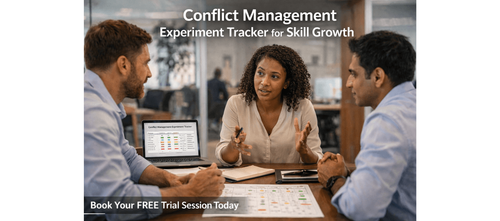
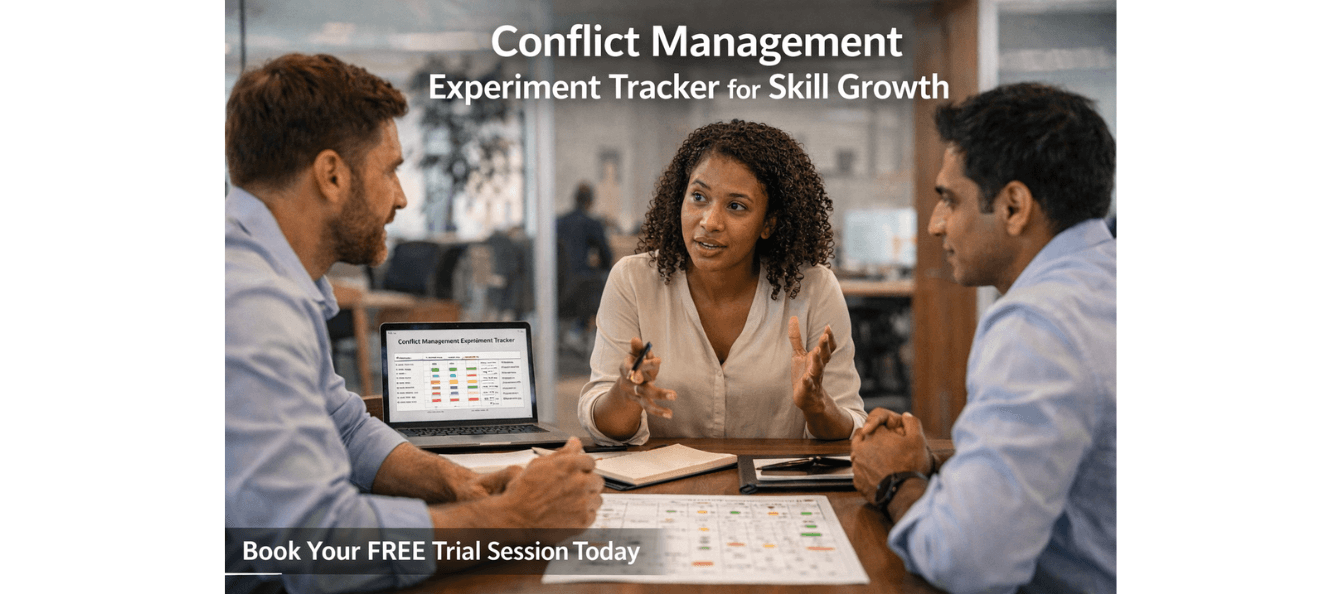
Conflict Management Experiment Tracker for Skill Growth

Conflict Management Tracker: A Practical System to Master Difficult Conversations and Build Professional Influence
Conflict is not the exception in professional life — it is the norm. Whether you are managing a team, collaborating with peers, or dealing with demanding stakeholders, friction is inevitable. Yet most professionals are never formally trained to handle conflict effectively. As a result, they either avoid difficult conversations, react emotionally, or rely on instinct rather than strategy.
This leads to a familiar pattern: unresolved issues resurface, relationships weaken, productivity declines, and workplace stress compounds over time. What makes this worse is not the conflict itself, but the absence of a structured approach to learn from it.
This is where a Conflict Management Experiment Tracker becomes transformative. Instead of treating conflict as something to survive, it turns every interaction into a deliberate learning opportunity. You move from reactive responses to intentional actions, building a personalised playbook that improves with every conversation.
Download these resources and apply them alongside your daily work for improved clarity, productivity, and professional growth. You can also book a free trial to gain expert guidance and enhance your communication, problem-solving, and decision-making skills. The materials are designed in a clear, structured format to help professionals learn efficiently and implement insights with confidence.
Who Is This Blog For?
- Working professionals struggling with difficult
conversations at work
- Managers handling team conflicts without a structured approach
- Individuals who tend to avoid or delay conflict situations
- Professionals aiming to improve communication, leadership, and emotional intelligence
- Anyone looking to build a repeatable system for handling workplace challenges
Why This Topic Matters Today?
Conflict is one of the most frequent and costly aspects of modern work environments. Managers spend a significant portion of their time navigating interpersonal friction, often without a framework to guide them.
The consequences are clear:
- Repeated conflicts due to lack of resolution
- Delayed conversations that worsen over time
- Declining team trust and collaboration
- Reduced productivity as energy shifts from results to tension management
In today’s fast-paced, high-pressure workplaces, the ability to handle conflict strategically is no longer optional. It is a core professional skill that directly impacts performance, leadership credibility, and career growth.
Core Concept or Framework Explained
At the heart of this system is a powerful shift in mindset: treat conflict as an experiment, not a threat.
Instead of entering conversations hoping for the best, you approach them with a hypothesis. You test a strategy, observe the outcome, and refine your approach. Over time, this builds a personalised, data-driven understanding of what works.
The framework is built on three key pillars:
Awareness of Your Conflict Fingerprint
Every professional has a default conflict style. Understanding this pattern is the first step toward change.
The five common styles include:
- Avoiding: Sidestepping conflict, useful for low-stakes situations but risky when overused
- Accommodating: Prioritising others’ needs, builds goodwill but may weaken your position
- Competing: Assertive and outcome-focused, effective in urgency but damaging if habitual
- Compromising: Finding middle ground quickly, efficient but often incomplete
- Collaborating: Seeking win-win outcomes, most effective but time-intensive
Strategy Selection
Instead of relying on instinct, you choose from a structured menu of eight proven strategies, such as:
- Naming the conflict dynamic
- Leading with curiosity
- Exploring underlying interests
- Pausing heated discussions
- Using impact statements
- Reframing toward shared goals
Experimentation and Reflection
Each conflict becomes a repeatable learning cycle:
- Prepare with a clear hypothesis
- Execute with awareness
- Reflect to capture insights
This cycle transforms everyday interactions into long-term skill development.
How This Blog and Guidebook Help You?
This approach delivers measurable professional outcomes:
- Improves confidence in handling difficult conversations
- Reduces emotional reactivity in high-pressure situations
- Builds stronger workplace relationships
- Enhances leadership presence and credibility
- Creates a repeatable system for continuous improvement
Instead of guessing what works, you build a personalised strategy backed by real-world experience.
Step-by-Step Breakdown
Step 1: Identify Your Conflict Style
Start by assessing your natural tendencies. Reflect on how you typically respond:
- Do you avoid confrontation?
- Do you prioritise harmony over results?
- Do you push strongly for your viewpoint?
Understanding your dominant style reveals both your strengths and blind spots.
Step 2: Choose a Strategy Before the Conversation
Before entering a conflict situation, select one strategy intentionally.
For example:
- Use curiosity to understand the other person’s perspective
- Name the pattern if the issue keeps repeating
- Focus on shared goals to reset the conversation
This step shifts you from reactive to strategic thinking.
Step 3: Prepare Effectively Before the Conversation
Preparation determines the outcome of most conversations.
Focus on:
- Defining a clear goal
- Anticipating the other person’s perspective
- Planning your opening statement
- Regulating your emotional state
Even 10 minutes of preparation can significantly improve results.
Step 4: Navigate the Conversation in Real Time
During the interaction, focus on three critical skills:
- Active listening without interrupting
- Monitoring emotional escalation
- Redirecting toward shared objectives
Avoid the common trap of trying to “win” the argument. The goal is resolution, not victory.
Step 5: Reflect Immediately After the Conversation
Within 24 hours, document:
- What actually happened
- Whether your strategy worked
- Your emotional responses
- One improvement for next time
This reflection converts experience into actionable insight.
Step 6: Log and Track Your Experiments
Use a structured tracker to record:
- Conflict context
- Strategy used
- Outcome rating
- Key learnings
Over time, patterns emerge, helping you refine your approach.
Step 7: Build Momentum Over 90 Days
Consistency is key. Over a 30–60–90 day period:
- Experiment with multiple strategies
- Track progress and outcomes
- Identify your most effective approaches
This transforms conflict management from a weakness into a professional strength.
Common Mistakes or Pitfalls to Avoid
Even experienced professionals fall into predictable traps:
- Waiting too long to address issues, allowing problems to escalate
- Starting conversations with accusations instead of curiosity
- Confusing the person with the behaviour
- Trying to resolve everything in one discussion
- Skipping follow-ups, leading to repeated conflicts
- Escalating prematurely instead of attempting direct resolution
- Treating conflict resolution as final instead of monitoring progress
Avoiding these mistakes improves both outcomes and relationships.
How Should You Use This Guidebook Effectively?
To get the most value from this system:
- Start with one low-stakes conflict to build confidence
- Spend 5–10 minutes preparing before conversations
- Log reflections within 24 hours of each interaction
- Review your progress monthly to identify patterns
- Commit to at least 8–12 experiments over 90 days
Consistency matters more than perfection. Even small, regular efforts lead to significant growth.
Key Takeaways
- Conflict is not the problem — unmanaged conflict is
- Your default conflict style shapes your responses, but it can be expanded
- Strategic preparation dramatically improves conversation outcomes
- Experimentation turns real-world situations into learning opportunities
- Reflection is essential for long-term skill development
- Avoid common mistakes like delaying conversations or seeking to “win”
- Consistent practice over 90 days leads to measurable professional growth
Your Next Step: Accelerate Your Career with PlanetSpark
Creating an impact-driven resume is not just about landing your next job—it’s about owning your professional story and presenting it with clarity, confidence, and credibility. When your resume clearly communicates value, results, and impact, opportunities follow naturally.
At PlanetSpark, we are committed to empowering working professionals with practical, outcome-focused resources that drive real career growth. From resume building and workplace communication to leadership presence and professional writing, our programs are designed to help you succeed in today’s fast-evolving job market.
Visit https://www.planetspark.in/resources to explore:
- Career and resume-building guides
- Workplace communication and professional writing resources
- Skill-development tools curated for working professionals
Want a deeper, hands-on experience?
You can also book a free trial session to learn more about PlanetSpark’s Working Professional Courses, designed to accelerate your career through personalised coaching, real-world practice, and expert guidance.
Your career deserves more than generic advice.
It deserves clarity, confidence, and measurable impact.
Start building that advantage today—with PlanetSpark.
Personalized Communication Roadmaps
Record a video to get a AI generated personalized communication reports