
Context Switching Survival Guide for Working Professionals
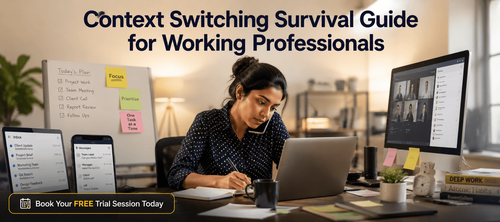

Avoid Energy Depletion from Constant Context Switching: A Practical Guide for Working Professionals
You open one task, answer a message, attend a quick meeting, return to your original work, and suddenly your focus is gone. This is the everyday reality of constant context switching. For working professionals, the problem is not just distraction. It is the hidden cognitive energy lost every time the brain has to rebuild focus.
The PlanetSpark guidebook explains that every switch creates a mental cost. Your brain carries attention residue from the previous task, making it harder to think clearly, work deeply, and finish the day with energy. This blog breaks down the guidebook into a simple, practical system you can apply to protect your focus, reduce mental fatigue, and work with more clarity.
Download these resources and apply them alongside your daily work for improved clarity, productivity, and professional growth. You can also book a free trial to gain expert guidance and enhance your communication, problem-solving, and decision-making skills. The materials are designed in a clear, structured format to help professionals learn efficiently and implement insights with confidence.
Who Is This Blog For?
- Working professionals who feel drained by constant task switching
- Managers handling meetings, messages, and team responsibilities
- Employees who struggle to complete deep work without interruptions
- Professionals who feel busy all day but still fall behind
- Anyone who wants better productivity, focus, and work-life energy
Why This Topic Matters Today?
Modern work is filled with apps, messages, meetings, emails, and urgent requests. The guidebook explains that every switch forces the prefrontal cortex to rebuild focus. Research cited in the guide notes that it may take 8 to 23 minutes to regain deep focus after an interruption.
This matters because context switching can lead to:
- Lower productive output
- More mistakes in routine work
- Poorer creative and strategic thinking
- Faster decision fatigue
- Higher stress and end-of-day exhaustion
The issue is not weak willpower. It is a system problem. Professionals need better daily structures, not just more motivation.
Core Concept or Framework Explained
The guidebook is built around one main idea: protect cognitive energy by reducing unnecessary switching and improving recovery between unavoidable switches.
It explains four common types of context switches:
Tool Switching
This happens when you move between apps such as email, Slack, spreadsheets, browsers, and project tools. Each change may seem small, but together they create mental fatigue.
Domain Switching
This happens when you move between different kinds of thinking, such as analysis, writing, brainstorming, and meetings. This type creates a heavy cognitive tax because each task requires a different mental mode.
Stakeholder Switching
This happens when you shift between people, teams, clients, or communication threads. It is common for managers, consultants, and team leads.
Priority Switching
This happens when urgent tasks pull you away from important work. It is especially draining because it creates emotional friction and unfinished work.
How This Blog and Guidebook Help You?
This blog helps you turn the guidebook into a simple action plan. You will learn how to:
- Identify your biggest switching triggers
- Protect your peak energy hours
- Use a 2-minute transition ritual
- Control notifications instead of reacting to them
- Batch tasks by mental mode
- Build a 21-day implementation routine
The goal is not to remove every interruption. The goal is to recover faster, reduce mental clutter, and finish work with more clarity.
Step-by-Step Breakdown
Step 1: Design Your Day Around Your Brain
The guidebook recommends planning your day around energy, not just calendar availability.
Use three work zones:
Peak Zone
Use this for deep work, strategy, writing, problem-solving, or high-value thinking. For many professionals, this is in the morning.
Maintenance Zone
Use this for meetings, emails, calls, and collaboration. This work matters, but it should not consume your sharpest mental hours.
Recovery Zone
Use this for admin, planning, updates, and reflection. This is usually better for lighter tasks.
A simple 3-block day can look like this:
- Block 1: Deep Work for 90 to 120 minutes
- Block 2: Collaboration and communication
- Block 3: Close-out, planning, and task updates
Step 2: Build Transition Rituals That Close the Loop
The guidebook explains that unfinished tasks create open loops. When you switch without closure, part of your mind stays attached to the old task.
Use the 2-Minute Close Protocol before switching:
- Write: I paused at ___. Next step is ___.
- Close tabs or notes related to the task
- Take 3 slow breaths
- State your next task clearly
This helps your brain release the previous task and enter the next one with less attention residue.
Step 3: Tame Your Notification Environment
Notifications are context-switching triggers. The guidebook recommends redesigning your environment instead of relying on willpower.
Start with a notification audit:
- Turn off non-essential badges and sounds
- Allow real-time alerts only for genuine urgency
- Check email and messages at fixed times
- Use Focus Mode during deep work
Use the urgency filter before responding:
Will this cause real harm if I reply in 2 hours?
If yes, respond. If no, park it for your next check-in.
Step 4: Batch, Group, and Sequence Your Work
The guidebook recommends grouping work by mental mode instead of jumping randomly between tasks.
Use these modes:
- Creative: writing, ideation, strategy
- Analytical: data, finance, problem-solving
- Communicative: meetings, emails, feedback
- Administrative: scheduling, filing, updates
Batching reduces the number of times your brain has to rebuild a new mental model.
A strong daily sequence is:
- Complex work first
- Communication next
- Admin last
Also keep a parking lot list for interruptions. Capture new thoughts, tasks, or requests there and process them later.
Common Mistakes or Pitfalls to Avoid
Protecting deep work but leaving notifications on
A calendar block alone is not enough. Turn on Focus Mode or Do Not Disturb during deep work.
Using a parking lot but never processing it
A capture list only works if you review it. Set 15 minutes daily to sort items into do now, schedule, or delete.
Skipping the transition ritual when busy
The busier you are, the more important the ritual becomes. It prevents mental carryover from becoming stress.
Not communicating focus blocks to your team
If people do not know your response schedule, they may assume you are unavailable or unresponsive. Set clear expectations.
How Should You Use This Guidebook Effectively?
Use the guidebook as a working tool, not just a reading document.
Suggested workflow:
- Day 1: Complete the context-switching audit
- Days 1 to 7: Use the morning setup checklist daily
- Days 8 to 14: Add the 2-minute close protocol
- Days 15 to 21: Add batching, notification control, and weekly review
Spend 5 minutes each morning to plan your deep work, communication windows, and parking lot. Spend 5 minutes at the end of the day closing loops and writing tomorrow’s top 3 priorities.
For managers, the guidebook also recommends team focus hours, async-first communication, and batched check-ins. This helps reduce context switching across the whole team.
Key Takeaways
- Context switching drains energy because the brain pays a focus recovery cost
- Attention residue makes unfinished tasks harder to leave behind
- Deep work should be scheduled during your peak energy window
- Transition rituals help close open loops before switching tasks
- Notifications should be controlled through systems, not willpower
- Batching tasks by mental mode reduces cognitive distance
- A parking lot list helps capture interruptions without acting on them immediately
- Managers can reduce team-wide switching by modeling focus-friendly habits
- A 21-day routine can create a stronger productivity baseline
Your Next Step: Accelerate Your Career with PlanetSpark
Creating an impact-driven resume is not just about landing your next job—it’s about owning your professional story and presenting it with clarity, confidence, and credibility. When your resume clearly communicates value, results, and impact, opportunities follow naturally.
At PlanetSpark, we are committed to empowering working professionals with practical, outcome-focused resources that drive real career growth. From resume building and workplace communication to leadership presence and professional writing, our programs are designed to help you succeed in today’s fast-evolving job market.
Visit https://www.planetspark.in/resources to explore:
- Career and resume-building guides
- Workplace communication and professional writing resources
- Skill-development tools curated for working professionals
Want a deeper, hands-on experience?
You can also book a free trial session to learn more about PlanetSpark’s Working Professional Courses, designed to accelerate your career through personalised coaching, real-world practice, and expert guidance.
Your career deserves more than generic advice.
It deserves clarity, confidence, and measurable impact.
Personalized Communication Roadmaps
Record a video to get a AI generated personalized communication reports