
Cost Optimization Resume Guide for Career Growth in 2026
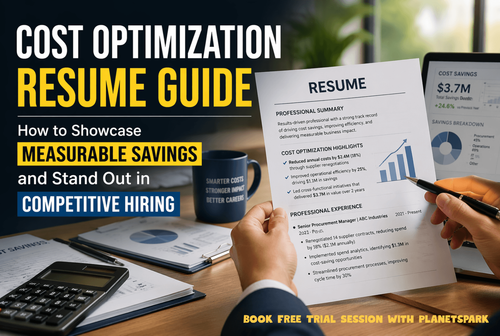

Cost Optimization Resume Guide: How to Showcase Measurable Savings and Stand Out in Competitive Hiring
Most professionals have contributed to cost savings at some point in their careers—but very few know how to communicate that impact effectively. You may have reduced operational expenses, renegotiated contracts, or improved efficiency, yet your resume still reads like a list of responsibilities rather than a record of measurable results.
Book your free trial session today with Planetspark.
Download for more details or PDF file.
In a hiring environment where recruiters spend just seconds scanning each resume, failing to highlight financial impact clearly can cost you opportunities. As highlighted in the guide, even significant achievements can go unnoticed if they are buried under generic descriptions.
This guide breaks down exactly how to transform cost optimisation achievements into powerful, outcome-driven resume narratives using structured, ATS-friendly templates designed for real-world scenarios.
Who Is This Blog For?
- Professionals who have delivered measurable cost savings but struggle to present them effectively
- Procurement, operations, finance, IT, and supply chain professionals
- Mid-to-senior leaders responsible for P&L or budget optimisation
- Consultants and analysts involved in cost transformation initiatives
- Early-career professionals who contributed to cost-saving projects
Why This Topic Matters Today?
Cost optimisation is no longer a niche skill—it is a core business priority across industries. Organisations today are under constant pressure to improve margins, reduce waste, and operate efficiently.
Despite this, many professionals fail to communicate their cost impact effectively. The resource highlights a critical reality: hiring managers spend an average of six seconds scanning a resume before deciding whether to continue reading.
Common challenges include:
- Important financial achievements buried within generic bullet points
- Lack of quantified impact or baseline comparison
- Vague language that reduces credibility
- Poor structuring that hides business value
In a competitive job market, clarity of impact often matters more than the impact itself.
Core Concept or Framework Explained
At the heart of this guide is a simple but powerful principle:
Replace responsibilities with quantified, contextualised outcomes.
Instead of describing what you did, your resume should demonstrate:
- What problem you solved
- What action you took
- What measurable result you delivered
- What business context makes the result meaningful
For example:
- Weak statement: Managed supplier contracts
- Strong statement: Renegotiated 14 supplier contracts, reducing annual spend by 18%
The templates in the guide are built around three key structural elements:
Outcome-first storytelling
Each bullet prioritises results before actions, ensuring immediate impact during quick scans
Quantification and context
Every achievement includes numbers, percentages, timelines, and business scale
Scenario-specific positioning
Each template aligns with a specific professional role, ensuring relevance and clarity
How This Blog and Guidebook Help You?
This guidebook does more than provide templates—it reshapes how you think about presenting your career.
By using it effectively, you can:
- Turn invisible contributions into visible business impact
- Improve your chances of getting shortlisted for high-value roles
- Position yourself as a commercially aware professional
- Align your resume with ATS and recruiter expectations
- Build a consistent narrative across resume, LinkedIn, and interviews
Ultimately, it helps you move from being “experienced” to being “impact-driven.”
Step-by-Step Breakdown
Step 1: Identify Your Cost Impact Story
Start by identifying where you have delivered measurable value. This could include:
- Procurement savings
- Operational efficiency improvements
- Budget optimisation
- IT cost reductions
- Workforce cost restructuring
Even early-career professionals can highlight contributions to larger cost-saving initiatives.
Step 2: Choose the Right Scenario-Based Template
The guide includes 10 scenario-specific templates designed for different roles:
- Procurement and sourcing leaders
- Operations efficiency managers
- Finance business partners
- IT cost reduction specialists
- Supply chain optimisation leads
- Lean or Six Sigma project leaders
- Real estate and facilities managers
- HR cost strategists
- Management consultants
- Early-career analysts
Each template ensures your achievements are framed in a way that aligns with recruiter expectations in that domain.
Step 3: Quantify Every Achievement
Numbers are the foundation of a strong cost optimisation resume.
You should include:
- Total savings delivered
- Percentage reductions
- Budget size or spend managed
- Timeframes for impact
- Scale of operations
For example:
- Reduced logistics costs by 12% across a ₹50 crore supply chain
- Eliminated ₹30 lakh in annual operational waste within 9 months
Step 4: Provide Baseline Context
A number without context is incomplete.
Always clarify:
- What the situation was before
- What changed after your intervention
For instance:
- Improved forecast accuracy from 65% to 85%, reducing excess inventory costs
This makes your impact credible and meaningful.
Step 5: Structure Your Resume Strategically
The templates emphasise a structured layout that includes:
- Professional summary focused on impact
- Cost impact summary section
- Role-specific achievements
- Key projects with measurable outcomes
This ensures your most important contributions are visible within seconds.
Step 6: Highlight Career-Defining Wins
Every template includes sections such as “Cost Optimisation Highlights” or “Career-Defining Cost Wins.”
These sections help you:
- Showcase your biggest achievements upfront
- Capture recruiter attention immediately
- Differentiate yourself from other candidates
Step 7: Align Skills with Cost Optimisation
Your skills section should reinforce your cost-saving capabilities.
Examples include:
- Spend analytics
- Process redesign
- Financial modelling
- Lean methodologies
- Vendor negotiation
This alignment strengthens your positioning.
Step 8: Tailor for ATS and Readability
The guide emphasises ATS compatibility through:
- Standard section headings
- Clean formatting
- Avoiding complex layouts that ATS cannot read
It also recommends using single-column layouts for ATS submissions and structured formatting for readability.
Step 9: Replace All Placeholders with Real Data
Every template includes placeholders for metrics and achievements.
Before finalising:
- Replace all placeholders with actual numbers
- Ensure accuracy and consistency
- Validate data with supporting evidence where possible
Step 10: Finalise and Validate
Before submitting your resume:
- Ensure all achievements are quantified
- Remove vague language
- Check formatting consistency
- Align resume with LinkedIn profile
A final review can significantly improve effectiveness.
Common Mistakes or Pitfalls to Avoid
The guide highlights several common errors that reduce resume impact:
- Listing responsibilities instead of measurable outcomes
- Failing to include baseline data for comparison
- Using vague phrases like “supported” or “contributed to”
- Hiding financial impact within dense paragraphs
- Ignoring context when presenting savings
These mistakes can make even strong profiles appear average.
How Should You Use This Guidebook Effectively?
To get maximum value from this resource:
- Select the template that matches your role and experience
- Dedicate 1–2 focused hours to input accurate data
- Prioritise measurable outcomes over descriptive content
- Use the same structure to update LinkedIn and portfolios
- Revisit and refine periodically as you gain new achievements
The guide is designed to be practical and immediately usable—simply fill in your data and adapt as needed.
Key Takeaways
- Cost optimisation achievements must be quantified and contextualised
- Recruiters prioritise clarity of impact over volume of experience
- Scenario-specific templates improve relevance and positioning
- Outcome-driven language is critical for standing out
- Strong resumes combine structure, metrics, and storytelling
- Avoid vague descriptions and focus on measurable results
- Consistency across resume and LinkedIn strengthens credibility
Your Next Step: Accelerate Your Career with PlanetSpark
Creating an impact-driven resume is not just about landing your next job—it’s about owning your professional story and presenting it with clarity, confidence, and credibility. When your resume clearly communicates value, results, and impact, opportunities follow naturally.
At PlanetSpark, we are committed to empowering working professionals with practical, outcome-focused resources that drive real career growth. From resume building and workplace communication to leadership presence and professional writing, our programs are designed to help you succeed in today’s fast-evolving job market.
Visit https://www.planetspark.in/resources to explore:
- Career and resume-building guides
- Workplace communication and professional writing resources
- Skill-development tools curated for working professionals
Want a deeper, hands-on experience?
You can also book a free trial session to learn more about PlanetSpark’s Working Professional Courses, designed to accelerate your career through personalised coaching, real-world practice, and expert guidance.
Your career deserves more than generic advice.
It deserves clarity, confidence, and measurable impact.
Personalized Communication Roadmaps
Record a video to get a AI generated personalized communication reports