
Cover Letter Alignment Guide With Job Roles for Professionals
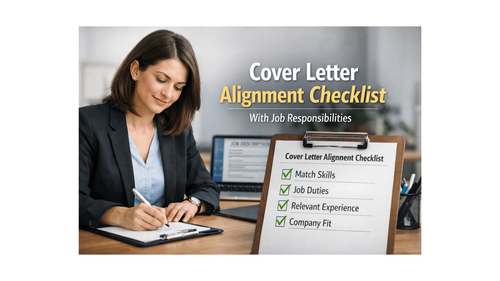

How to Write a Winning Cover Letter: The Complete Alignment Checklist to Increase Interview Callbacks
Introduction
You’ve tailored your resume, found the right job openings, and hit “apply” multiple times—yet the callbacks don’t come. For most working professionals, the problem isn’t lack of experience or capability. It’s misalignment.
A generic cover letter talks about you. An effective cover letter speaks directly to the employer’s needs.
Hiring managers don’t want another summary of your background. They want proof that you can solve the specific problem their role exists to address. This is where most candidates fall short—and where the Cover Letter Alignment Checklist becomes a powerful advantage.
This guide transforms how you approach cover letters by replacing guesswork with a structured, repeatable system that aligns your experience with what employers actually care about.
Who Is This Blog For?
- Job seekers struggling to convert applications into interview calls
- Career switchers trying to position transferable skills effectively
- Mid-career professionals targeting growth or leadership roles
- Consultants and managers applying for competitive positions
- Professionals with 0–15 years of experience who want a structured approach to job applications
Why This Topic Matters Today?
In today’s competitive job market, recruiters review dozens—sometimes hundreds—of applications for a single role. Most cover letters sound the same because candidates focus on their own story rather than the employer’s priorities.
The result is predictable:
- Generic applications that fail to stand out
- Longer job search cycles
- Missed opportunities despite strong qualifications
The core issue is simple: lack of alignment.
Employers are not evaluating how impressive your background sounds in isolation. They are assessing whether your experience directly connects to their current needs. Without that connection, even strong candidates get overlooked.
This is why alignment has become the most critical skill in cover letter writing—and why a structured checklist can significantly improve outcomes like callback rates, interview confidence, and negotiation strength.
Core Concept or Framework Explained
At the heart of this guide is one powerful idea: alignment.
Alignment means connecting your skills, experiences, and language directly to the responsibilities and expectations outlined in the job description. It is not about rewriting your entire story for every role. It is about selecting and presenting the most relevant parts of your experience in a way that mirrors the employer’s priorities.
The framework breaks this into three clear phases:
- Before you write: Understand the job deeply
- While you write: Structure your letter strategically
- Before you send: Audit for alignment and impact
A key technique within this framework is the two-column alignment method. On one side, you list the job’s key responsibilities. On the other, you map your specific experiences and results. This creates a direct bridge between what the employer needs and what you bring.
The shift is subtle but powerful. Instead of describing who you are, you demonstrate what you have done in contexts that closely match what the employer needs next.
How This Blog and Guidebook Help You?
This blog and the underlying checklist give you a clear, repeatable system to improve every cover letter you write.
You will be able to:
- Identify exactly what employers are looking for before writing
- Structure your cover letter with purpose and clarity
- Replace vague claims with specific, outcome-driven evidence
- Use employer language naturally to improve relevance
- Eliminate generic content that weakens your application
The result is a stronger professional narrative that positions you as a solution—not just a candidate.
Step-by-Step Breakdown
Before You Write: Decode the Job Description
Most professionals skip this step, which is why their cover letters feel generic. The process begins with analysing the job posting in detail.
Start by reading the job description twice. The first read builds understanding, while the second helps you identify key signals such as responsibilities, required skills, and company priorities.
Next, focus on extracting what truly matters:
- Identify action verbs like lead, manage, develop, or oversee. These reveal expected behaviours
- Separate must-have requirements from nice-to-have qualifications
- Look for hidden pain points such as fast-paced environments or cross-functional collaboration
- Note industry-specific language, tools, and frameworks
Then, apply the two-column method:
- Left column: key responsibilities from the job description
- Right column: your matching experiences and achievements
This becomes the foundation of your cover letter.
While You Write: Structure for Impact
An aligned cover letter is not an essay. It is a structured argument built around the employer’s needs.
Opening hook
Start by naming the role and referencing a specific company priority or challenge. Follow this with a strong value statement. Avoid generic openings that begin with “I am writing to apply.”
Responsibility match paragraphs
Focus on the top responsibilities from the job description. For each one:
- Present a relevant example from your experience
- Use a situation, action, result format
- Include measurable outcomes wherever possible
If you are switching careers, explicitly connect transferable skills to the role.
Culture and value alignment
Demonstrate that you have researched the company. Reference a real initiative, mission, or direction. This signals genuine interest and effort.
Confident closing
End with a clear and direct call to action. Invite the next step instead of passively hoping for a response.
Before You Send: Final Alignment Check
This phase ensures your cover letter is not just well-written, but strategically strong.
Ask yourself:
- Does the opening reflect the company’s challenge?
- Have you addressed the top responsibilities?
- Are your achievements specific and measurable?
- Is the language aligned with the job description?
- Could this letter be sent to another company without changes?
Additionally, use practical tests:
- The 60-second read test to ensure clarity
- The “so what” test to validate impact
- The mirror test to check uniqueness
A final checklist ensures your letter is concise, specific, and professionally formatted.
Common Mistakes or Pitfalls to Avoid
Even experienced professionals make avoidable errors that reduce the effectiveness of their cover letters.
Summarising your resume
Instead of repeating your experience, focus on one strong example that demonstrates impact.
Leading with yourself
Starting every sentence with “I” shifts focus away from the employer’s needs.
Addressing the wrong priorities
Highlighting less relevant achievements while ignoring key responsibilities weakens alignment.
Making vague claims
Statements like “strong leadership skills” lack credibility without evidence.
Ignoring company context
Failing to reference company-specific details makes your application feel generic.
Using a weak closing
Ending without a confident call to action reduces impact.
Avoiding these mistakes alone can significantly improve your results.
How Should You Use This Guidebook Effectively?
To get maximum value, treat this guidebook as a working tool rather than a one-time read.
Recommended workflow:
- Spend 20 to 30 minutes analysing the job description
- Take 10 minutes to research the company
- Use 20 to 30 minutes to draft your cover letter
- Allocate 10 to 15 minutes for alignment checks and revisions
- Spend 5 minutes on final formatting and review
On average, a high-quality application takes around 75 minutes. This investment significantly increases your chances of success compared to sending multiple generic applications.
Keep the checklist open while writing and revisit it for every new role. Over time, the process becomes faster and more intuitive.
Key Takeaways
- Alignment is more important than enthusiasm in a cover letter
- Employers evaluate relevance, not just experience
- Use the exact language from the job description naturally
- Focus on the top responsibilities, not just your strengths
- Replace vague claims with measurable results
- Include at least one company-specific detail
- Keep your cover letter concise and under 400 words
- Treat every application as a unique opportunity, not a template
---
Your Next Step: Accelerate Your Career with PlanetSpark
Creating an impact-driven resume is not just about landing your next job—it’s about owning your professional story and presenting it with clarity, confidence, and credibility. When your resume clearly communicates value, results, and impact, opportunities follow naturally.
At PlanetSpark, we are committed to empowering working professionals with practical, outcome-focused resources that drive real career growth. From resume building and workplace communication to leadership presence and professional writing, our programs are designed to help you succeed in today’s fast-evolving job market.
Visit https://www.planetspark.in/resources to explore:
- Career and resume-building guides
- Workplace communication and professional writing resources
- Skill-development tools curated for working professionals
Want a deeper, hands-on experience?
You can also book a free trial session to learn more about PlanetSpark’s Working Professional Courses, designed to accelerate your career through personalised coaching, real-world practice, and expert guidance.
Your career deserves more than generic advice.
It deserves clarity, confidence, and measurable impact.
Start building that advantage today—with PlanetSpark.
---