
Cover Letter Editing Checklist for Working Professionals in 2026
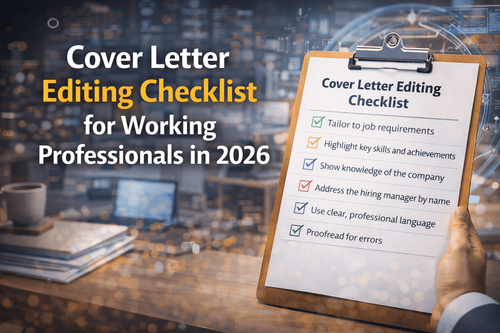

How to Edit and Refine a Cover Letter for Maximum Impact
Most professionals believe writing a cover
letter is the hardest part of the job application process. In reality, the biggest gap lies in editing it effectively. A poorly refined cover letter—no matter how strong the experience behind it—fails to communicate relevance, clarity, and value within seconds.
Hiring managers don’t read cover letters—they scan them. If your message isn’t sharp, structured, and tailored, it gets ignored. This is where a systematic editing and refinement process becomes a game-changer.
This blog transforms a proven checklist into a practical, step-by-step guide to help you turn a rough draft into a compelling, job-winning cover letter that captures attention and drives interview calls.
Who Is This Blog For?
This blog and guidebook are designed for:
- Working professionals applying for new roles across industries
- Job seekers struggling to convert applications into interviews
- Mid-career professionals aiming for strategic career moves
- Career switchers needing tailored and targeted applications
- Professionals who already have a draft but want to refine it for impact
Why This Topic Matters Today
The modern hiring landscape prioritises relevance, speed, and clarity. Recruiters often review applications in seconds, making it essential for every line in your cover letter to justify its presence.
A generic or unstructured cover letter signals lack of effort and clarity. On the other hand, a well-edited, tailored letter answers the most critical hiring question: Why are you the right fit for this role at this company?
Many professionals make the mistake of focusing only on writing, ignoring the refinement process. However, the real differentiation happens during editing—where clarity improves, evidence strengthens, and positioning becomes sharper.
Core Concept or Framework Explained
The foundation of an effective cover letter lies in structured editing—not random improvements. The guide introduces a three-phase refinement framework that ensures clarity, alignment, and impact.
The first phase focuses on alignment—ensuring your letter directly responds to the job role and company expectations.
The second phase introduces a structured editing sequence:
- Structure first to fix flow and organisation
- Language next to sharpen clarity and remove redundancy
- Evidence third to strengthen credibility with results
- Tone last to ensure confidence and professionalism
The third phase addresses real-world mistakes and introduces corrective strategies.
This framework ensures that your cover letter evolves from a generic draft into a targeted, persuasive communication tool.
How This Blog and Guidebook Help You
By applying this structured checklist, you can:
- Align your cover letter precisely with job requirements
- Eliminate generic content and replace it with targeted messaging
- Strengthen your narrative with measurable results and outcomes
- Improve readability and recruiter engagement
- Build a repeatable system for every job application
Ultimately, this approach helps you move from sending applications to securing interviews.
Step-by-Step Breakdown
Step 1: Align Before You Edit
Before making any changes, you must ensure your cover letter is answering the right question. Most edits fail because professionals jump directly into wording instead of fixing alignment.
Start by reviewing the job description alongside your draft. Identify where your content reflects the employer’s expectations and where it becomes generic.
Focus on:
- Highlighting key skills, outcomes, and values from the role
- Defining your unique value in one clear sentence
- Identifying and removing overused phrases
- Rewriting your opening line to immediately signal relevance
This step builds the strategic foundation for all further edits.
Step 2: Fix the Structure First
Structure determines whether your message is understood quickly. Without a clear flow, even strong content loses impact.
A well-structured cover letter includes:
- An opening paragraph that establishes relevance in 2–3 sentences
- A body section presenting evidence of impact and achievements
- A closing paragraph with a clear and confident call to action
Additionally, ensure:
- The total length stays concise between 250–350 words
- Paragraphs are short and easy to scan
- There are no dense blocks of text
Fixing structure first prevents wasted effort on polishing content that may later be removed.
Step 3: Refine Language and Clarity
Once structure is in place, focus on improving how your message is communicated.
Strong language makes your cover letter direct, professional, and easy to read. Replace passive constructions with active verbs that show ownership and impact.
For example:
- Instead of describing responsibilities, emphasise actions
- Remove filler words and unnecessary phrases
- Ensure every sentence contributes to your central message
Clarity is achieved not by adding more words, but by removing what is unnecessary.
Step 4: Strengthen Evidence and Specificity
A cover letter without evidence feels unconvincing. This step focuses on replacing vague claims with concrete proof.
To improve credibility:
- Include at least one measurable or clearly defined outcome
- Replace general statements with specific achievements
- Highlight how your actions created value
For instance, instead of stating experience, demonstrate results achieved through that experience.
Additionally, reference something specific about the company—such as its mission, product, or recent initiative—to show genuine interest and research.
Step 5: Refine Tone and Voice
Tone determines how your message is perceived. Even well-structured content can fail if the tone feels unsure or overly formal.
An effective tone is:
- Confident but not arrogant
- Professional but not rigid
- Direct without sounding aggressive
Avoid language that sounds apologetic or uncertain. Your cover letter should position you as a capable professional proposing value—not requesting validation.
Reading your letter aloud is a powerful technique to identify awkward phrasing or unnatural flow.
Step 6: Apply the Final Review Checklist
Before sending your cover letter, run it through a final quality check to ensure readiness.
Ask yourself:
- Is the letter tailored specifically to the role and company?
- Does the opening line immediately create relevance?
- Have you included strong evidence of impact?
- Is the content concise and free from unnecessary details?
- Are active verbs used consistently?
- Does the letter present one clear and strong central argument?
This final step ensures your application meets professional standards and avoids common rejection triggers.
Common Mistakes or Pitfalls to Avoid
Even experienced professionals make avoidable mistakes that reduce effectiveness.
- Treating the cover letter as a summary of the resume instead of adding new value
- Using generic openings that fail to capture attention
- Ignoring company-specific details, making the letter feel mass-produced
- Placing key achievements too late in the letter
- Ending with weak or passive closing statements
- Editing in isolation without external feedback
Avoiding these pitfalls immediately improves clarity, credibility, and impact.
How Should You Use This Guidebook Effectively?
To get the best results from this checklist, follow a structured approach:
- Start by reading the entire framework to understand the process
- Apply each phase sequentially without skipping steps
- Allocate focused time for editing rather than rushing
- Review your letter multiple times using the structured sequence
- Use the checklist for every application to build consistency
Spending even a few extra minutes on structured editing can significantly increase your chances of success.
Key Takeaways / Summary
- Align your cover letter with the job role before editing
- Fix structure first, then refine language, evidence, and tone
- Replace generic phrases with targeted, role-specific content
- Lead with strong evidence of impact and achievements
- Maintain clarity, conciseness, and professionalism throughout
- Use a repeatable editing system for consistent results
Your Next Step: Accelerate Your Career with PlanetSpark
Creating an impact-driven resume is not just about landing your next job—it’s about owning your professional story and presenting it with clarity, confidence, and credibility. When your resume clearly communicates value, results, and impact, opportunities follow naturally.
At PlanetSpark, we are committed to empowering working professionals with practical, outcome-focused resources that drive real career growth. From resume building and workplace communication to leadership presence and professional writing, our programs are designed to help you succeed in today’s fast-evolving job market.
Visit https://www.planetspark.in/resources to explore:
- Career and resume-building guides
- Workplace communication and professional writing resources
- Skill-development tools curated for working professionals
Want a deeper, hands-on experience?
You can also book a free trial session to learn more about PlanetSpark’s Working Professional Courses, designed to accelerate your career through personalised coaching, real-world practice, and expert guidance.
Your career deserves more than generic advice.
It deserves clarity, confidence, and measurable impact.
Start building that advantage today—with PlanetSpark.
Personalized Communication Roadmaps
Record a video to get a AI generated personalized communication reports