
Cover Letter vs Email Pitch: Ultimate Guide for Professionals
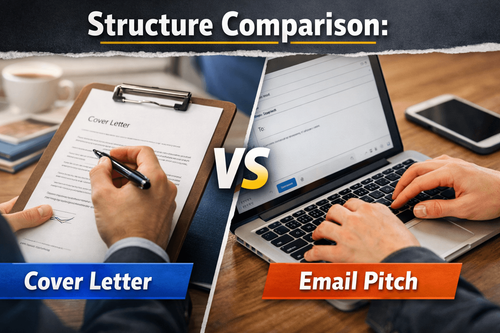

Choosing the Right Format to Maximise Your Job Application Success Cover Letter or Email Pitch
In today’s fast-moving job market, professionals
are no longer limited to a single way of applying for roles. Some positions require a formal cover letter attached to your resume. Others expect a short, persuasive email pitch directly in the body of the message.
Yet many candidates treat both formats the same way. They either paste a long cover letter into an email or send a brief, underdeveloped message when a structured letter was expected.
Understanding the difference between a cover letter and an email pitch is essential. Each serves a different purpose, follows a different structure, and creates a different impression.
This guide explains when to use each format, how to structure them effectively, and how to ensure your application communicates professionalism, clarity, and impact.
Who Is This Blog For?
This blog and guidebook are designed for:
- Working professionals applying across multiple job platforms
- Candidates confused about application instructions
- Mid-career professionals targeting competitive roles
- Freelancers and consultants pitching directly to decision-makers
- Anyone wanting to increase response rates from job applications
If you’ve ever wondered whether to attach a formal letter or write a concise pitch email, this guide provides clarity.
Why This Topic Matters Today?
Hiring processes have evolved significantly.
Traditional corporate roles often require:
- Resume
- Formal cover letter
- Structured documentation
However, modern hiring—especially in startups, creative industries, consulting, and networking scenarios—often relies on:
- Direct email pitches
- LinkedIn outreach messages
- Short professional introductions
Using the wrong format can:
- Reduce readability
- Signal misunderstanding of expectations
- Create unnecessary friction for recruiters
Choosing the right format demonstrates awareness, adaptability, and communication intelligence.
Core Concept or Framework Explained
The Format Decision Framework (F.D.F.)
Before applying, evaluate three factors:
1. Application Instructions
2. Industry Norms
3. Communication Context
Based on these, choose between:
- Formal Cover Letter (structured, attached document)
- Email Pitch (concise, persuasive message in email body)
Each format has a distinct purpose and structure.
How This Blog and Guidebook Help You?
Together, this blog and guidebook help you:
- Understand structural differences between formats
- Identify when each format is appropriate
- Avoid common formatting mistakes
- Write concise yet persuasive email pitches
- Craft professional, structured cover letters
- Improve recruiter response rates
The goal is alignment and clarity.
Section 1: What Is a Cover Letter?
A cover letter is a formal document attached to your resume. It typically:
- Follows a structured format
- Includes an opening paragraph, body paragraphs, and closing
- Explains your fit for the role
- Demonstrates alignment with company needs
- Expands on key achievements
Length: Approximately 250–400 words.
Best Used When:
- The job description explicitly requests it
- Applying to traditional corporate organisations
- Submitting applications via formal portals
- Roles requiring structured communication
Structure Overview:
1. Opening: Role applied for and brief alignment
2. Body: 1–2 paragraphs highlighting measurable achievements
3. Alignment: Why you are interested in this company
4. Closing: Clear call-to-action and appreciation
Cover letters emphasise depth and structured narrative.
Section 2: What Is an Email Pitch?
An email pitch is a concise professional introduction written directly in the email body. It is shorter, sharper, and more direct.
Length: 3–6 short paragraphs or 100–180 words.
Best Used When:
- Reaching out directly to hiring managers
- Applying to startups or informal environments
- Networking referrals
- Cold outreach
- Situations where brevity is expected
Structure Overview:
1. Clear subject line
2. Short introduction
3. Key achievement or value proposition
4. Reason for writing
5. Professional closing
Email pitches prioritise clarity and speed.
Section 3: Key Differences Between Cover Letter and Email Pitch
1. Length
Cover Letter: Detailed and structured
Email Pitch: Concise and direct
2. Tone
Cover Letter: Formal and comprehensive
Email Pitch: Professional but conversational
3. Depth
Cover Letter: Explains multiple achievements
Email Pitch: Highlights 1–2 strong value points
4. Format
Cover Letter: Separate document attachment
Email Pitch: Written within email body
5. Purpose
Cover Letter: Demonstrates full alignment
Email Pitch: Sparks interest quickly
Choosing the correct format shows communication maturity.
Section 4: Common Mistakes to Avoid
When Writing a Cover Letter:
- Repeating your resume word-for-word
- Writing long, dense paragraphs
- Using generic templates without customisation
- Forgetting measurable achievements
- Ending without a clear call-to-action
When Writing an Email Pitch:
- Making it too long
- Writing in overly casual tone
- Forgetting to attach your resume
- Using vague subject lines
- Sounding desperate instead of confident
Professional clarity is key in both formats.
Section 5: How to Decide Which Format to Use
Ask yourself:
- Did the job posting request a cover letter?
- Is the company formal or startup-oriented?
- Am I applying through a portal or direct contact?
- Is brevity valued in this industry?
- Am I networking or formally applying?
When in doubt, follow explicit instructions first.
If no instructions are provided:
- For corporate roles → Attach a formal cover letter
- For direct outreach → Use a concise email pitch
Section 6: Strategic Tips for Maximum Impact
For Cover Letters:
- Tailor to company mission
- Quantify achievements
- Maintain professional formatting
- Keep under one page
- Use confident language
For Email Pitches:
- Use clear subject lines
- Keep paragraphs short
- Lead with value
- Include measurable results
- Attach resume properly named
Both formats should reflect professionalism and alignment.
Common Pitfalls That Reduce Response Rates
- Sending a long cover letter pasted into email
- Writing a vague, two-line email without substance
- Ignoring role-specific alignment
- Overusing generic praise for the company
- Failing to proofread
Format errors can signal inattention to detail.
How Should You Use This Guidebook Effectively?
To maximise results:
1. Study both structures carefully
2. Create templates for each format
3. Customise content for every role
4. Maintain a measurable achievement bank
5. Review tone before sending
6. Always proofread final drafts
Time required:
- Template creation: 1–2 hours
- Customisation per application: 20–30 minutes
Strategic preparation increases efficiency.
Key Takeaways
- Cover letters and email pitches serve different purposes
- Follow application instructions first
- Cover letters provide structured depth
- Email pitches prioritise brevity and impact
- Tone and format must match context
- Customisation improves response rates
- Clear, measurable achievements strengthen both formats
- Professional presentation influences recruiter perception
Choosing the right format is a strategic decision—not a guess.
Your Next Step: Accelerate Your Career with PlanetSpark
Effective professional communication requires more than strong experience—it demands clarity, structure, and adaptability. Knowing when to use a formal cover letter and when to send a concise email pitch can significantly influence your success rate.
At PlanetSpark, we help working professionals build structured communication skills that elevate resumes, cover letters, interviews, and leadership presence. Our programs focus on practical, measurable improvement aligned with real-world hiring expectations.
Visit https://www.planetspark.in/resources to explore:
- Resume and cover letter mastery guides
- Interview communication frameworks
- Workplace writing toolkits
- Career acceleration resources
You can also book a free trial session to learn more about PlanetSpark’s Working Professional Courses, designed to help you communicate strategically and secure better opportunities.
Clarity creates confidence.
Structure builds credibility.
Choose the right format—and present your value with impact.
Start building your advantage today—with PlanetSpark.