
Crafting Resumes for Client-Facing Professionals: Best Practices
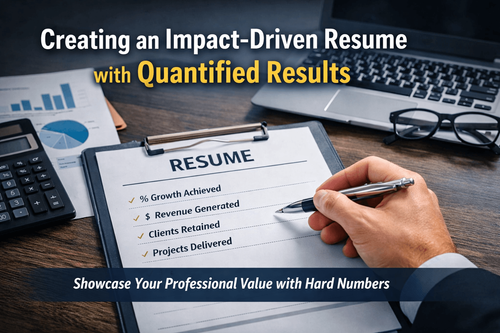

Creating an Impact-Driven Resume with Quantified Results: A Practical Guide to Showcase Professional Value
Most professionals believe their resumes fail because they lack the right skills or experience. In reality, the problem is usually much simpler: the resume does not clearly communicate impact.
Recruiters typically spend only a few seconds scanning a resume before deciding whether to continue reading. In that short window, they are not analysing every detail. They are looking for signals of value. They want to know whether a candidate can deliver measurable results, build trust with stakeholders, and contribute meaningfully to business outcomes.
Traditional resumes rarely answer these questions. They list responsibilities, outline tasks, and describe job functions. But hiring managers want something more specific. They want proof that a candidate’s work created tangible value.
The PlanetSpark guidebook on structuring resumes for client-facing professionals explains that a resume is not just a work history. It is a proof of concept. It must show that you can be trusted to represent the organisation and deliver results in high-stakes environments. :contentReference[oaicite:0]{index=0}
This blog translates the guidebook’s frameworks, examples, and worksheets into a practical roadmap. By applying these strategies, professionals can transform routine job descriptions into compelling achievement statements that demonstrate measurable impact and attract interview opportunities.
Book your free trial session today with Planetspark.
Download for more details or PDF file.
Who Is This Blog For?
This blog and the accompanying guidebook
are designed for:
- Working professionals with 0–15 years of experience seeking faster career growth
- Career changers repositioning their experience for a new industry
- Consultants, account managers, and client-facing professionals aiming to strengthen their resume
- Mid-career professionals pursuing leadership roles or promotions
- Job seekers struggling with strong experience but low interview response.
Why This Topic Matters Today?
The modern hiring environment is defined by speed, automation, and measurable performance.
Recruiters often review hundreds of resumes for a single role. Applicant Tracking Systems filter many applications before a recruiter ever reads them. Even when a resume reaches a human reviewer, it is scanned in seconds rather than read line by line.
For professionals in client-facing roles, the stakes are even higher. Hiring managers are asking a silent but critical question: Can I trust this person in front of my clients?
Roles such as consulting, account management, customer success, business development, and advisory work require a unique combination of technical knowledge, interpersonal authority, and commercial awareness. A resume that only lists tasks cannot demonstrate those qualities.
The PlanetSpark guidebook emphasises that your resume must signal three things immediately: trusted advisor, revenue contributor, and relationship builder. :contentReference[oaicite:1]{index=1}
An impact-driven resume achieves this by presenting evidence of outcomes. Instead of explaining what you were responsible for, it shows what actually changed because of your work.
Core Concept or Framework Explained:
The central idea behind an impact-driven resume is simple but powerful: shift from responsibilities to results.
Traditional resumes describe activities. Impact-driven resumes demonstrate outcomes.
The guidebook introduces a structured approach that helps professionals convert everyday work into compelling achievement statements. One of the most effective ways to do this is by using a framework that connects context, actions, and measurable results.
This approach ensures that every resume bullet point communicates three essential elements:
- What challenge or task existed
- What actions you took
- What measurable outcome occurred
For professionals in client-facing roles, the framework emphasises external impact. Hiring managers are not just interested in internal processes. They want to see what happened to clients, revenue, relationships, or operational performance as a result of your work.
For example, a traditional bullet might say:
Managed key accounts and conducted client reviews.
An impact-driven statement might read:
Managed a portfolio of enterprise clients and maintained high retention while identifying expansion opportunities.
The difference is specificity. The second statement demonstrates business outcomes rather than simply describing duties.
How This Blog and Guidebook Help You?
This blog and guidebook help professionals translate everyday work into powerful career signals.
By applying the frameworks outlined here, you will learn how to:
- Identify hidden achievements across your career
- Translate responsibilities into measurable outcomes
- Present client impact and commercial contribution clearly
- Structure your resume to guide the recruiter’s attention
- Align your resume with the language used in job descriptions
The result is a resume that communicates credibility quickly. Instead of blending into the crowd, your professional story becomes clear, specific, and compelling.
Step-by-Step Breakdown:
Step 1: Define Your Professional Identity
Before writing bullet points or describing your experience, you must define how you want to be perceived professionally.
The guidebook explains that positioning begins with the top section of your resume. This area establishes your professional identity and influences how recruiters interpret everything that follows.
A strong resume header includes three elements:
- A precise role title with industry context
- A short value-focused headline describing your expertise
- A professional summary explaining who you serve and what you deliver
For example, a generic title such as “Account Manager” provides little insight. A more specific title like “Senior Account Manager — B2B SaaS” immediately signals industry relevance and domain expertise.
Your summary should answer three questions:
- What type of clients have you served successfully?
- What core value do you provide to organisations?
- How do you deliver results in your role?
A powerful summary reads like a recommendation rather than a job description.
Step 2: Structure Your Experience Around Client Impact
The experience section is where many resumes lose their effectiveness.
Most professionals list activities rather than outcomes. They describe what they were responsible for rather than what their work achieved.
The guidebook introduces a clear formula to improve this section:
Task → Action → Client Outcome
Each bullet point should follow this sequence.
First, establish the task or context. Next, describe the actions you took. Finally, highlight the outcome experienced by the client or organisation.
For example, instead of writing:
Managed enterprise accounts.
A stronger bullet could describe portfolio size, retention rates, or expansion opportunities.
The focus shifts from tasks to results. Recruiters immediately understand the scale of responsibility and the business impact delivered.
Step 3: Demonstrate Relationship Capital and Commercial Impact
Client-facing professionals are evaluated on two critical dimensions:
Relationship capital and commercial acumen.
Relationship capital refers to your ability to build trust and maintain strong client relationships. Commercial acumen refers to your contribution to revenue, growth, or operational value.
Your resume should include signals that demonstrate both.
Examples of relationship capital indicators include:
- Client retention rates
- Net Promoter Score or customer satisfaction improvements
- Long-term client partnerships
- Successful resolution of escalations
Commercial impact can be demonstrated through metrics such as:
- Revenue growth or contract value
- Expansion or upsell opportunities
- Pipeline contributions
- Cost savings or efficiency gains
The guidebook recommends including multiple measurable metrics in each role whenever possible. Even when exact numbers are unavailable, professionals can reference scale indicators such as client portfolio size, project scope, or geographic reach.
Step 4: Tailor Your Resume for the Role and Industry
A generic resume rarely succeeds in a competitive job search.
The guidebook emphasises that tailoring your resume for each role can significantly increase interview callbacks.
This process does not require rewriting your entire resume. Instead, it involves prioritising and reframing the most relevant parts of your experience.
A practical approach includes:
- Analysing the job description to identify repeated keywords
- Mirroring the language used in the job posting
- Highlighting achievements relevant to the role’s objectives
- Reordering bullet points to emphasise the most relevant outcomes
For example, if a job description emphasises client retention and stakeholder engagement, those achievements should appear prominently in your experience section.
Tailoring ensures that your resume speaks the same language as the employer.
Step 5: Format Your Resume for Clarity and Authority
Formatting plays a critical role in how your resume is perceived.
According to the guidebook, a poorly formatted resume signals weak attention to detail, which can undermine credibility in client-facing roles. :contentReference[oaicite:2]{index=2}
Effective formatting principles include:
- Using a single-column layout for ATS compatibility
- Maintaining consistent typography and section hierarchy
- Including generous white space for readability
- Keeping resume length appropriate for your experience level
The skills section also deserves careful placement. For many roles, recruiters want to confirm your familiarity with tools and platforms immediately. Placing this section near the top allows recruiters to identify your technical capabilities during the initial scan.
Common Mistakes or Pitfalls to Avoid:
Even experienced professionals make mistakes that weaken their resumes.
Some of the most common issues include:
- Listing responsibilities instead of achievements
- Using vague language such as “worked with clients” or “helped improve outcomes”
- Omitting measurable metrics that demonstrate impact
- Underselling the seniority of client relationships
- Submitting identical resumes for different job roles
These mistakes reduce credibility and make it harder for recruiters to understand the value you bring.
Replacing vague statements with specific, outcome-driven language can dramatically strengthen your resume.
How Should You Use This Guidebook Effectively?
The guidebook is designed as a practical implementation tool rather than theoretical advice.
To use it effectively:
- Read the guide once to understand the complete framework
- Work through each section with your resume open beside you
- Use the provided prompts and worksheets to refine your positioning
- Dedicate a focused block of time to rewrite your experience bullets
- Revisit the guide when updating your resume for new opportunities
Most professionals can complete a first draft revision in approximately one hour. Subsequent updates become much faster once the core structure is established.
Key Takeaways:
- Focus on measurable outcomes rather than responsibilities
- Structure experience bullet points around client or business impact
- Demonstrate both relationship-building ability and commercial results
- Tailor your resume to match the language and priorities of each role
- Use clean formatting that improves readability and ATS compatibility
- Position your strongest achievements prominently in your resume.
Your Next Step: Accelerate Your Career with PlanetSpark
Creating an impact-driven resume is not just about landing your next job—it’s about owning your professional story and presenting it with clarity, confidence, and credibility. When your resume clearly communicates value, results, and impact, opportunities follow naturally.
At PlanetSpark, we are committed to empowering working professionals with practical, outcome-focused resources that drive real career growth. From resume building and workplace communication to leadership presence and professional writing, our programs are designed to help you succeed in today’s fast-evolving job market.
Visit https://www.planetspark.in/resources to explore:
- Career and resume-building guides
- Workplace communication and professional writing resources
- Skill-development tools curated for working professionals.
Want a deeper, hands-on experience?
You can also book a free trial session to learn more about PlanetSpark’s Working Professional Courses, designed to accelerate your career through personalised coaching, real-world practice, and expert guidance.
Your career deserves more than generic advice.
It deserves clarity, confidence, and measurable impact.
Start building that advantage today—with PlanetSpark.
Personalized Communication Roadmaps
Record a video to get a AI generated personalized communication reports