
Create Work That Gets Approved With Minimal Changes Guide
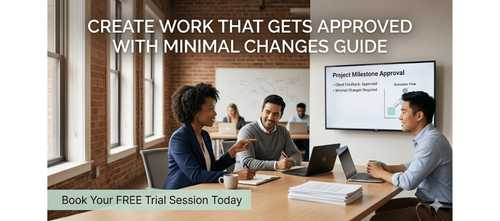

Creating Work That Gets Approved With Minimal Changes
Every working professional has experienced the frustration of submitting work only to receive it back covered in revisions, questions, and requests to rethink the approach. It is demoralising, time-consuming, and often avoidable. The problem is rarely a lack of talent; it is almost always a flawed process. Most professionals were never taught how to structure thinking for a specific audience, anticipate objections, or frame output so that decision-makers can say yes quickly and confidently.
This blog introduces a repeatable, practical system for producing work that lands well. By following these structured steps, you can build your professional reputation and free up your time for higher-value thinking.
Download these resources and apply them alongside your daily work for improved clarity, productivity, and professional growth. You can also book a free trial to gain expert guidance and enhance your communication, problem-solving, and decision-making skills. The materials are designed in a clear, structured format to help professionals learn efficiently and implement insights with confidence.
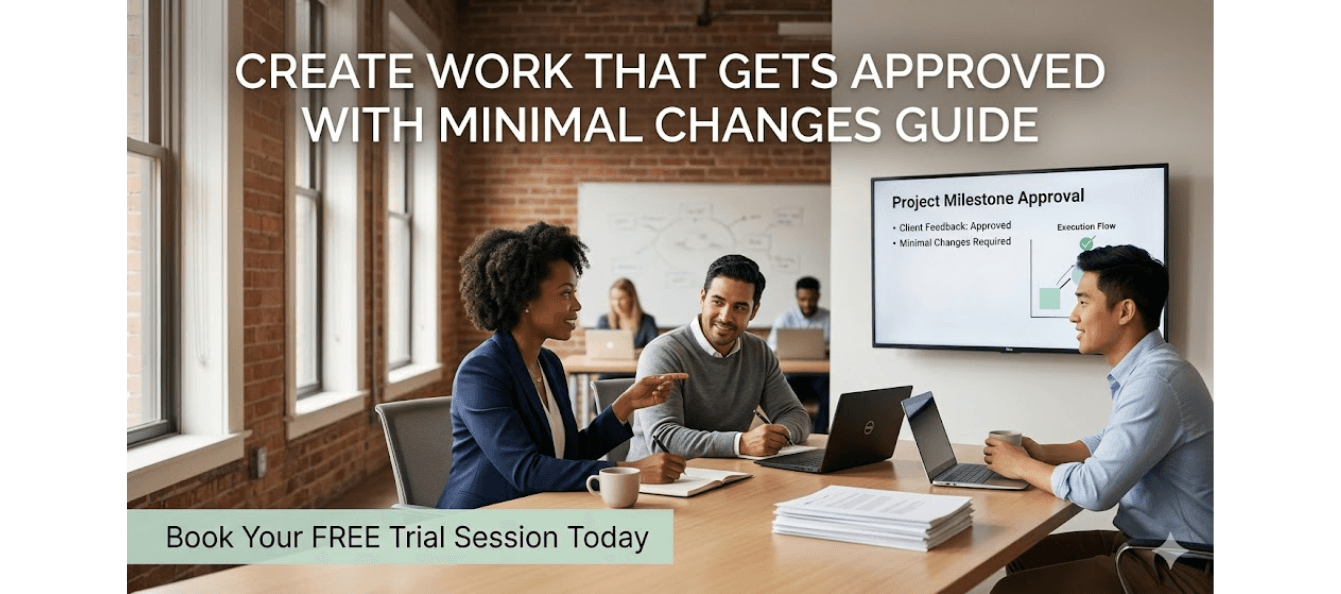
Who Is This Blog For?
- Career switchers looking to build professional credibility quickly
- Managers navigating complex stakeholder expectations
- Consultants delivering high-stakes, client-facing work
- Working professionals tired of endless revision cycles
Why This Topic Matters Today?
In a fast-paced work environment, misaligned stakeholder expectations and unclear briefs lead to lost credibility and repeated rework. When work is good but not decision-ready, it creates a bottleneck in the workflow. Stakeholders who receive overloaded information often get stuck reviewing instead of deciding, creating unnecessary delays. Mastering a repeatable process ensures your output is consistently sharp and ready for approval.
Core Concept or Framework Explained
The foundation of approval-ready work is Structured Thinking, which moves the focus from your own creative process to the needs of the listener. Instead of following the order of your research—background, analysis, then conclusion—you must use the Pyramid Principle.
This framework requires leading with your conclusion, supporting it with three concise pillars or arguments, and backing each with concrete evidence and data. This approach signals that you can think clearly under pressure and allows a busy approver to grasp your recommendation in under 60 seconds.
How This Blog and Guidebook Help You?
This guide provides a repeatable system to eliminate the most common reason work gets sent back: a lack of logical clarity. By applying these frameworks, you will:
- Surface implicit requirements before starting work
- Map the decision chain to identify the real audience
- Proactively address concerns before they are raised
- Design work for scannability so critical points are never missed
Step-by-Step Breakdown
Step 1: Decode the Brief Before You Touch the Work?
The biggest cause of rework is starting before you truly understand what is being asked. Use a Brief Decoder Worksheet to identify the core objective, the primary approver, and any non-negotiable constraints like format or data sources. Identifying exactly what decision the work needs to enable will save hours of revision.
Step 2: Map Your Stakeholders?
Not all approvers value the same things. Profile your reviewers using the Stakeholder Value Map:
- Strategists care about long-term impact and competitive advantage.
- Risk Managers care about compliance and mitigation.
- Pragmatists value speed, clarity, and actionability.
- Data-Driven stakeholders require evidence, methodology, and accuracy.
Step 3: Structure for Decision-Making?
Design your document to help people act rather than to exhaustively cover every detail. Lead with your recommendation upfront, followed by key supporting arguments and specific proof points. Supporting details should only be included if they directly influence the decision.
Step 4: Anticipate Objections Proactively?
Approval is often blocked by unanswered questions lingering in an approver's mind. Run a pre-mortem by imagining the work has been rejected and identifying why. Address concerns about approach, risks, ROI, and delivery timelines directly in your submission.
Step 5: Write for Scannability?
Approvers scan rather than read linearly. Use descriptive headings that communicate a complete idea and lead sentences that carry the main point. Apply the 30-second test: if someone cannot understand your core message by reading only headings and bold text, you must restructure.
Step 6: Perform a Strategic Pre-Submission Review?
High-performers review for strategic alignment rather than just errors. Step away for 30 minutes, then return and ask: would I feel confident acting on this in 90 seconds? Ensure the ask or next step is explicit and unambiguous.
Common Mistakes or Pitfalls to Avoid
- Burying the recommendation: If the point is hard to find, the approver loses confidence. Fix this by stating the recommendation in the first paragraph.
- Writing for yourself: Avoid showing your entire process; focus on the approver's decision needs.
- Ignoring implicit requirements: Use the Brief Decoder to find what the approver needs but hasn't said.
- No risk acknowledgement: If you don't name the risks, the approver feels you haven't thought it through.
- Dense paragraphs: Apply the 30-second scan test to ensure key points aren't missed.
How Should You Use This Guidebook Effectively?
This guide is most valuable when turned into a habit. For the next 30 days, pick one project and apply the system end-to-end. Start by sharing a completed Brief Decoder Worksheet with your stakeholder for confirmation—this quick step prevents misalignment from compounding. Use the Executive Summary Block for every report to ensure the situation, recommendation, evidence, and ask are always clear.
Key Takeaways
- Decode the brief before creating to catch unanswered questions early.
- Profile stakeholders to understand what they value and fear.
- Always lead with the conclusion using the Pyramid Principle.
- Proactively address top concerns through a pre-mortem.
- Ensure your document passes the 30-second scan test.
- End every piece of work with a specific, time-bound ask.
Your Next Step: Accelerate Your Career with PlanetSpark
Creating an impact-driven resume is not just about landing your next job—it’s about owning your professional story and presenting it with clarity, confidence, and credibility. When your resume clearly communicates value, results, and impact, opportunities follow naturally.
At PlanetSpark, we are committed to empowering working professionals with practical, outcome-focused resources that drive real career growth. From resume building and workplace communication to leadership presence and professional writing, our programs are designed to help you succeed in today’s fast-evolving job market.
Visit https://www.planetspark.in/resources to explore:
- Career and resume-building guides
- Workplace communication and professional writing resources
- Skill-development tools curated for working professionals
Want a deeper, hands-on experience?
You can also book a free trial session to learn more about PlanetSpark’s Working Professional Courses, designed to accelerate your career through personalised coaching, real-world practice, and expert guidance.
Your career deserves more than generic advice.
It deserves clarity, confidence, and measurable impact.
Personalized Communication Roadmaps
Record a video to get a AI generated personalized communication reports