
Bridge Role Strategy Guide for Seamless Career Transitions in 2026
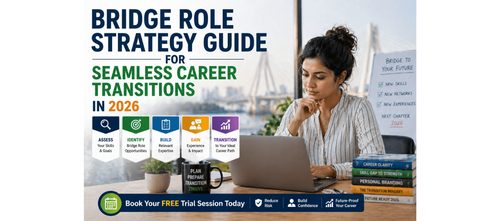

Formulating a Personal “Bridge Role” Strategy for Smoother Career Transitions: A Proven Career Strategy
Most career transition advice falls into two traps: you’re either told to take a leap of faith into a new career without preparation, or you’re advised to wait for the perfect moment that never arrives. Both approaches often fail to account for the practical needs of professionals who want to advance without risking their financial or professional stability. The answer? A Bridge Role.
A Bridge Role is a strategic intermediate position—a calculated stepping stone that closes the gap between where you are now and where you want to be. It lets you use your existing strengths as a launchpad while simultaneously closing the gap with targeted skill development. Think of it as building the bridge while still walking on solid ground.
Download these resources and apply them alongside your daily work for improved clarity, productivity, and professional growth. You can also book a free trial to gain expert guidance and enhance your communication, problem-solving, and decision-making skills. The materials are designed in a clear, structured format to help professionals learn efficiently and implement insights with confidence.
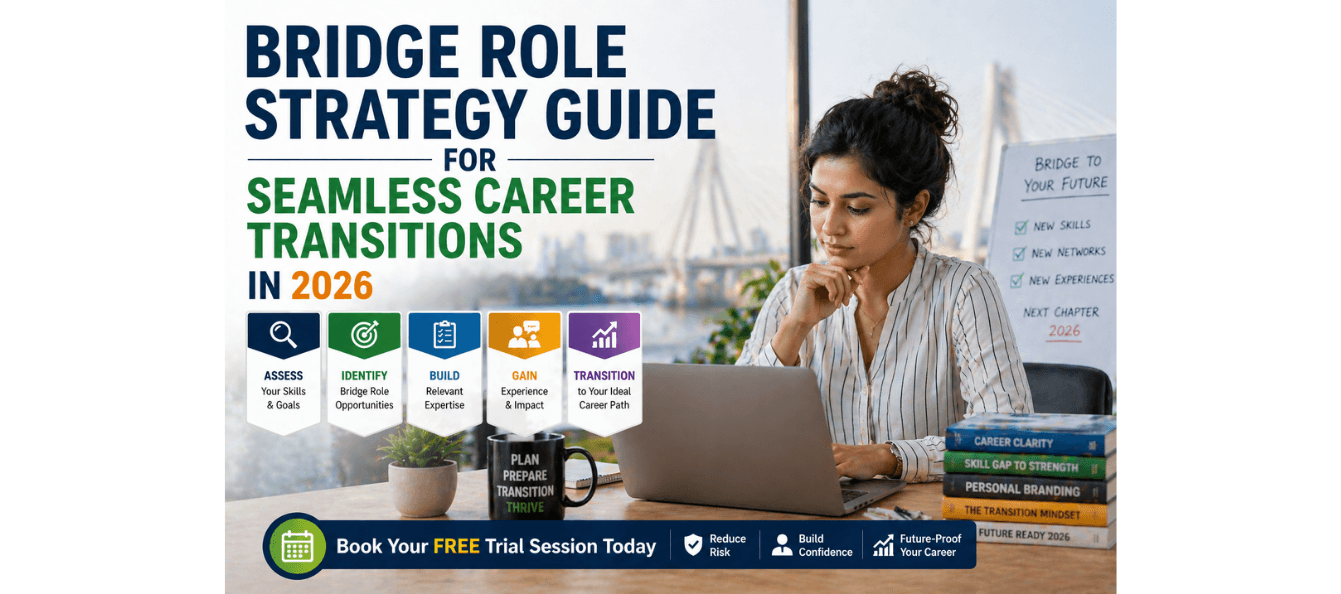
Who Is This Blog For?
This blog is for working professionals who want to strategically transition to a new role without losing ground in their current career. If you are:
- Looking to pivot into a new industry or function without starting over
- A seasoned professional who needs a structured way to transition into your target role
- Interested in building a bridge between your current job and future aspirations
- Eager to gain experience in your target field while maintaining financial and professional stability
This guide will give you the tools and framework to design your Bridge Role Strategy and take actionable steps toward your next career move.
Why This Topic Matters Today?
Career transitions are common, yet most people either go too fast and end up overwhelmed, or move too slowly and miss out on opportunities. With the rise of specialized roles and industries, transitioning successfully requires strategic planning and smart decision-making.
The concept of a Bridge Role addresses a key gap in traditional career advice—building experience in your target field while still maintaining your current job. The key insight is that you don’t have to give up everything to move forward; a well-chosen intermediate role can seamlessly integrate the new skills you need without losing sight of your existing professional value.
Core Concept
The Bridge Role Strategy is about transitioning intelligently, using a job that strategically prepares you for your future career while leveraging your current skills and experience. This framework is based on a six-step strategy:
1. Map where you actually are right now – Take stock of your current professional assets.
2. Define your target role with precision – Understand the specific requirements of the role you want.
3. Identify the gap – Conduct an honest gap analysis of your skills and network.
4. Design your Bridge Role – Choose a strategic role that leverages your strengths while closing the gap.
5. Activate your plan – Set a clear 30-60-90 day plan for success in your Bridge Role.
6. Know when you’re ready to cross – Define your exit criteria and move into your target role when the time is right.
By following this framework, you’ll not only position yourself for a smoother transition, but you’ll also build credibility and experience as you move toward your desired career.
How This Blog and Guidebook Help You?
This blog and guidebook will walk you through the process of designing and executing a Bridge Role Strategy. By focusing on actionable steps like mapping your assets, defining your target role, and closing your skill gaps, you will develop a personalized career strategy that puts you in control of your transition.
The core advantage of this approach is that it allows you to strategically layer new experience on top of your existing strengths, without needing to leave your current job. This guide equips you with a concrete plan to manage your career transition while reducing risks and uncertainty.
Step-by-Step Breakdown
1. Map Where You Actually Are Right Now
The first step in any career transition is understanding where you currently stand. This involves a detailed audit of your professional assets, including your hard skills, transferable capabilities, domain knowledge, and network.
- Hard Skills: List every technical tool, methodology, or software you have mastered.
- Transferable Skills: Document skills like project management, communication, and leadership that apply across industries.
- Domain Knowledge: Highlight your industry expertise, even if you’re transitioning to a new field.
- Network & Reputation: Evaluate your professional connections and online credibility (e.g., LinkedIn endorsements, client feedback).
2. Define Your Target Role with Precision
Vague goals lead to vague results. Therefore, it’s essential to research the roles that align with your aspirations. Start by gathering 15–20 real job descriptions for the role you're targeting. Analyze the job postings for common skills, certifications, and required experience.
Once you have a clear understanding of the role, you can compare this to your current professional assets. This comparison forms the foundation of your gap analysis and will inform your decision on which skills or experiences to focus on next.
3. Identify the Gap – Honestly and Strategically
Gap analysis is one of the most critical steps in the Bridge Role Strategy. Here, you’ll compare your current skills and experience with the requirements of your target role. The goal is to identify skill gaps, credibility gaps (lack of proof of experience), and network gaps (people you don’t know yet).
- Skill Gaps: These are technical or functional gaps that can be closed with training, courses, or side projects.
- Credibility Gaps: Even if you have the skills, you may lack the proof to demonstrate them to employers.
- Network Gaps: This involves identifying key people in your target field and actively working to expand your professional connections.
4. Design Your Bridge Role
Your Bridge Role should leverage your existing strengths and close the most critical gaps. When selecting this role, apply the following tests:
- The Leverage Test: Does the role utilize 60-70% of your existing skills?
- The Gap-Closing Test: Will this role provide exposure to the most critical gaps between you and your target role?
- The Network Test: Will this role introduce you to professionals and companies in your target field?
- The Signal Test: Does the role enhance your resume in a way that makes sense for your future career path?
5. Activate Your 30-60-90 Day Bridge Plan
Once you’ve secured your Bridge Role, it’s time to take action. A Bridge Role is not a passive waiting game; it requires intentional planning and execution.
- Days 1–30: Orient yourself to your new role and start signaling your transition publicly (e.g., updating LinkedIn).
- Days 31–60: Build skills and connect with people in your target field by volunteering for relevant projects and attending industry events.
- Days 61–90: Review your progress, adjust your gap analysis, and begin quietly exploring roles in your target field.
By following this structured plan, you ensure that each phase of your Bridge Role is intentional and focused on skill-building and networking.
6. Know When You’re Ready to Cross
It’s critical to know when to make the leap from your Bridge Role to your target role. Define your exit criteria in advance, such as:
- Skills Threshold: Demonstrating at least 75% of the competencies required for your target role.
- Network Threshold: Building 10–15 genuine relationships in your target field.
- Story Threshold: Being able to tell a clear, confident narrative about your transition.
- Market Signal Threshold: Getting feedback from job applications or interviews.
Once you meet these thresholds, you’re ready to make your move.
Common Mistakes
- Staying heads-down in execution only: Block time weekly for learning, networking, and portfolio work.
- Waiting to be "ready" before networking: Start networking from Day 1; early relationships will be critical when you're ready.
- Treating credentials as the finish line: Focus on demonstrable experience rather than just certifications.
- Not telling your story intentionally: Frame your Bridge Role as a deliberate choice to gain specific skills and experience.
How Should You Use This Guidebook Effectively?
This guidebook provides actionable steps to strategically design and activate your Bridge Role. The key is to start with precision, actively manage the transition process, and always evaluate your progress against the criteria you set.
Key Takeaways
- Audit your professional assets to assess where you stand.
- Define your target role with detailed research and precision.
- Conduct a strategic gap analysis and prioritize the gaps that matter most.
- Design a Bridge Role that leverages your strengths and fills the gaps.
- Activate your Bridge Role with a clear, structured 30-60-90 day plan.
- Know when you’re ready to transition by defining your exit criteria in advance.
Your Next Step: Accelerate Your Career with PlanetSpark
Creating an impact-driven resume is not just about landing your next job—it’s about owning your professional story and presenting it with clarity, confidence, and credibility. When your resume clearly communicates value, results, and impact, opportunities follow naturally.
At PlanetSpark, we are committed to empowering working professionals with practical, outcome-focused resources that drive real career growth. From resume building and workplace communication to leadership presence and professional writing, our programs are designed to help you succeed in today’s fast-evolving job market.
Visit https://www.planetspark.in/resources to explore:
- Career and resume-building guides
- Workplace communication and professional writing resources
- Skill-development tools curated for working professionals
Want a deeper, hands-on experience?
You can also book a free trial session to learn more about PlanetSpark’s Working Professional Courses, designed to accelerate your career through personalised coaching, real-world practice, and expert guidance.
Your career deserves more than generic advice.
It deserves clarity, confidence, and measurable impact.
Personalized Communication Roadmaps
Record a video to get a AI generated personalized communication reports