
Creating a Personal Dashboard for Life Management
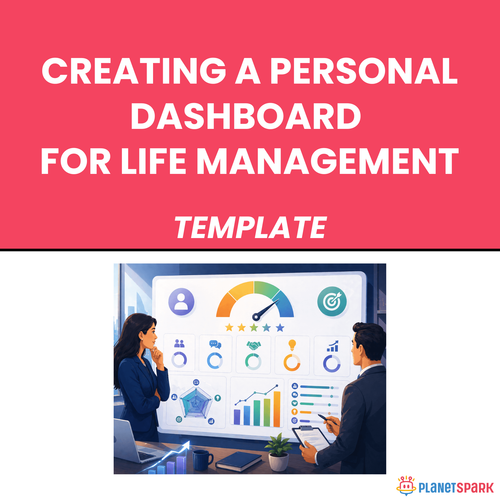

Build a Personal Dashboard for Life Management and Achieve Greater Clarity
In the fast-paced, ever-evolving professional world, it’s easy to get caught up in the demands of work, health, finances, and personal growth, all without having a system in place to manage it all effectively. Many professionals are excellent at managing projects and deadlines at work but struggle to apply the same level of structure to their own lives. As a result, they often feel overwhelmed and unproductive despite being constantly busy.
This is where a personal life dashboard comes in. By creating a customized, clear, and actionable dashboard, you can track your most important life domains—career, health, finances, relationships, personal growth, and more—giving you the structure and insight to achieve greater clarity, control, and momentum.
This blog walks you through the process of building a life management dashboard, a simple yet powerful tool that helps you take charge of your life and make consistent progress in the areas that matter most.
Download these resources and apply them alongside your daily work for improved clarity, productivity, and professional growth. You can also book a free trial to gain expert guidance and enhance your communication, problem-solving, and decision-making skills. The materials are designed in a clear, structured format to help professionals learn efficiently and implement insights with confidence.
Who Is This Blog For?
- Career switchers, consultants, and managers looking for a more organized approach to managing personal and professional responsibilities
- Working professionals feeling stretched thin by multiple competing priorities
- Anyone seeking a clearer, more intentional system to track their goals, habits, and progress in a holistic manner
- Individuals who want to move beyond feeling “busy” to feeling productive and aligned with their priorities
Why This Topic Matters Today?
In today’s world, it’s easy to feel busy but not productive. With the increasing demands on our time—work, personal projects, health goals, and more—it can seem impossible to stay on top of everything. A personal dashboard changes this by consolidating everything you need to track into one organized space, making it easier to visualize your priorities, see your progress, and ensure you're moving toward the right goals.
The personal dashboard system, borrowed from the world of business intelligence, gives you a bird’s-eye view of the key areas of your life. With this tool, you can replace mental clutter with visible clarity, bringing balance and intentionality back to your day-to-day routine.
Core Concept or Framework Explained
The personal dashboard framework is broken down into four main steps:
1. Define Your Life Domains: Identify the most important areas of your life that you want to actively manage (e.g., career, health, relationships, personal growth).
2. Set Goals & Metrics for Each Domain: For each life domain, define specific goals and measurable metrics that will allow you to track progress.
3. Build Your Dashboard Structure: Choose a tool (e.g., Notion, Google Sheets, or Airtable) and create a simple structure for your dashboard. The dashboard will include sections for each domain, goals, metrics, weekly actions, and a status tracker.
4. Populate Your Dashboard & Set Review Cadence: Complete your dashboard with the goals, actions, and progress indicators for each domain. Schedule a regular review cadence to assess and update your dashboard.
How This Blog and Guidebook Help You?
This blog provides a clear framework to help you build and sustain a personal life dashboard that works for you. By following this system, you’ll gain:
- Greater intentionality and focus on your personal and professional goals
- A measurable way to track progress across various life domains
- Clarity on your priorities and a method for continuously reviewing and adjusting your goals
- A tool that helps you avoid overwhelm by simplifying your focus areas into manageable tasks
Step-by-Step Breakdown
Step 1: Define Your Life Domains
Before you can build a dashboard, you need to decide what it will track. Most people try to manage everything at once and end up managing nothing well. The first step is to identify the key domains of your life—broad categories that, when thriving together, constitute a well-lived life. Some of the domains to consider include:
- Career & Work
- Health & Wellbeing
- Finances
- Relationships
- Personal Growth
- Rest & Recreation
For each domain, ask yourself, "If I looked back in 12 months and felt genuinely proud of my progress, which areas of life would have improved?" These will be your priority domains. Fewer domains tracked consistently are more effective than many domains tracked sporadically.
Step 2: Set Goals & Metrics for Each Domain
A dashboard without metrics is just a wish list. The power of a personal dashboard lies in its ability to show you, at a glance, whether you are moving in the right direction. For each domain, define what success looks like and how you will measure it. Use the SMART framework for goal-setting:
- S: Specific
- M: Measurable
- A: Achievable
- R: Relevant
- T: Time-bound
Each goal should have both a leading indicator (an action you control, like “exercise 3x per week”) and a lagging indicator (an outcome you measure, like “lost 4kg”). Track both indicators to monitor your progress effectively.
Step 3: Build Your Dashboard Structure
Now, it’s time to bring your dashboard to life. The structure you choose will determine how consistently you use it, so simplicity and clarity are key. Your dashboard should take no more than 10–15 minutes to update each week. Here’s how to set it up:
1. Choose Your Tool: Notion, Google Sheets, Airtable, or even a printed template. Pick the tool you already use.
2. Create Your Sections: Each section of the dashboard represents one of your life domains. Within each section, you will have:
- Your goal
- Your metrics
- Weekly action
- A simple status indicator (🟢On Track / 🟡At Risk / 🔴Off Track)
3. Add a Weekly Review Block: Reserve one section for your weekly check-in: What went well? What needs attention? What is your one priority for next week?
4. Set a Review Cadence: Schedule weekly micro-reviews (10 min), monthly deep-dives (30 min), and quarterly resets (1 hour). Consistency beats perfection.
Step 4: Populate Your Dashboard & Set Review Cadence
Now, complete your dashboard by entering the 5–7 life domains you’ve chosen and the corresponding 90-day goals, weekly actions, and status trackers for each. This should be completed in a focused session of 45–60 minutes. Set a regular review cadence:
- Weekly Micro-Review: Spend 10–15 minutes each week reviewing your dashboard, identifying what's on track and what needs attention.
- Monthly Deep-Dive: Dedicate 30 minutes each month to take a deeper look at your progress, reassessing your goals and strategies.
- Quarterly Reset: Every three months, spend an hour to completely reset your dashboard, ensuring that your goals still align with your current priorities.
Real-World Application – A Case Example: Priya’s Dashboard in Action
Priya, a marketing manager, felt overwhelmed by her responsibilities at work, fitness goals she kept abandoning, and a nagging sense that she wasn’t making meaningful progress. She created her personal dashboard over one weekend, committing to a 10-minute weekly review every Sunday evening. After 90 days, Priya secured two interviews for senior roles, ran her first 10km race, saved £1,400 toward her emergency fund, and felt more in control than ever before.
Key Takeaways
- Start with domains, not goals. Define 5–7 areas of your life that matter most to you.
- Set specific, measurable goals for each domain and track both leading and lagging indicators.
- Build your dashboard with simplicity in mind. It should only take 10–15 minutes to update each week.
- Regularly review your progress through weekly, monthly, and quarterly check-ins.
- Treat your dashboard as a living document, adapting as your priorities shift.
Your Next Step: Accelerate Your Career with PlanetSpark
Creating an impact-driven resume is not just about landing your next job—it’s about owning your professional story and presenting it with clarity, confidence, and credibility. When your resume clearly communicates value, results, and impact, opportunities follow naturally.
At PlanetSpark, we are committed to empowering working professionals with practical, outcome-focused resources that drive real career growth. From resume building and workplace communication to leadership presence and professional writing, our programs are designed to help you succeed in today’s fast-evolving job market.
Visit https://www.planetspark.in/resources to explore:
- Career and resume-building guides
- Workplace communication and professional writing resources
- Skill-development tools curated for working professionals
Want a deeper, hands-on experience?
You can also book a free trial session to learn more about PlanetSpark’s Working Professional Courses, designed to accelerate your career through personalized coaching, real-world practice, and expert guidance.
Your career deserves more than generic advice.
It deserves clarity, confidence, and measurable impact.
Personalized Communication Roadmaps
Record a video to get a AI generated personalized communication reports