
Creating Repeatable Execution Playbooks for Common Professional Tasks
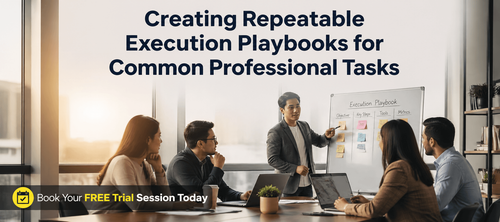

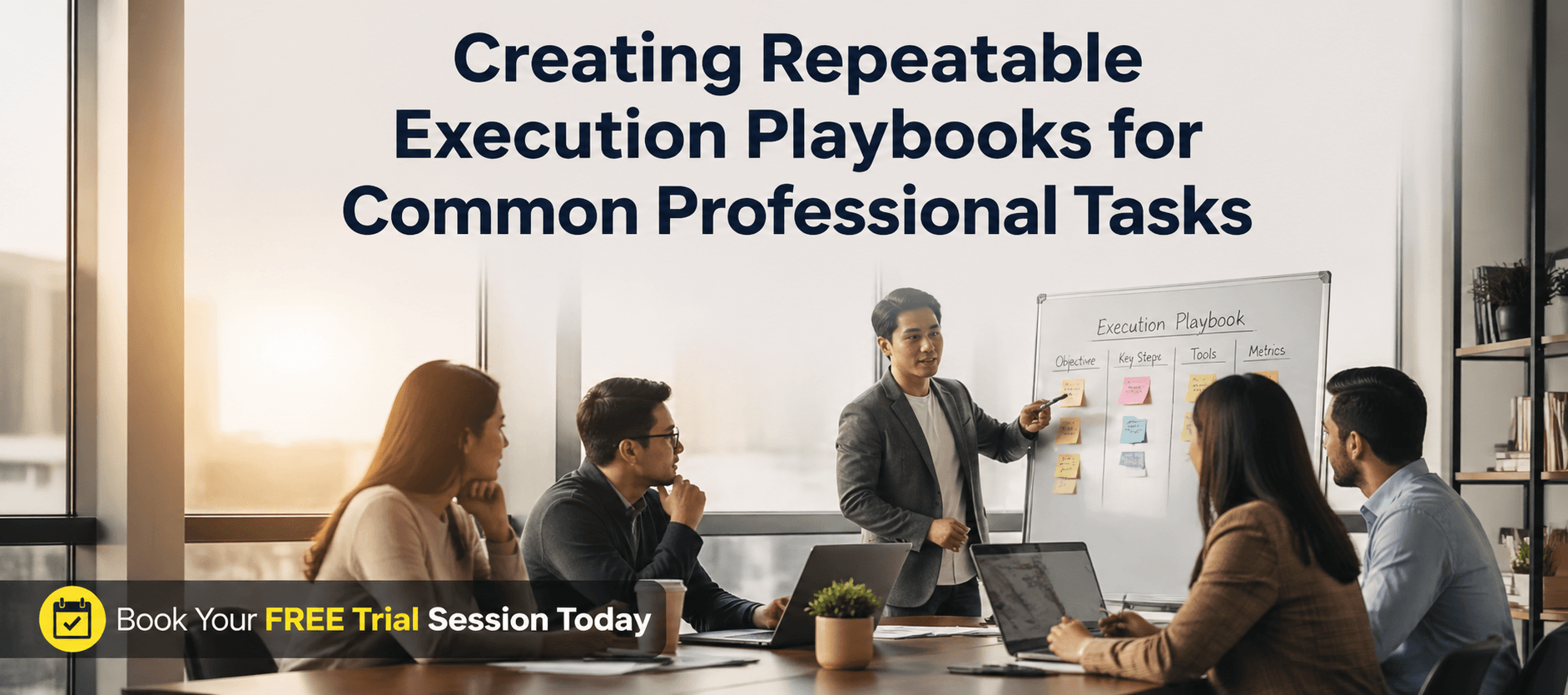
How to Create Repeatable Execution Playbooks for Common Tasks to Boost Your Professional Efficiency
In today’s fast-paced work environment, tasks can feel like they pile up without a clear, repeatable process. From onboarding clients to preparing reports, professionals often spend a significant amount of time figuring out how to execute tasks effectively. The real issue? A lack of structured execution leads to wasted time, mistakes, and inconsistencies.
This is where execution playbooks come in. A playbook offers you a clear, repeatable system for performing any common task in your professional life—no more guesswork or unnecessary delays. This guide will help you understand the importance of execution playbooks and provide actionable steps to create your own.
Download these resources and apply them alongside your daily work for improved clarity, productivity, and professional growth. You can also book a free trial to gain expert guidance and enhance your communication, problem-solving, and decision-making skills. The materials are designed in a clear, structured format to help professionals learn efficiently and implement insights with confidence.
Who Is This Blog For?
Job seekers preparing for interviews and networking opportunities
Career switchers exploring new industries or roles
Working professionals aiming to build stronger connections
Freelancers and consultants managing client communication
Managers and leaders focused on professional relationship-building.
Why This Topic Matters Today?
In the modern job market, professionals are expected to juggle multiple tasks while maintaining high performance. Yet, according to the resource, professionals who fail to systematize their work often find themselves bogged down by inefficiency and errors. Having a structured execution playbook is critical to overcoming these challenges.
Here’s why execution playbooks are essential:
They reduce repetitive mistakes and streamline workflows.
They help new team members onboard quickly by providing clarity.
They ensure that critical tasks are always completed on time and at a high standard.
With a solid playbook, you won’t just get through tasks—you’ll excel at them every single time.
Core Concept or Framework Explained
A well-built playbook follows a clear and effective framework designed to systematize tasks. The key principles include:
Structured Communication
Each playbook must include the following components:
Context: Provide a reference point for the task.
Personalisation: Tailor the playbook to specific interactions and scenarios.
Value Statement: Show the relevance of the task.
Clear Call to Action: What’s expected from the task executor.
Personalisation Over Generic Messaging
Adding a personal touch to your playbook can transform it from being a basic checklist into a powerful tool. This makes the process more engaging and increases task ownership among team members.
Timing and Relevance
Playbooks must be used at the right time to ensure maximum effectiveness. For instance:
Interview follow-ups should be done within 24 hours.
Application follow-ups should take place after 7–10 days.
Proposal follow-ups should be made 5–7 business days later.
How This Blog and Guidebook Help You?
This blog and the underlying guidebook will help you create execution playbooks that will:
Save time by offering ready-to-use templates.
Help you communicate tasks with precision.
Provide a framework for consistent execution and error prevention.
By following these steps, you can increase your efficiency, reduce execution errors, and improve overall career growth outcomes.
Step-by-Step Breakdown
Step 1: Define Your Playbook Scope
Before you start creating a playbook, you must first define its scope. Be specific—tasks like “Client Management” are too broad, but “Onboarding a New Retainer Client in the First 14 Days” is actionable and repeatable.
Consider the following:
What task do you frequently redo?
Where do handoffs break down?
What task causes the most friction in your workflow?
Step 2: Map Every Step
Once your scope is defined, break down the task into actionable steps. Each step should be:
Action-oriented with a clear result.
Specific to tools and platforms.
Time-bound.
For example, rather than saying “Prepare report,” you should write “Draft the executive summary using the approved template in Google Drive.”
Step 3: Build Your Quality Checkpoint System
A playbook is not just a to-do list; it’s a structured system. Include checkpoints at:
The pre-execution stage to ensure all inputs are ready.
The mid-task scan to check if you are on track.
The pre-delivery review to ensure the output meets the defined success criteria.
Step 4: Use the Playbook Template
Your playbook should follow a consistent, reusable template that includes:
Task name, trigger event, final output, time envelope.
Detailed steps broken into before, during, and after phases.
Checkpoints at critical stages.
This template can be adapted to any professional task, whether it’s onboarding a client or preparing a report.
Common Mistakes or Pitfalls to Avoid
Building a playbook is an effective strategy, but many professionals make these common mistakes:
Vague steps: Use clear action verbs like “Draft,” “Send,” or “Review.”
Lack of ownership: Assign a specific owner for each step to ensure accountability.
No time estimates: Without time frames, tasks can easily derail.
Assuming knowledge: Don’t assume the reader knows the context. Provide all the necessary information.
How Should You Use This Guidebook Effectively?
To maximize the impact of this guidebook:
Read through the entire guide for orientation.
Build your playbook one section at a time, starting with your highest-priority tasks.
Review and update your playbook regularly to keep it relevant.
Key Takeaways
Start with clearly defined tasks and precision at the scope stage.
Break down tasks into specific steps using the Before/During/After framework.
Build checkpoints at key stages to ensure quality.
Use a template that is easy to scan and update.
Assign ownership and make your playbook accessible.
Your Next Step: Accelerate Your Career with PlanetSpark
Creating an impact-driven resume is not just about landing your next job—it’s about owning your professional story and presenting it with clarity, confidence, and credibility. When your resume clearly communicates value, results, and impact, opportunities follow naturally.
At PlanetSpark, we are committed to empowering working professionals with practical, outcome-focused resources that drive real career growth. From resume building and workplace communication to leadership presence and professional writing, our programs are designed to help you succeed in today’s fast-evolving job market.
Visit https://www.planetspark.in/resources
to explore:
Career and resume-building guides
Workplace communication and professional writing resources
Skill-development tools curated for working professionals.
Want a deeper, hands-on experience?
You can also book a free trial session to learn more about PlanetSpark’s Working Professional Courses, designed to accelerate your career through personalised coaching, real-world practice, and expert guidance.
Your career deserves more than generic advice.
It deserves clarity, confidence, and measurable impact.
Start building that advantage today—with PlanetSpark.
Personalized Communication Roadmaps
Record a video to get a AI generated personalized communication reports