
Customer Success Leadership Resume Guide for Career Growth
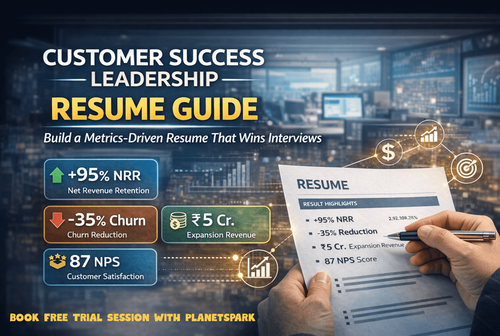

Customer Success Leadership Resume Guide: Build a Metrics-Driven Resume That Wins Interviews
In Customer Success, your impact is measurable—retention rates, churn reduction, expansion revenue, and customer satisfaction scores all tell a clear story. But if your resume fails to highlight these metrics within seconds, hiring managers will move on.
Book your free trial session today with Planetspark.
Download for more details or PDF file.
This is the reality of today’s hiring landscape. As outlined in this guide, Customer Success is a highly specialised function, and recruiters are scanning for very specific signals like NRR, NPS, onboarding success, and account growth. A generic resume that lacks these indicators simply does not make the cut.
If you want to stand out in Customer Success roles—from CSM to VP level—you need a resume that clearly communicates value, outcomes, and strategic impact. This guide will show you how to do exactly that.
Who Is This Blog For?
- Customer Success Managers aiming for their next role
- CS team leads, managers, and directors stepping into leadership positions
- Professionals transitioning from support or account management into CS
- CS professionals targeting enterprise or SaaS environments
- Customer Success Operations specialists and analysts
- Senior leaders preparing for Director or VP-level roles
Why This Topic Matters Today?
Customer Success has evolved into a revenue-critical function, especially in SaaS and subscription-based businesses. Retention and expansion are now as important as acquisition.
Hiring managers are not just evaluating experience—they are evaluating measurable business impact. According to the guide, recruiters expect to see:
- Net Revenue Retention (NRR) and churn metrics
- Customer onboarding and time-to-value improvements
- NPS, CSAT, and customer health scores
- Expansion and upsell contribution
- Strategic account management and executive engagement
Despite this, many professionals make critical mistakes:
- Listing responsibilities instead of outcomes
- Omitting key metrics entirely
- Using support-oriented language for strategic roles
- Failing to tailor resumes for different CS scenarios
In a competitive job market, these gaps can significantly reduce your chances of getting shortlisted.
Core Concept or Framework Explained
The core principle of this guide is clear: your resume must speak the language of Customer Success.
Customer Success is not a one-size-fits-all role. It spans multiple career paths and responsibilities, including:
- Individual contributor roles managing customer portfolios
- Team leadership roles overseeing CSMs
- Strategic roles focused on retention and expansion
- Operations roles managing systems and data
- Executive roles driving post-sale revenue strategy
To address this diversity, the guide provides 10 scenario-based templates tailored to real-world career situations.
These include:
- First CSM role transitioning from support
- Mid-market SaaS Customer Success Manager
- Enterprise Customer Success Manager
- CS Team Lead on a promotion track
- Director and VP of Customer Success
- Account Management to CS transition
- CS Operations specialist
- Career re-entry after a break
- Transition from CS to Product or RevOps
Each template is designed to align your resume with the expectations of hiring managers for that specific role.
How This Blog and Guidebook Help You?
This blog and the template pack help you transform your resume into a results-driven, recruiter-ready document.
Key benefits include:
- Clear guidance on showcasing retention and revenue impact
- Structured templates aligned with CS hiring expectations
- Focus on metrics that matter in Customer Success
- ATS-optimised formatting for better visibility
- Flexibility to adapt for different career scenarios
Instead of underselling your contributions, you learn how to present them as measurable business outcomes.
Step-by-Step Breakdown
1. Identify Your Customer Success Narrative
Start by defining your core contribution in Customer Success. This could include:
- Improving retention and reducing churn
- Driving expansion revenue
- Enhancing onboarding and product adoption
- Managing strategic customer relationships
Your resume should centre around these outcomes.
2. Choose the Right Template
The guide provides scenario-specific templates. Select one that aligns with your career stage.
For example:
- Transitioning from support aligns with the First CSM template
- Managing SaaS accounts aligns with the Mid-Market CSM template
- Leading teams aligns with the Enterprise Manager or Director template
Using the correct template ensures clarity and relevance.
3. Lead With Metrics
Metrics are the foundation of a strong CS resume. Examples include:
- Net Revenue Retention percentage
- Churn reduction rate
- Portfolio ARR managed
- NPS or CSAT scores
- Expansion revenue contribution
For example:
- Retained $X million ARR across enterprise accounts
- Reduced churn by X percent year-over-year
- Improved NPS from X to Y
These numbers make your impact tangible.
4. Structure Your Resume Strategically
Each template follows a consistent structure:
- Contact details and professional branding
- Summary highlighting key achievements
- Experience section focused on outcomes
- Skills and competencies aligned with CS
- Tools and technologies relevant to the role
This ensures readability and alignment with recruiter expectations.
5. Highlight Tools and Platforms
Customer Success relies heavily on tools. The guide emphasises including platforms such as:
- Gainsight, Totango, or ChurnZero
- Salesforce or HubSpot
- Analytics tools like Tableau or Looker
These tools signal your operational readiness.
6. Demonstrate Cross-Functional Impact
Customer Success is inherently cross-functional. Your resume should show collaboration with:
- Sales teams for expansion opportunities
- Product teams for feature improvements
- Marketing teams for customer engagement
- RevOps for data alignment
This demonstrates your ability to drive outcomes across the organisation.
7. Show Career Progression
For leadership roles, highlight:
- Team size managed
- ARR responsibility
- Strategic initiatives led
- Executive stakeholder engagement
This helps position you for senior roles.
8. Ensure ATS Compatibility
The templates are designed to be ATS-friendly. Best practices include:
- Using standard section headings
- Avoiding complex formatting
- Including keywords from job descriptions
- Keeping content concise and structured
This improves your chances of passing automated filters.
Common Mistakes or Pitfalls to Avoid
The guide highlights several common errors:
- Listing tasks instead of measurable outcomes
- Omitting key CS metrics like retention and churn
- Using generic or vague language
- Failing to highlight tools and platforms
- Applying the same resume to every role
Avoiding these mistakes can significantly improve your resume’s effectiveness.
How Should You Use This Guidebook Effectively?
To maximise the value of this resource, follow a structured approach:
- Select the template that matches your scenario
- Replace all placeholders with real data
- Focus on measurable outcomes and metrics
- Tailor your summary and skills for each role
- Align your resume with job description keywords
Suggested workflow:
- Spend 1–2 hours gathering metrics and achievements
- Spend 2–3 hours customising the template
- Spend 30–45 minutes refining language and structure
- Review for ATS compatibility before submission
As highlighted in the guide, most professionals can create a submission-ready resume in under 45 minutes when using these templates effectively.
Key Takeaways
- Customer Success resumes must highlight measurable business impact
- Metrics like NRR, churn, and ARR are critical signals
- Scenario-based templates help align your resume with specific roles
- Always lead with outcomes, not responsibilities
- Include tools and platforms to demonstrate expertise
- Tailor your resume for each job application
- Optimise for ATS to improve visibility
Your Next Step: Accelerate Your Career with PlanetSpark
Creating an impact-driven resume is not just about landing your next job—it’s about owning your professional story and presenting it with clarity, confidence, and credibility. When your resume clearly communicates value, results, and impact, opportunities follow naturally.
At PlanetSpark, we are committed to empowering working professionals with practical, outcome-focused resources that drive real career growth. From resume building and workplace communication to leadership presence and professional writing, our programs are designed to help you succeed in today’s fast-evolving job market.
Visit https://www.planetspark.in/resources to explore:
- Career and resume-building guides
- Workplace communication and professional writing resources
- Skill-development tools curated for working professionals
Want a deeper, hands-on experience?
You can also book a free trial session to learn more about PlanetSpark’s Working Professional Courses, designed to accelerate your career through personalised coaching, real-world practice, and expert guidance.
Your career deserves more than generic advice.
It deserves clarity, confidence, and measurable impact.
Personalized Communication Roadmaps
Record a video to get a AI generated personalized communication reports