
Daily Productivity Tracking: Build an Energy Dashboard That Works
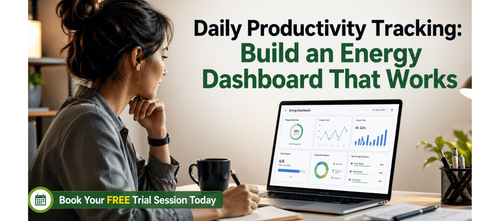

Energy Dashboard for Peak Daily Performance and Productivity
Most professionals believe that managing time is the key to productivity. They optimise calendars, schedule meetings efficiently, and try to squeeze more into every hour. Yet despite all this effort, they still experience energy crashes, inconsistent focus, and burnout before the week even ends.
If you’ve ever felt productive one day and completely drained the next despite having the same schedule, the issue is not time—it is energy. Your ability to perform, think clearly, and make decisions depends on how well you manage your energy across the day.
This is exactly where an Energy Dashboard becomes a game-changer. Instead of guessing how you feel or reacting to burnout, it gives you a structured system to track, understand, and optimise your daily performance.
Download these resources and apply them alongside your daily work for improved clarity, productivity, and professional growth. You can also book a free trial to gain expert guidance and enhance your communication, problem-solving, and decision-making skills. The materials are designed in a clear, structured format to help professionals learn efficiently and implement insights with confidence.
Who Is This Blog For?
- Working professionals struggling with burnout or inconsistent productivity
- Managers and leaders handling high-pressure responsibilities
- Career switchers trying to optimise performance in new roles
- Freelancers and consultants managing multiple priorities
- Early to mid-career professionals aiming for sustainable growth
Why This Topic Matters Today?
In today’s demanding work environment, being busy is often mistaken for being productive. However, the resource highlights a critical reality: two professionals with identical schedules can deliver vastly different results based on how they manage their energy.
Modern challenges include:
- Frequent energy crashes during the day
- Mental fatigue caused by constant decision-making
- Emotional exhaustion from workplace interactions
- Lack of alignment between work and personal goals
These issues lead to reduced performance, poor decision-making, and long-term burnout. Managing energy—not just time—has become a critical professional skill.
Core Concept or Framework Explained
The Energy Dashboard framework is built on a powerful idea: your performance is driven by four interconnected energy dimensions.
Physical Energy
This is your foundation. It is influenced by sleep, nutrition, hydration, and movement. When physical energy is low, every other aspect of performance suffers.
Mental Energy
This represents your ability to focus, think clearly, and solve problems. It is limited throughout the day and gets depleted with distractions and decision fatigue.
Emotional Energy
This determines how well you handle stress, interact with others, and maintain resilience. Emotional drains are often invisible but highly impactful.
Purposive Energy
This reflects your sense of meaning and motivation. When your work aligns with your values, your energy naturally increases. When it doesn’t, even simple tasks feel exhausting.
The key insight is simple: you cannot optimise performance by tracking a single “tired vs energetic” metric. You must track all four dimensions to understand what is truly driving or draining your productivity.
How This Blog and Guidebook Help You?
This blog and the underlying resource provide a complete system to:
- Identify your natural energy patterns
- Track daily performance across multiple dimensions
- Make smarter decisions about when to do what
- Recover proactively instead of reacting to burnout
- Build sustainable high-performance habits
Instead of working harder, you start working smarter—aligned with your natural energy rhythms.
Step-by-Step Breakdown
Step 1: Understand the Four Energy Dimensions
Before tracking anything, you need clarity on what you are measuring.
Start observing:
- Your sleep quality and physical state
- Your ability to focus and make decisions
- Your emotional reactions during the day
- Your motivation and sense of purpose
This awareness alone begins to shift how you approach your workday.
Step 2: Run a 7-Day Energy Baseline Audit
You cannot optimise what you don’t measure. The baseline audit helps you identify patterns.
What to do:
- Track all four energy dimensions daily on a scale of 1 to 10
- Record scores in the morning, midday, and evening
- Identify your peak two-hour performance window
- Note your biggest energy drain each day
- Identify what gives you the most energy
The goal is not perfection—it is pattern recognition. Within a week, you will start noticing clear trends.
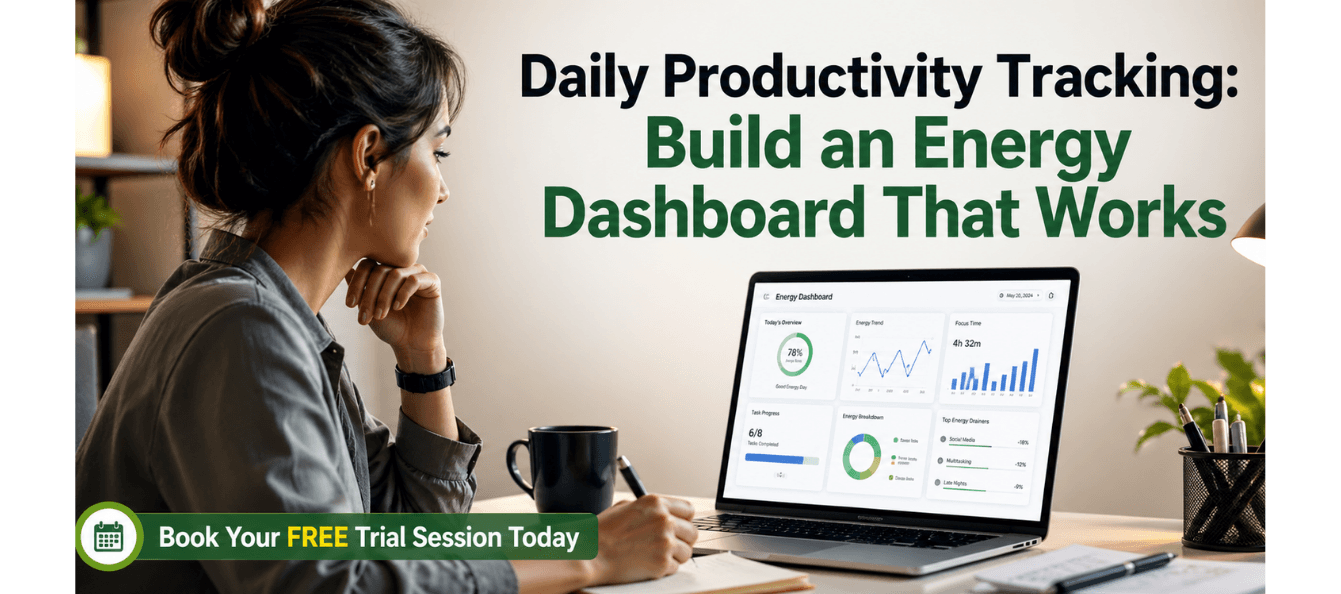
Step 3: Build Your Daily Energy Dashboard
Once you understand your patterns, create a daily tracking system.
Morning Launch (5 minutes)
- Score your energy across all four dimensions
- Identify your top priority for the day
- Block your peak performance window
- Plan a recovery break
Midday Checkpoint (3 minutes)
- Re-evaluate your energy levels
- Identify which dimension has dropped the most
- Adjust your schedule accordingly
- Take a short physical or mental break
This simple system transforms your day from reactive to intentional.
Step 4: Use the Daily Dashboard Worksheet
Your dashboard becomes your daily performance tool.
Track:
- Morning, midday, and evening scores
- Total energy score out of 40
- Key patterns and observations
Daily reflection questions:
- What gave me the most energy today?
- What drained me unexpectedly?
- Did I protect my peak performance window?
- What will I change tomorrow?
This reflection helps convert data into actionable insights.
Step 5: Apply Micro-Recovery Rituals
Tracking alone is not enough—you need recovery strategies.
Physical recovery
- Short walks or movement breaks
- Hydration resets
- Breathing exercises
Mental recovery
- Non-screen breaks
- Brain dump exercises
- Single-task focus
Emotional recovery
- Naming your emotions
- Practicing gratitude
- Taking short breaks after stressful interactions
These small actions create measurable improvements in performance.
Step 6: Learn from Real-World Application
The resource highlights a case study of a marketing manager who transformed her productivity.
Key insights:
- Identifying peak mental hours helped prioritise deep work
- Recognising emotional drains improved recovery strategies
- Aligning tasks with energy levels significantly improved output
Her performance improved not by reducing workload, but by aligning work with energy.
Step 7: Apply Advanced Energy Optimisation Techniques
Once you master the basics, you can optimise further.
Energy stacking
- Combine multiple recovery techniques for stronger impact
Task sequencing
- Align high-focus tasks with peak energy periods
Recovery sandwiching
- Add recovery before and after draining activities
Peak protection
- Protect your most productive hours from interruptions
These strategies help sustain high performance consistently.
Step 8: Follow a 30-Day Transformation Plan
Week 1
- Focus on tracking and awareness
Week 2
- Build consistency in using the dashboard
Week 3
- Identify patterns and introduce recovery strategies
Week 4
- Optimise your schedule based on insights
This structured approach ensures long-term results.
Common Mistakes or Pitfalls to Avoid
Many professionals fail because of avoidable mistakes:
- Tracking energy only at the end of the day
- Treating all fatigue as physical exhaustion
- Ignoring emotional and purposive energy
- Not acting on the data collected
- Failing to protect peak performance windows
A better approach:
- Track consistently throughout the day
- Differentiate between energy types
- Take immediate action when energy dips
- Use data to guide decisions
How Should You Use This Guidebook Effectively?
To maximise results, follow this workflow:
- Start with the 7-day baseline audit
- Build your daily dashboard system
- Track consistently with minimal time investment
- Apply recovery rituals immediately when needed
- Review weekly patterns and adjust your schedule
Time investment:
- 5 minutes in the morning
- 3 minutes at midday
- 5 minutes in the evening
Consistency matters more than perfection. Even simple tracking can lead to powerful insights over time.
Key Takeaways
- Energy management is more important than time management
- Performance depends on physical, mental, emotional, and purposive energy
- Tracking your energy reveals powerful productivity patterns
- Small recovery rituals can significantly improve performance
- Aligning tasks with energy levels boosts efficiency
- Protecting peak performance windows is critical
- Consistency in tracking leads to long-term transformation
Your Next Step: Accelerate Your Career with PlanetSpark
Creating an impact-driven resume is not just about landing your next job—it’s about owning your professional story and presenting it with clarity, confidence, and credibility. When your resume clearly communicates value, results, and impact, opportunities follow naturally.
At PlanetSpark, we are committed to empowering working professionals with practical, outcome-focused resources that drive real career growth. From resume building and workplace communication to leadership presence and professional writing, our programs are designed to help you succeed in today’s fast-evolving job market.
Visit https://www.planetspark.in/resources to explore:
- Career and resume-building guides
- Workplace communication and professional writing resources
- Skill-development tools curated for working professionals
Want a deeper, hands-on experience?
You can also book a free trial session to learn more about PlanetSpark’s Working Professional Courses, designed to accelerate your career through personalised coaching, real-world practice, and expert guidance.
Your career deserves more than generic advice.
It deserves clarity, confidence, and measurable impact.
Start building that advantage today—with PlanetSpark.
Personalized Communication Roadmaps
Record a video to get a AI generated personalized communication reports