
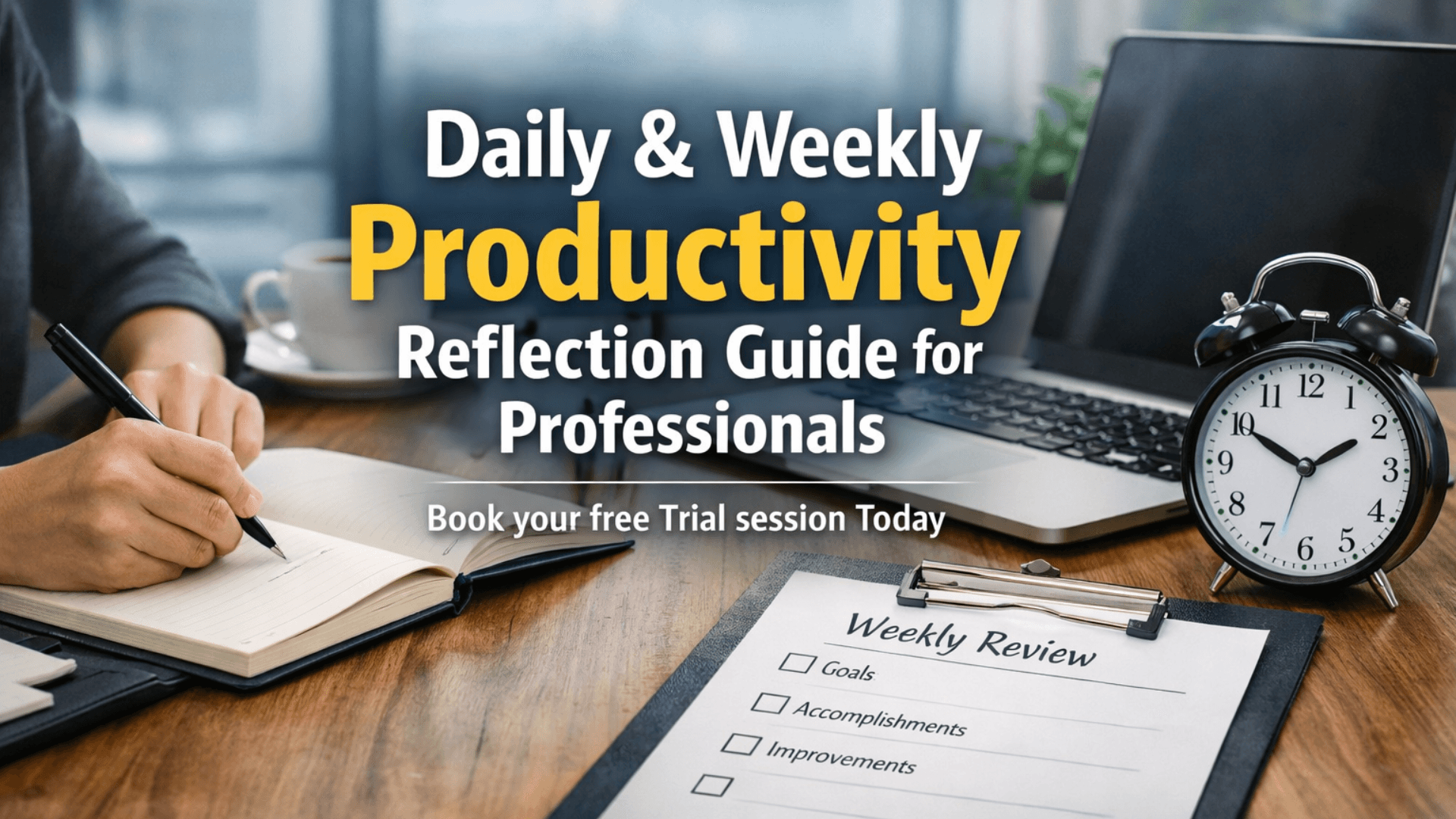
Daily & Weekly Productivity Reflection Guide for Professionals
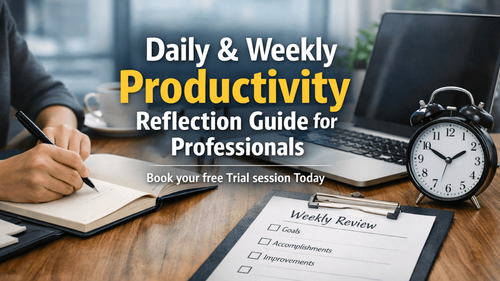

Weekly Review System for Professionals: Boost Productivity and Career Growth
You’re busy all day—meetings, emails, deadlines, constant task-switching. Yet at the end of the week, it often feels like you haven’t made meaningful progress. This is one of the most common frustrations among working professionals today: high effort, low clarity, and inconsistent results.
The problem isn’t a lack of productivity tools or hard work. It’s the absence of structured reflection. Without pausing to evaluate how you work, you repeat the same patterns—both good and bad—without awareness.
This is where a structured productivity reflection system becomes powerful. The Productivity Reflection Worksheet introduces a practical, time-efficient framework that helps professionals convert daily effort into measurable progress, better decisions, and long-term career growth.
Instead of simply moving from one task to another, this system encourages you to step back and ask critical questions: What actually moved the needle today? Where did time get lost? Which tasks created real value, and which ones only created the illusion of productivity? By consistently answering these questions, you begin to identify patterns that either support or hinder your performance.
Over time, this reflection process builds clarity, focus, and intentionality into your work. You stop reacting to your schedule and start designing it. Small, consistent improvements compound into stronger execution, better prioritization, and more meaningful outcomes—turning busy days into productive weeks and sustained professional growth.
Book your free trial session today with Planetspark.
Download for more details or PDF file.
Who Is This Blog For?
- Working professionals with 0–15 years of experience seeking structured productivity improvement
- Managers and team leads aiming to enhance strategic thinking and decision-making
- Career switchers looking to build disciplined work habits
- Consultants and knowledge workers managing multiple priorities
- Professionals feeling overwhelmed, reactive, or stuck in busy but unproductive routines
Why This Topic Matters Today?
Modern work environments are fast-paced, distraction-heavy, and constantly demanding attention. Most professionals spend their days reacting rather than leading their time intentionally.
The guide highlights a critical insight: professionals lose approximately 20–30 percent of their productive capacity to tasks that are urgent but not important. This hidden inefficiency accumulates over weeks and months, leading to stagnation despite consistent effort.
In a world where performance, outcomes, and strategic thinking define career growth, reflection is no longer optional. It is a competitive advantage. Professionals who consistently evaluate and adjust their work patterns outperform those who simply stay busy.
Core Concept or Framework Explained
At the heart of this system is the REFLECT model—a structured productivity architecture designed to turn daily work into continuous improvement.
Each letter represents a critical dimension of high-performance thinking:
- Review: What actually happened during your day or week
- Energy: When you performed at your best and worst
- Focus: Whether your time aligned with your priorities
- Leverage: Which actions created the most meaningful impact
- Eliminate: What wasted time or energy
- Commit: The one change you will implement next
- Track: Measuring progress over time
This model is cyclical, meaning every reflection feeds the next improvement cycle. Over time, it reveals patterns in your behaviour, energy levels, and decision-making, enabling smarter and more intentional work.
How This Blog and Guidebook Help You?
This blog and the accompanying worksheet help you:
- Identify where your time is actually going
- Understand your personal energy patterns and productivity rhythms
- Reduce time spent on low-value tasks
- Improve focus on high-impact work
- Build a consistent system for daily and weekly self-improvement
The outcome is not just better productivity—but better control, clarity, and confidence in how you work.
Step-by-Step Breakdown
Step 1: Start with a Daily Check-In
The daily check-in is a simple but powerful habit that takes only 5–10 minutes at the end of your workday. It is designed to help you understand—not judge—your performance.
You answer four core questions:
- What is one meaningful win from today?
- When did you feel most energised and most drained?
- What did you plan but fail to complete—and why?
- What is one change you will make tomorrow?
This process builds awareness. Over time, these small reflections create a clear picture of how you actually work.
Step 2: Follow the Daily Reflection Rules
To make the daily check-in effective, the guide outlines three essential rules:
- Be specific: Clearly name tasks, times, and outcomes
- Avoid self-criticism: Focus on observation, not judgment
- Prioritise consistency: A short daily habit is more powerful than occasional deep reflection
These rules ensure that reflection leads to actionable insights instead of vague observations.
Step 3: Use the Weekly Review for Strategic Clarity
While daily check-ins are tactical, the weekly review provides a strategic perspective. It takes 15–20 minutes and helps you evaluate your overall direction.
The weekly review includes five phases:
- Look Back: Identify patterns across the week
- Measure Impact: Assess whether your work moved key goals forward
- Name the Blockers: Recognise recurring challenges
- Celebrate Progress: Acknowledge wins and momentum
- Set the Anchor: Define one key priority for the next week
This step ensures that your effort aligns with your long-term goals.
Step 4: Conduct an Energy and Focus Audit
One of the most valuable insights from reflection is understanding your energy patterns.
The guide introduces the concept of aligning high-priority work with high-energy periods. For example:
- Schedule deep work like strategy or problem-solving during peak energy hours
- Reserve low-energy periods for administrative or routine tasks
Many professionals unknowingly do the opposite—wasting their most productive hours on emails or meetings. Correcting this can significantly improve output quality without increasing work hours.
Step 5: Use Reflection Prompts for Deeper Insight
To go beyond surface-level thinking, the worksheet provides a library of 30 reflection questions across three categories:
- Energy and focus
- Priorities and goals
- Growth and patterns
These prompts help you uncover hidden inefficiencies, behavioural patterns, and opportunities for improvement that standard reflection might miss.
Step 6: Apply the Productivity Audit Checklist
At the end of each week, the checklist provides a structured way to evaluate your performance across four areas:
- Time and prioritisation
- Energy and wellbeing
- Focus and flow
- Reflection and learning
By scoring yourself honestly, you gain a clear snapshot of how effectively you worked—and where you need to improve.
Step 7: Learn from Real-World Application
The guide shares a practical case study of a marketing manager who transformed her productivity in 21 days using this system.
Initially overwhelmed and reactive, she identified key issues through daily reflection:
- Scheduling complex work during low-energy periods
- Spending excessive time on low-value communication
By adjusting her schedule and batching tasks, she significantly improved her productivity, strategic contribution, and overall work satisfaction—all without increasing working hours.
This demonstrates that productivity is not about doing more—it is about working smarter with better awareness.
Common Mistakes or Pitfalls to Avoid
Many professionals struggle with reflection due to avoidable mistakes:
- Reflecting only after bad days instead of making it a daily habit
- Writing vague observations that lead to no action
- Ignoring wins and focusing only on problems
- Failing to act on insights from previous reflections
- Treating weekly reviews as optional
- Measuring productivity by activity instead of impact
Avoiding these mistakes ensures that reflection becomes a high-impact habit rather than an occasional exercise.
How Should You Use This Guidebook Effectively?
To get the best results, follow this practical approach:
- Read the full framework once to understand the system
- Start with daily check-ins using the four core prompts
- Schedule a fixed weekly review session
- Use prompts and checklists as needed for deeper analysis
- Commit to a 21-day consistency challenge
Time investment is minimal:
- 5–10 minutes daily
- 15–20 minutes weekly
This small investment compounds into significant productivity gains over time.
Key Takeaways
- Reflection is a performance tool that converts effort into meaningful progress
- Daily check-ins build awareness and consistency
- Weekly reviews ensure alignment with long-term goals
- Energy management is critical for high-quality output
- Small, consistent improvements create long-term impact
- Productivity is not about doing more—it is about doing what matters
Your Next Step: Accelerate Your Career with PlanetSpark
Creating an impact-driven resume is not just about landing your next job—it’s about owning your professional story and presenting it with clarity, confidence, and credibility. When your resume clearly communicates value, results, and impact, opportunities follow naturally.
At PlanetSpark, we are committed to empowering working professionals with practical, outcome-focused resources that drive real career growth. From resume building and workplace communication to leadership presence and professional writing, our programs are designed to help you succeed in today’s fast-evolving job market.
Visit https://www.planetspark.in/resources to explore:
- Career and resume-building guides
- Workplace communication and professional writing resources
- Skill-development tools curated for working professionals
Want a deeper, hands-on experience?
You can also book a free trial session to learn more about PlanetSpark’s Working Professional Courses, designed to accelerate your career through personalised coaching, real-world practice, and expert guidance.
Your career deserves more than generic advice.
It deserves clarity, confidence, and measurable impact.
Start building that advantage today—with PlanetSpark.
Personalized Communication Roadmaps
Record a video to get a AI generated personalized communication reports