
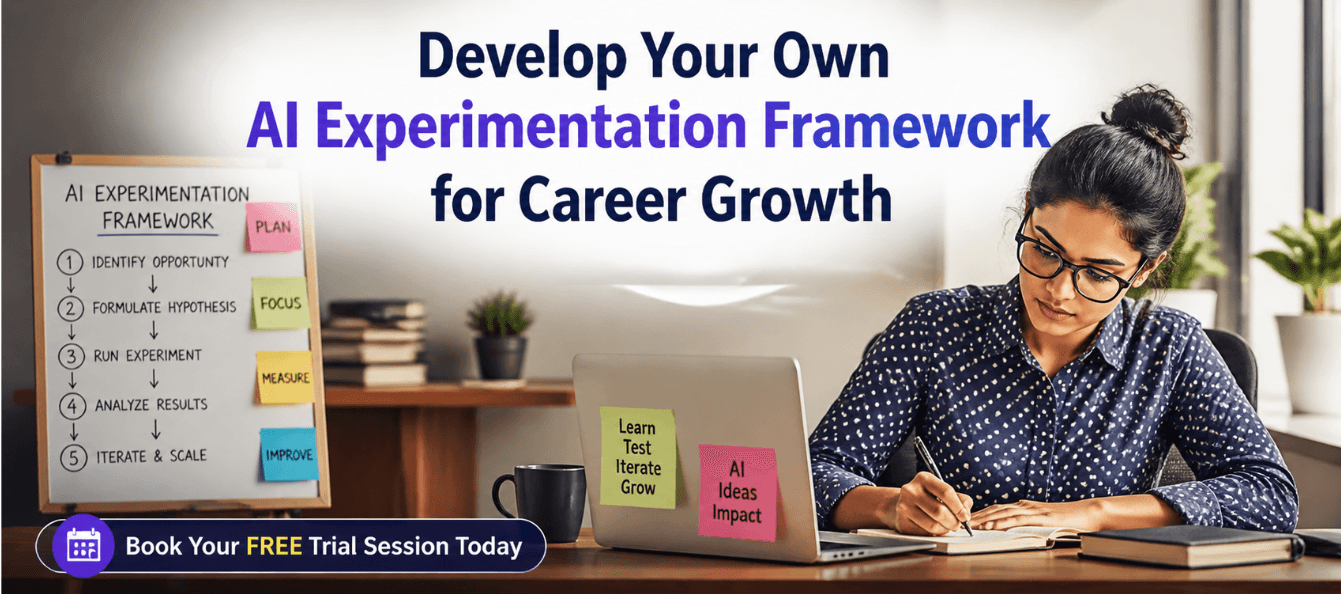
Develop Your Own AI Experimentation Framework for Career Growth
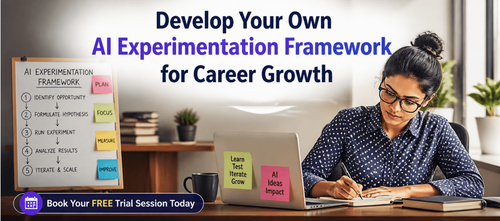

Commanding AI Experimentation: How to Build a Personal AI Framework for Career Growth
As AI tools like ChatGPT, Copilot, and Midjourney become staples in the workplace, many professionals find themselves frustrated by underwhelming results. They try the tools, but the outcomes often fall short of expectations. Instead of abandoning AI tools, the real solution lies in adopting a structured approach to experimentation. This blog will introduce you to a proven framework for personal AI experimentation that will help you move from AI curiosity to confident, career-defining application in 30 days or less.
Download these resources and apply them alongside your daily work for improved clarity, productivity, and professional growth. You can also book a free trial to gain expert guidance and enhance your communication, problem-solving, and decision-making skills. The materials are designed in a clear, structured format to help professionals learn efficiently and implement insights with confidence.
Who Is This Blog For?
This blog is for professionals looking to harness AI tools more effectively and strategically. It’s especially beneficial for:
- Professionals new to AI tools who want a structured approach to experimentation
- Busy professionals looking to improve efficiency without overwhelming themselves with multiple tools
- Managers, consultants, marketers, and creators who want to integrate AI into their workflow without losing quality
- Anyone interested in scaling their AI knowledge and applications, gradually moving from curiosity to career impact
Why This Topic Matters Today?
AI has already changed how we work, but for many professionals, it’s still a tool they struggle to use effectively. The real problem isn’t the technology itself but the lack of a structured approach to integrating AI into daily tasks. Experimenting with AI tools without a clear framework often leads to wasted time, underwhelming results, and frustration. As a result, AI can feel like a burden rather than an advantage.
The conversation has moved beyond “should I use AI?” to “how do I use AI effectively?” Building a personal AI experimentation framework allows you to make intentional decisions, track your progress, and apply AI to your role in a way that genuinely drives career growth.
Core Concept or Framework Explained
The core framework for personal AI experimentation is the 4-Phase AI Experimentation Model. This model gives professionals a structured, repeatable approach to AI integration that ensures consistent, measurable results.
1. Discover: Understand the requirements of your project and identify key objectives. This phase focuses on auditing your current tasks and pinpointing where AI can provide the most value.
2. Design: Create detailed blueprints and mockups for the AI solution. This step involves defining the specific tools and processes that will be used to implement AI in your workflow.
3. Develop: Build and code the AI solution based on the approved design. In this phase, you begin to use the selected AI tools for the tasks you've outlined.
4. Deploy: Launch the solution and start using it in your daily tasks. This phase involves applying the AI tools to real-world scenarios and observing the results.
This 4-phase cycle is not a one-time process but something that should be repeated. Each cycle refines your approach and makes you more adept at using AI in your professional environment. Starting with one experiment at a time, you’ll gradually scale your AI usage as you gather insights and improve your strategies.
How This Blog and Guidebook Help You?
This blog and the accompanying playbook help you:
- Move beyond curiosity and become a proactive AI practitioner.
- Create structured, repeatable AI experiments to measure their effectiveness.
- Apply AI tools with specific, targeted goals that align with your professional objectives.
- Build an AI experimentation library that saves time and increases efficiency.
- Track your progress and refine your AI strategies over time for career impact.
Step-by-Step Breakdown
Step 1: Audit Your Work — Find Your AI Opportunities
Before diving into AI experimentation, you need to identify which tasks will benefit the most from AI integration. Start by auditing your current workload. Spend 15 minutes listing everything you did last week and categorize each task as:
- Repetitive & Structured: Tasks you do the same way every time, such as reporting or meeting summaries. These tasks have the highest AI ROI.
- Creative & Variable: Tasks that require judgment, creativity, or stakeholder input, like proposals or presentations. These tasks have medium AI ROI.
- Relational & Nuanced: Tasks involving communication or decision-making, such as negotiations or mentoring. These tasks have low AI ROI.
Once you categorize your tasks, prioritize the repetitive tasks as your first AI experiment subjects.
Step 2: Design & Run Your First AI Experiment
Once you’ve identified a task to experiment with, create a clear plan. Define the experiment's question, such as: “Can AI draft my weekly status report in under 5 minutes, at acceptable quality?” Then, choose one tool (e.g., ChatGPT or Copilot) and run the experiment for 5 consecutive days. Track time saved, output quality, and confidence level daily. This disciplined, one-task-at-a-time approach ensures you isolate variables effectively.
Step 3: Reflect, Document, and Scale What Works
The most crucial phase in your AI experimentation cycle is reflection. After completing an experiment, evaluate the outcome using a structured review. Answer these five questions:
1. What actually happened? Document time saved, quality of output, and any feedback you received.
2. What surprised me? Note where AI exceeded expectations or caused frustration.
3. What would I do differently? Reflect on what you could improve in terms of prompt structure, tool choice, or task selection.
4. Should I scale, maintain, or drop this? Decide whether the experiment was worth expanding or adjusting for future use.
5. What’s the next step? Plan your next experiment based on what you learned.
This structured reflection turns experiments into actionable insights and builds a personalized AI playbook for your career.
Step 4: Scaling Your AI Experiments
As you run more experiments, you’ll accumulate valuable data. After 4–6 experiments, you’ll begin to see patterns that allow you to build your personal AI stack — a curated set of 3–5 AI-assisted workflows that genuinely accelerate your work. With a well-documented playbook, you can scale these workflows across your tasks, saving time and boosting productivity.
Common Mistakes or Pitfalls to Avoid
There are several mistakes to avoid during AI experimentation:
- Vague Task Selection: Starting with too broad or unfocused tasks can lead to unclear results. Focus on one task at a time and define your success criteria upfront.
- Overuse of AI Tools: Experimenting with multiple AI tools simultaneously can make it hard to isolate the factors that influence the results. Stick to one tool per experiment.
- Skipping Reflection: Failing to reflect on your experiments means you miss out on key insights that could improve future experiments. Always document and evaluate results thoroughly.
- Relying on AI Without Verification: AI-generated content can sometimes be inaccurate. Always verify the facts and results before using AI outputs professionally.
How Should You Use This Guidebook Effectively?
To maximize the effectiveness of this guidebook:
1. Understand the Framework: Start by familiarizing yourself with the 4-phase AI experimentation model and the common mistakes professionals make when using AI tools.
2. Run your first experiment: Follow the 4-phase framework to conduct a time-boxed, focused experiment.
3. Reflect and refine: Use the post-experiment review to assess results and adjust your approach.
4. Scale your AI usage: As you refine your experiments, begin scaling successful AI workflows into your regular routine.
Key Takeaways
- AI experimentation is a skill that anyone can develop with the right framework.
- Focus on one task at a time for the clearest insights.
- Use structured reflection to turn experimentation into career capital.
- Build a personal AI playbook to streamline your workflow and save time.
- Scaling AI workflows starts with documenting successes and iterating on them.
Your Next Step: Accelerate Your Career with PlanetSpark
Creating an impact-driven resume is not just about landing your next job—it’s about owning your professional story and presenting it with clarity, confidence, and credibility. When your resume clearly communicates value, results, and impact, opportunities follow naturally.
At PlanetSpark, we are committed to empowering working professionals with practical, outcome-focused resources that drive real career growth. From resume building and workplace communication to leadership presence and professional writing, our programs are designed to help you succeed in today’s fast-evolving job market.
Visit https://www.planetspark.in/resources to explore:
- Career and resume-building guides
- Workplace communication and professional writing resources
- Skill-development tools curated for working professionals
Want a deeper, hands-on experience?
You can also book a free trial session to learn more about PlanetSpark’s Working Professional Courses, designed to accelerate your career through personalised coaching, real-world practice, and expert guidance.
Your career deserves more than generic advice.
It deserves clarity, confidence, and measurable impact.
Personalized Communication Roadmaps
Record a video to get a AI generated personalized communication reports