
Developing a Communication Flywheel for Continuous Improvement
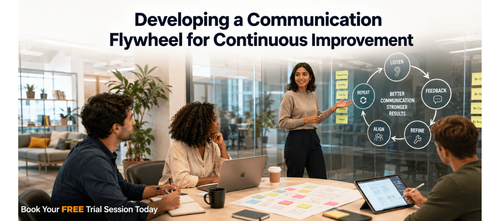

How to Build a Personal Communication Flywheel for Continuous Improvement
In today’s fast-paced professional world, communication is not a skill that is learned and perfected once. It is an ongoing process—one that requires continuous reflection, adaptation, and improvement. For professionals aiming to achieve lasting impact and influence, mastering the art of communication requires building a system for continuous growth. That system is what we call the Personal Communication Flywheel.
Just like a mechanical flywheel, your personal communication flywheel builds momentum through consistent, deliberate practice. Every conversation, presentation, or email becomes an opportunity to spin the wheel faster and make your communication more effective. This toolkit is designed to help you build that flywheel, transforming your communication from reactive to strategic, and ensuring you continuously improve your communication impact.
Download these resources and apply them alongside your daily work for improved clarity, productivity, and professional growth. You can also book a free trial to gain expert guidance and enhance your communication, problem-solving, and decision-making skills. The materials are designed in a clear, structured format to help professionals learn efficiently and implement insights with confidence.
Who Is This Blog For?
- Career switchers looking to refine their communication skills
- Mid-career professionals and managers aiming to increase their communication effectiveness
- Consultants and entrepreneurs who want to communicate with clarity and confidence
- Anyone eager to develop habits for continuous improvement in communication
Why This Topic Matters Today?
Most professionals treat communication as a skill to be solved with a quick fix: one course, one book, or one workshop. But communication is not a one-time problem—it is an evolving skill that compounds over time. Professionals who communicate most powerfully aren’t necessarily the most naturally gifted—they are the ones who have built a system for ongoing improvement. The key to powerful communication is not just frequency, but intention.
The Personal Communication Flywheel offers a system for continuous improvement. The goal isn’t to achieve perfection in communication but to make incremental improvements over time that build momentum and increase influence.
Core Concept or Framework Explained
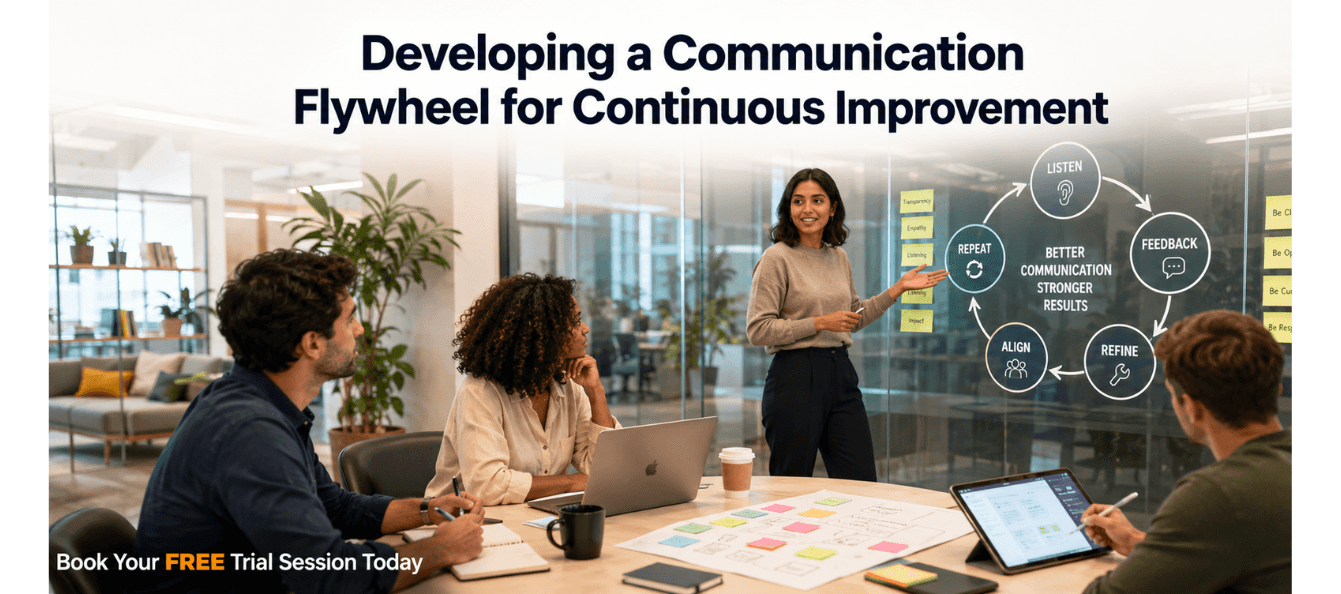
The Personal Communication Flywheel is built on four interconnected phases that form a continuous cycle of improvement:
1. Awareness: Recognizing where you currently stand in terms of communication and identifying your strengths and areas for growth.
2. Application: Practicing communication skills with intention, not just repetition, to actively improve.
3. Reflection: Reviewing what worked, what didn’t, and why, to extract valuable lessons and adjust.
4. Mastery: Integrating refined skills into your default communication style, ensuring consistency under pressure.
This cyclical model ensures that you’re always evolving your communication habits, adapting to new challenges, and becoming more effective with every cycle.
How This Blog and Guidebook Help You?
This blog and its accompanying toolkit provide you with the necessary tools to build your communication flywheel. You’ll learn:
- How to assess your current communication habits and where to focus your energy for improvement
- How to apply the PREP–DO–REVIEW micro-cycle to structure your communications with purpose
- How to adapt your communication style to different contexts and audiences
- The importance of consistent reflection and how to track progress to accelerate growth
- Real-world examples and exercises to develop communication mastery
Step-by-Step Breakdown
Step 1: Awareness – Know Where You Actually Stand
The flywheel begins with self-awareness. Many professionals overestimate their communication effectiveness because they measure intent rather than impact. This phase helps you close that gap by offering tools to assess your communication contexts and identify your default communication patterns.
- Audit Your Communication Contexts: List your most common communication situations (e.g., team meetings, client calls, presentations) and rate your confidence and effectiveness. This helps you identify where to focus your improvement efforts.
- Identify Your Default Patterns: Recognize your habitual communication tendencies. Are you over-explaining, avoiding directness, or speaking at length without clarity? Understanding your defaults helps you address them.
- Seek Structured Feedback: Ask colleagues for specific feedback, like "What’s one thing I could do differently to communicate more clearly with you?" This feedback is invaluable for pinpointing areas for growth.
Step 2: Application – Practise With Purpose, Not Just Frequency
Simply repeating communication tasks isn’t enough. You must practice with purpose. The PREP–DO–REVIEW micro-cycle helps you approach each communication opportunity with intention:
1. PREP: Define your outcome. What do you want your audience to think, feel, or do after this interaction?
2. DO: Execute with your outcome in mind. Stay focused on your purpose, and redirect if you drift.
3. REVIEW: Reflect within 30 minutes. What worked well? What would you change? Quick reflection helps you improve each time.
Step 3: Reflection & Mastery – Close the Loop, Raise the Bar
Reflection is the engine of continuous improvement. Every interaction provides data on what worked and what didn’t, and how you can improve moving forward.
- Weekly Reflection Ritual: Set aside 10 minutes every week to review your communication. Use prompts like "What communication moment am I most proud of?" and "What pattern am I noticing across the week?"
- Track Your Progress: Keep a communication log where you record key events, skills practiced, and your observations. Over time, this log provides insights into your growth.
- Defining Mastery: Mastery doesn’t mean perfection. It means consistency—knowing that your communication is clear, adaptable, and effective, even under pressure.
Step 4: Real-World Application – From Reactive to Strategic
Real-world examples, such as Priya's story from the toolkit, demonstrate how the Personal Communication Flywheel can transform communication from reactive to strategic. Priya, a project manager, used the flywheel model to improve her visibility with senior leadership. By practicing the headline-first structure in meetings and proactively providing updates, she gained more influence and received a promotion.
Common Mistakes or Pitfalls to Avoid
- Practising Only in High-Stakes Situations: Use everyday interactions to test and refine your communication strategies.
- Seeking Feedback from Only Affirming Colleagues: Find someone who will challenge you to improve, not just agree with you.
- Trying to Improve Everything at Once: Focus on one area of improvement at a time to ensure deeper learning.
- Skipping Reflection: Even when busy, don’t skip the reflection ritual. This is key to sustained improvement.
How Should You Use This Guidebook Effectively?
To make the most of this toolkit:
- Start by completing the Communication Habits Audit Checklist to identify your current communication habits.
- Apply the PREP–DO–REVIEW cycle to every significant communication event.
- Use the weekly reflection prompts to assess your progress and focus on specific areas for growth.
- Keep track of your progress with the self-assessment sheet and adjust your focus every 30 days.
Key Takeaways
- Communication is a continuous process—there’s no "end" to improvement, only cycles of growth
- The Personal Communication Flywheel model offers a system for building momentum through awareness, application, reflection, and mastery
- Deliberate practice with intentionality and feedback accelerates your communication growth
- Consistent reflection and tracking ensure that your communication improves, even in high-pressure situations
Your Next Step: Accelerate Your Career with PlanetSpark
Creating an impact-driven resume is not just about landing your next job—it’s about owning your professional story and presenting it with clarity, confidence, and credibility. When your resume clearly communicates value, results, and impact, opportunities follow naturally.
At PlanetSpark, we are committed to empowering working professionals with practical, outcome-focused resources that drive real career growth. From resume building and workplace communication to leadership presence and professional writing, our programs are designed to help you succeed in today’s fast-evolving job market.
Visit https://www.planetspark.in/resources to explore:
- Career and resume-building guides
- Workplace communication and professional writing resources
- Skill-development tools curated for working professionals
Want a deeper, hands-on experience?
You can also book a free trial session to learn more about PlanetSpark’s Working Professional Courses, designed to accelerate your career through personalised coaching, real-world practice, and expert guidance.
Your career deserves more than generic advice.
It deserves clarity, confidence, and measurable impact.
Personalized Communication Roadmaps
Record a video to get a AI generated personalized communication reports