
Developing a Winning Resume Narrative for Career Success
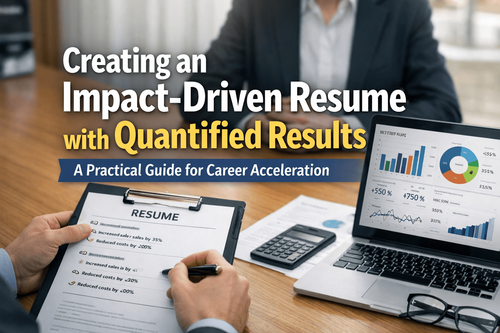

Creating an Impact-Driven Resume with Quantified Results: A Practical Guide for Career Acceleration
Most professionals assume their resumes fail because they lack the right skills or experience. In reality, the problem is often much simpler: the resume does not communicate impact clearly.
Recruiters typically spend only six to eight seconds scanning a resume before deciding whether to continue reading. In that brief window, they are not analysing every detail. They are searching for signals of value. They want to understand what you achieved, how you delivered results, and why your experience matters to their organisation.
Unfortunately, many resumes read like job descriptions. They list responsibilities, outline tasks, and repeat phrases such as “responsible for managing projects” or “worked with cross-functional teams.” These statements provide activity but not evidence of results.
This is where an impact-driven resume becomes powerful. Instead of describing duties, it demonstrates outcomes. It shows how your work increased revenue, improved efficiency, solved problems, or created measurable value.
The PlanetSpark Resume Narrative Development Worksheet introduces a structured method for turning everyday work into a compelling career story that hiring managers immediately understand. :contentReference[oaicite:0]{index=0}
In this blog, we translate that worksheet into a practical, step-by-step guide that helps working professionals build resumes that attract attention, pass ATS systems, and convert applications into interviews. Book your free trial session today with Planetspark.
Download for more details or PDF file.
Who Is This Blog For?
This blog and the accompanying guidebook
are designed for:
- Working professionals with 0–15 years of experience seeking career acceleration
- Career changers repositioning their experience for a new industry or function
- Consultants and specialists building a stronger professional brand
- Managers aiming to demonstrate leadership and measurable impact
- Job seekers struggling to translate strong experience into interview opportunities.
Why This Topic Matters Today?
Hiring has changed dramatically over the last decade. Most organisations now use Applicant Tracking Systems and quick resume scans to filter candidates before a recruiter ever reads the document in detail.
This means your resume must communicate value almost instantly.
According to the worksheet, recruiters often spend only six to seven seconds on an initial resume scan, making clarity and narrative coherence critical. :contentReference[oaicite:1]{index=1}
In that short timeframe, recruiters are subconsciously asking one core question:
Why is this candidate the right person for this role right now?
A resume that simply lists responsibilities rarely answers that question. But a resume built around clear outcomes and measurable results immediately signals credibility.
Impact-driven resumes stand out because they:
- Show evidence of value rather than vague claims
- Connect experience into a coherent career story
- Demonstrate how past work translates into future success
In a competitive job market, the professionals who communicate their impact clearly are often the ones who secure interview.
Core Concept or Framework Explained:
At the heart of an impact-driven resume is a simple but powerful shift in thinking.
Instead of asking “What were my responsibilities?” the question becomes:
“What changed because of my work?”
The PlanetSpark worksheet describes this idea as building a resume narrative — the invisible thread that connects your experience, skills, and ambitions into a persuasive story. :contentReference[oaicite:2]{index=2}
This narrative ensures that every section of your resume contributes to a clear message about who you are as a professional and the value you create.
The framework behind this approach combines two complementary structures.
First is the STAR-Q method used for writing achievement statements:
- Situation: The context or challenge you faced
- Task: Your responsibility or objective
- Action: The steps you took
- Result: The outcome you delivered
- Quantification: The measurable impact of that outcome
Second is the CAR structure used for storytelling:
- Context: What problem existed or what situation you entered
- Action: What you specifically did
- Result: What changed because of your actions
Together, these frameworks help professionals convert everyday work into clear, persuasive proof points.
Instead of saying:
“Managed marketing campaigns”
You might write:
“Led a content-driven marketing campaign that increased organic traffic by 60 percent and generated ₹1.2Cr in qualified pipeline.”
The difference is clarity, credibility, and measurable value.
How This Blog and Guidebook Help You?
This blog and the PlanetSpark worksheet work together to help professionals transform their resumes from simple work histories into strategic career documents.
By applying the frameworks outlined in the guide, you will learn how to:
- Identify meaningful achievements hidden within everyday responsibilities
- Discover metrics that demonstrate real business impact
- Structure your resume so recruiters notice key accomplishments instantly
- Build a compelling professional narrative that connects your experience logically
- Adapt your resume efficiently for different roles and industries
The ultimate outcome is a resume that communicates value in seconds and positions you as a high-impact professional.
Step-by-Step Breakdown:
Step 1: Audit Your Career Experience
The first step in building an impact-driven resume is conducting a thorough audit of your professional experience.
Many professionals underestimate their achievements because they remember job titles and tasks but overlook the outcomes they delivered.
The worksheet recommends capturing everything before filtering or editing. :contentReference[oaicite:3]{index=3}
Start by documenting:
- Roles you have held and their key responsibilities
- Projects you led or significantly contributed to
- Problems you solved or inefficiencies you eliminated
- Teams you mentored, managed, or influenced
- Processes, systems, or tools you introduced
- Recognition, awards, or feedback received
Even informal contributions such as mentoring colleagues or improving team workflows can demonstrate leadership potential.
Once your experiences are documented, begin identifying patterns. Recurring themes often reveal your strongest capabilities and the value you consistently deliver.
Step 2: Define Your Professional Identity Statement
A powerful resume begins with a clear professional identity.
The worksheet calls this your Professional Identity Statement (PIS). :contentReference[oaicite:4]{index=4}
Unlike a job title, this statement describes the value you create.
An effective identity statement answers three key questions:
- Who you are as a professional
- What you help organisations achieve
- What impact your work creates
A helpful formula is:
“I am a [professional archetype] who helps [type of organisation or team] achieve [specific outcome] by [distinct capability]. Over [X] years, I have [evidence of impact].”
For example:
“I am a data-driven operations leader who helps fast-growing technology companies streamline delivery systems and improve execution. Over eight years, I have reduced operational delays by 35 percent while leading cross-functional teams across three markets.”
Strong identity statements are:
- Specific rather than generic
- Evidence-backed rather than descriptive
- Forward-looking rather than focused only on past roles
This statement becomes the anchor of your resume narrative.
Step 3: Build Your Proof Point Library
Claims alone are not persuasive. Evidence is what convinces hiring managers.
The worksheet recommends building a Proof Point Library consisting of three to five powerful career stories.
Each story should demonstrate measurable impact using the CAR framework.
For example:
Context
Your company was struggling with declining customer retention.
Action
You redesigned the onboarding process and introduced customer success tracking dashboards.
Result
Customer retention increased by 22 percent within six months.
These proof points serve multiple purposes:
- They become resume bullet points
- They provide examples during interviews
- They reinforce your professional identity statement
Maintaining a library of strong proof points ensures that you always have credible evidence to support your claims.
Step 4: Craft Your Narrative Arc for Each Role
A generic resume describes your career history. A targeted resume tells a story with a destination.
The worksheet introduces a three-phase exercise to align your resume with a specific job opportunity. :contentReference[oaicite:6]{index=6}
Part A: Decode the Role
Carefully analyse the job description.
Read it multiple times to identify:
- Explicit requirements
- Implicit priorities
- Language patterns used by the employer
Identify the three most important outcomes the role must deliver.
Part B: Map Your Evidence
From your Proof Point Library, select the achievements that best demonstrate your ability to deliver those outcomes.
One strong story can often support multiple requirements.
Part C: Write a Targeted Summary
Adapt your professional identity statement to reflect the specific role.
Incorporate language from the job description naturally and include your strongest proof point within the summary.
This targeted approach dramatically increases the relevance of your resume to both recruiters and ATS systems.
Step 5: Translate Your Narrative Into Resume Language
Once your narrative is defined, the final step is translating it into strong resume language.
Every bullet point on your resume must earn its place by doing one of three things:
- Establishing who you are
- Demonstrating what you can do
- Proving the value you create
The worksheet recommends starting each bullet with a strong action verb and ending with a measurable outcome.
Examples of strong verbs include:
- Grew, scaled, generated, expanded
- Streamlined, automated, optimised, redesigned
- Led, mentored, mobilised, negotiated
- Architected, spearheaded, launched, transformed
Strong resume bullet:
“Led a six-person analytics team that delivered insights reducing churn by 18 percent.”
Weak resume bullet:
“Responsible for managing analytics team.”
The difference is clarity, ownership, and measurable results.
Common Mistakes or Pitfalls to Avoid:
Even experienced professionals make mistakes that weaken their resumes.
Common issues include:
- Listing responsibilities instead of achievements
- Using vague language such as “worked on” or “helped with”
- Writing overly long summaries without measurable proof
- Including irrelevant experience that distracts from your narrative
- Submitting the same generic resume for every job application
Another common mistake is listing skills without demonstrating them.
Instead of saying you are “skilled in strategy,” show evidence through a result-driven achievement.
Impact always speaks louder than description.
How Should You Use This Guidebook Effectively?
To get the best results from the worksheet, follow a structured workflow.
Start by reading the entire guide to understand the overall framework.
Then apply each section step by step.
A recommended process is:
- Spend 30–45 minutes auditing your career experiences
- Write your Professional Identity Statement
- Develop three to five strong proof points
- Tailor your resume narrative to your target role
- Review your resume using the narrative quality checklist
The worksheet is designed to be a living document that evolves with your career. As you achieve new milestones or change roles, update your proof points and identity statement accordingly.
Key Takeaways:
- Recruiters spend only a few seconds scanning resumes, so impact must be visible immediately
- Strong resumes focus on measurable results rather than responsibilities
- A Professional Identity Statement clarifies your value as a professional
- Proof points structured with CAR or STAR-Q frameworks build credibility
- Targeting your resume for each role dramatically improves relevance
- Strong action verbs and quantified outcomes make achievements memorable.
Your Next Step: Accelerate Your Career with PlanetSpark
Creating an impact-driven resume is not just about landing your next job—it’s about owning your professional story and presenting it with clarity, confidence, and credibility. When your resume clearly communicates value, results, and impact, opportunities follow naturally.
At PlanetSpark, we are committed to empowering working professionals with practical, outcome-focused resources that drive real career growth. From resume building and workplace communication to leadership presence and professional writing, our programs are designed to help you succeed in today’s fast-evolving job market.
Visit https://www.planetspark.in/resources to explore:
- Career and resume-building guides
- Workplace communication and professional writing resources
- Skill-development tools curated for working professionals.
Want a deeper, hands-on experience?
You can also book a free trial session to learn more about PlanetSpark’s Working Professional Courses, designed to accelerate your career through personalised coaching, real-world practice, and expert guidance.
Your career deserves more than generic advice.
It deserves clarity, confidence, and measurable impact.
Start building that advantage today—with PlanetSpark.
Personalized Communication Roadmaps
Record a video to get a AI generated personalized communication reports