
Emotional Bias in Decisions: Identify and Improve Judgment
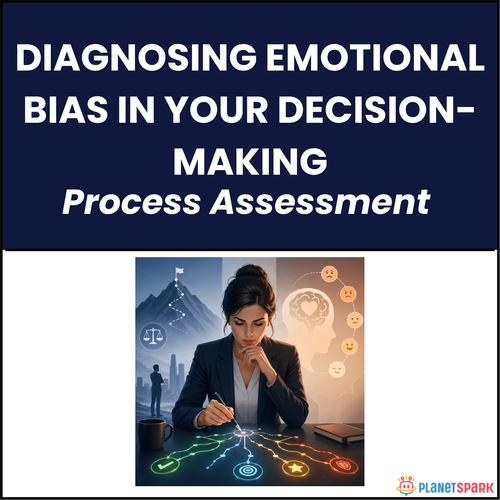

How to Identify and Overcome Emotional Bias in Decision-Making: A Practical Framework for Clearer, Smarter Choices
You’ve likely made a decision that felt right in the moment—only to question it later. Maybe you backed an idea too quickly, resisted a new opportunity without clear reason, or stuck with a failing plan longer than you should have.
This is not a lack of intelligence or experience. It is emotional bias at work.
In high-pressure professional environments, decisions are rarely made in purely logical conditions. Emotions—such as excitement, fear, familiarity, or discomfort—quietly influence how we interpret data, evaluate options, and take action.
The challenge is not to eliminate emotions. It is to recognise when they are influencing your thinking—and ensure they do not distort your decisions.
This blog is based on a structured assessment framework that helps professionals diagnose, understand, and neutralise emotional bias using a repeatable five-phase process that improves clarity and decision quality over time.

Download these resources and apply them alongside your daily work for improved clarity, productivity, and professional growth. You can also book a free trial to gain expert guidance and enhance your communication, problem-solving, and decision-making skills. The materials are designed in a clear, structured format to help professionals learn efficiently and implement insights with confidence.
Who Is This Blog For?
- Working professionals making high-stakes decisions regularly
- Managers and leaders responsible for hiring and strategy
- Consultants evaluating complex client recommendations
- Career switchers navigating uncertain opportunities
- Individuals struggling with overthinking, hesitation, or bias-driven choices
Why This Topic Matters Today?
In modern workplaces, decisions are fast, frequent, and highly visible.
As highlighted in the guide (page 2), emotional bias is not a flaw—it is a natural human tendency. However, when left unchecked, it leads to:
- Poor hiring and promotion decisions
- Misaligned career choices
- Biased evaluations of people and ideas
- Missed opportunities due to fear or comfort
The guide also emphasises a critical reality:
Professionals who succeed are not those who eliminate emotions—but those who learn to recognise and manage them effectively.
Core Concept or Framework Explained
The guide introduces a Five-Phase Emotional Bias Diagnosis Framework (page 3), designed as a repeatable decision-making process:
- Recognise: Identify emotional triggers
- Name Bias: Label the cognitive pattern
- Audit Evidence: Separate facts from assumptions
- Reframe: View the decision from multiple perspectives
- Commit & Track: Make and evaluate decisions systematically
As illustrated in the roadmap diagram on page 3, this framework transforms emotional reactions into structured thinking.
The key idea:
Better decisions come not from removing emotion—but from understanding and managing it.
How This Blog and Guidebook Help You?
By applying this framework, you can:
- Detect emotional bias before it affects decisions
- Improve objectivity without losing intuition
- Reduce regret and second-guessing
- Make decisions faster with greater clarity
- Build long-term decision-making discipline
You move from reactive thinking to conscious decision-making.
Step-by-Step Breakdown
Step 1: Recognise Emotional Triggers
Every biased decision begins with a trigger.
The guide (page 4) identifies four common triggers:
- Enthusiasm: Over-excitement about an option
- Threat: Feeling defensive or insecure
- Familiarity: Preference for known options
- Avoidance: Ignoring uncomfortable choices
These triggers often appear as physical signals—tightness, excitement, irritation—before conscious thought.
Key insight:
Awareness of the trigger is the first intervention.
Step 2: Name the Bias
Once you recognise the trigger, identify the underlying bias (page 5):
- Anchoring Bias: Over-relying on initial information
- Confirmation Bias: Seeking supporting evidence only
- Sunk Cost Fallacy: Continuing due to past investment
- In-Group Bias: Favoring familiar people
- Loss Aversion: Avoiding perceived losses
- Overconfidence Bias: Overestimating your judgement
Naming the bias creates distance between emotion and action.
Step 3: Audit the Evidence
The guide introduces a 4-question evidence audit (page 6):
- Source: Is the information reliable?
- Counter-evidence: What contradicts your view?
- Who benefits: Are personal motives influencing you?
- Outsider test: Would others agree with your reasoning?
Also avoid common traps:
- Selective memory
- Over-reliance on expert opinions
- Assuming popularity equals truth
This step ensures your decision is grounded in facts, not feelings.
Step 4: Reframe the Decision
Reframing shifts your perspective (page 7):
Future Self Lens:
- What will matter in 3 years?
Stakeholder Lens:
- How does this affect others?
Data Inversion Lens:
- What if the opposite were true?
This step challenges assumptions and expands thinking.
Step 5: Commit and Track Decisions
The final step builds long-term improvement (page 8):
- Write the decision clearly
- Document reasoning
- Identify biases addressed
- Set a review date
- Define success metrics
Tracking decisions reveals patterns and improves future judgement.
Common Mistakes or Pitfalls to Avoid
The guide highlights frequent errors (page 12):
- Running the framework after deciding
- Treating bias as a personal flaw
- Skipping counter-evidence
- Using the process only for major decisions
Better practices include:
- Applying the framework before committing
- Viewing bias as a skill to manage
- Actively seeking opposing views
- Practising consistently across decisions
How Should You Use This Guidebook Effectively?
To maximise results:
- Apply the full framework to one current decision
- Use a simplified version for daily decisions
- Document your decision-making process
- Review outcomes regularly
Suggested approach:
- 30–60 minutes for major decisions
- 5–10 minutes for smaller ones
Consistency builds awareness and control.
Key Takeaways
- Emotional bias is natural but manageable
- Awareness of triggers is the first step to clarity
- Naming bias reduces its influence
- Evidence audits separate facts from assumptions
- Reframing improves decision perspective
- Tracking decisions builds long-term intelligence
- Better decisions come from process, not instinct alone
Your Next Step: Accelerate Your Career with PlanetSpark
Creating an impact-driven resume is not just about landing your next job—it’s about owning your professional story and presenting it with clarity, confidence, and credibility. When your resume clearly communicates value, results, and impact, opportunities follow naturally.
At PlanetSpark, we are committed to empowering working professionals with practical, outcome-focused resources that drive real career growth. From resume building and workplace communication to leadership presence and professional writing, our programs are designed to help you succeed in today’s fast-evolving job market.
Visit https://www.planetspark.in/resources to explore:
- Career and resume-building guides
- Workplace communication and professional writing resources
- Skill-development tools curated for working professionals
Want a deeper, hands-on experience?
You can also book a free trial session to learn more about PlanetSpark’s Working Professional Courses, designed to accelerate your career through personalised coaching, real-world practice, and expert guidance.
Your career deserves more than generic advice.
It deserves clarity, confidence, and measurable impact.
Start building that advantage today—with PlanetSpark.
Personalized Communication Roadmaps
Record a video to get a AI generated personalized communication reports