
Enterprise Performance Strategy Resume Guide 2026
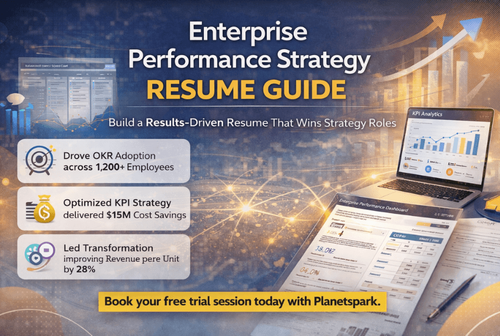

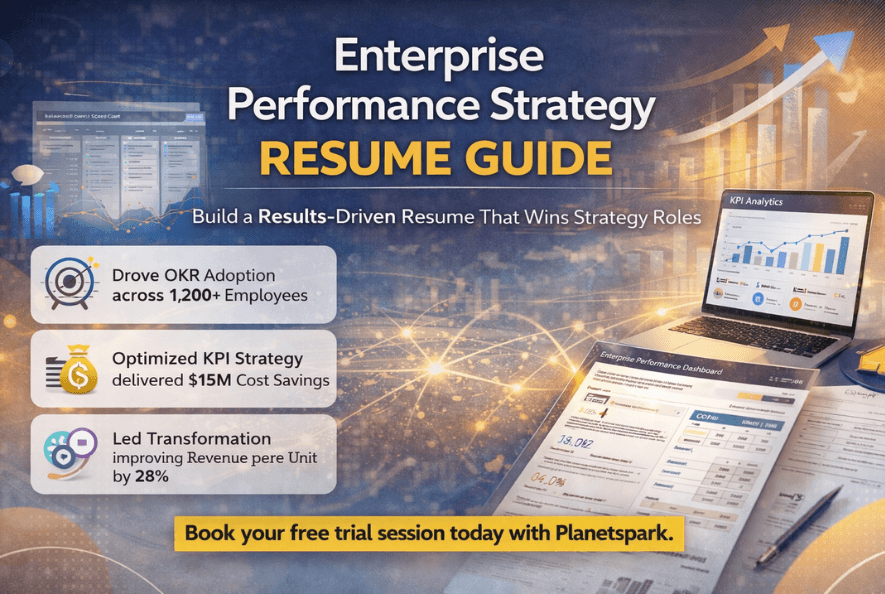
Enterprise Performance Strategy Resume Guide: Build a Results-Driven Resume That Wins Strategy Roles
Many professionals working in enterprise environments contribute to performance improvement, KPI tracking, and strategic decision-making—but their resumes fail to reflect that depth. Instead of showcasing measurable impact, they rely on vague statements that do not demonstrate real business value.
In enterprise performance strategy roles, this is a critical mistake. Recruiters and hiring managers expect resumes that clearly communicate strategic thinking, performance ownership, and measurable outcomes across large-scale operations.
A generic resume simply does not work in this domain. Enterprise strategy requires precision, structure, and evidence. The Resume Template Focused on Enterprise Performance Strategy is specifically designed to help professionals present their experience with clarity, measurable impact, and enterprise-level credibility.
Book your free trial session today with Planetspark.
Download for more details or PDF file.
Who Is This Blog For?
- Professionals working in enterprise performance, strategy, or operations roles
- Analysts, consultants, and managers aiming to move into strategy functions
- Mid-level professionals targeting Head of Strategy or leadership roles
- Career switchers transitioning from operations, finance, or project management
- Consultants delivering performance strategy engagements
Why This Topic Matters Today?
Enterprise performance strategy is a specialised discipline that includes KPI frameworks, OKR implementation, balanced scorecards, and transformation governance.
However, most professionals struggle to communicate this expertise effectively. As highlighted in the guide, common mistakes include:
- Leading with job duties instead of performance outcomes
- Failing to show enterprise-scale context such as team size or budget
- Using generic section headings that do not reflect strategy expertise
- Not quantifying impact of initiatives
- Submitting resumes that lack domain-specific language
These issues significantly reduce interview chances, even for highly qualified candidates.
Core Concept or Framework Explained
The foundation of an effective enterprise strategy resume lies in one powerful formula:
Action Verb + Enterprise Context + Quantified Outcome
As illustrated in the framework on page 14, every bullet point must combine these three elements to demonstrate capability, scale, and impact.
This means:
- Action Verb shows what you did
- Enterprise Context shows where and at what scale you operated
- Quantified Outcome proves the result of your work
For example:
Instead of saying “Managed KPIs,” a strong statement would highlight designing KPI frameworks across business units and improving reporting clarity by a measurable percentage.
This structure ensures your resume is both ATS-friendly and compelling to human reviewers.
How This Blog and Guidebook Help You?
This blog and template pack help you:
- Translate your work into measurable enterprise impact
- Structure your resume using proven strategy frameworks
- Highlight KPI, OKR, and performance management expertise
- Improve ATS ranking through keyword alignment
- Build a resume tailored to enterprise hiring expectations
It positions you as a performance strategist rather than an operational contributor.
Step-by-Step Breakdown
Step 1: Choose the Right Enterprise Strategy Scenario
The guide includes 10 templates tailored to specific roles such as:
- Entry-level strategy analyst
- KPI framework designer
- OKR programme lead
- Balanced scorecard specialist
- Transformation programme director
- Executive strategy reporting lead
- Head of strategy (promotion track)
Each template aligns your experience with a specific strategic context.
Step 2: Build a Strong Professional Summary
Your summary should clearly communicate:
- Your strategy specialisation (KPI, OKR, BSC, etc.)
- Years of experience
- Enterprise-scale impact
This immediately signals domain expertise.
Step 3: Apply the Enterprise Bullet Formula
Every experience bullet should follow:
- Action verb
- Enterprise context
- Quantified outcome
For example:
- Designed KPI frameworks across multiple business units
- Led OKR rollout across hundreds or thousands of employees
- Reduced reporting cycle time using automation
This structure increases clarity and impact.
Step 4: Highlight Strategy Frameworks and Tools
Explicitly mention recognised frameworks such as:
- KPI Framework
- Balanced Scorecard
- OKR
- OGSM
Also include tools like:
- Power BI
- Tableau
- SAP Analytics Cloud
- Excel
These keywords improve ATS performance.
Step 5: Demonstrate Enterprise Scale
Your resume must reflect scale through:
- Organisation size
- Budget managed
- Number of business units
- Geographic coverage
This helps recruiters understand your level of responsibility.
Step 6: Optimise for ATS Systems
Enterprise hiring relies heavily on ATS platforms such as Workday, SAP, and Oracle.
Best practices include:
- Using standard section headings
- Maintaining a single-column layout
- Avoiding graphics or complex formatting
- Matching keywords with job descriptions
The guide recommends targeting a 70–80 percent keyword match for optimal results.
Step 7: Strengthen Bullet Points
As shown in the examples on page 14, replacing weak statements with outcome-driven bullets dramatically improves resume quality.
Focus on:
- Measurable improvements
- Strategic ownership
- Clear business impact
This is one of the highest-impact improvements you can make.
Common Mistakes or Pitfalls to Avoid
Professionals often reduce their chances by:
- Writing duty-based bullet points
- Omitting enterprise context and scale
- Using internal jargon instead of recognised frameworks
- Not quantifying results
- Submitting generic resumes for specialised roles
- Using complex designs that break ATS parsing
These mistakes make strong candidates appear weak.
How Should You Use This Guidebook Effectively?
To get the best results:
- Select the template aligned with your target role
- Replace all placeholders with real, measurable data
- Follow the bullet formula consistently
- Tailor keywords to each job description
- Maintain both ATS-friendly and designed versions
Recommended workflow:
- 1–2 hours to customise your template
- 1 hour to refine metrics and outcomes
- 30 minutes to optimise for ATS
Consistency and precision are critical.
Key Takeaways
- Enterprise strategy resumes must highlight measurable performance impact
- The Action + Context + Outcome formula is essential
- Frameworks like KPI, OKR, and BSC strengthen credibility
- ATS optimisation significantly improves visibility
- Quantifying outcomes is critical for differentiation
- Tailored resumes outperform generic ones in enterprise hiring
Your Next Step: Accelerate Your Career with PlanetSpark
Creating an impact-driven resume is not just about landing your next job—it’s about owning your professional story and presenting it with clarity, confidence, and credibility. When your resume clearly communicates value, results, and impact, opportunities follow naturally.
At PlanetSpark, we are committed to empowering working professionals with practical, outcome-focused resources that drive real career growth. From resume building and workplace communication to leadership presence and professional writing, our programs are designed to help you succeed in today’s fast-evolving job market.
Visit https://www.planetspark.in/resources to explore:
- Career and resume-building guides
- Workplace communication and professional writing resources
- Skill-development tools curated for working professionals
Want a deeper, hands-on experience?
You can also book a free trial session to learn more about PlanetSpark’s Working Professional Courses, designed to accelerate your career through personalised coaching, real-world practice, and expert guidance.
Your career deserves more than generic advice.
It deserves clarity, confidence, and measurable impact.
Personalized Communication Roadmaps
Record a video to get a AI generated personalized communication reports