
Enterprise Project Leadership Resume Guide for Professionals
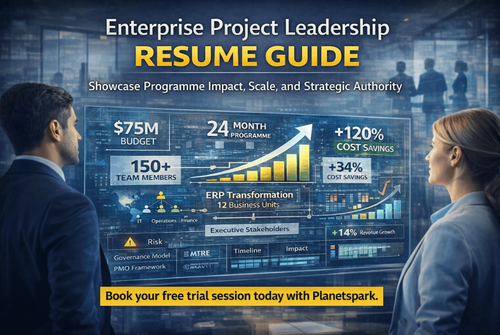

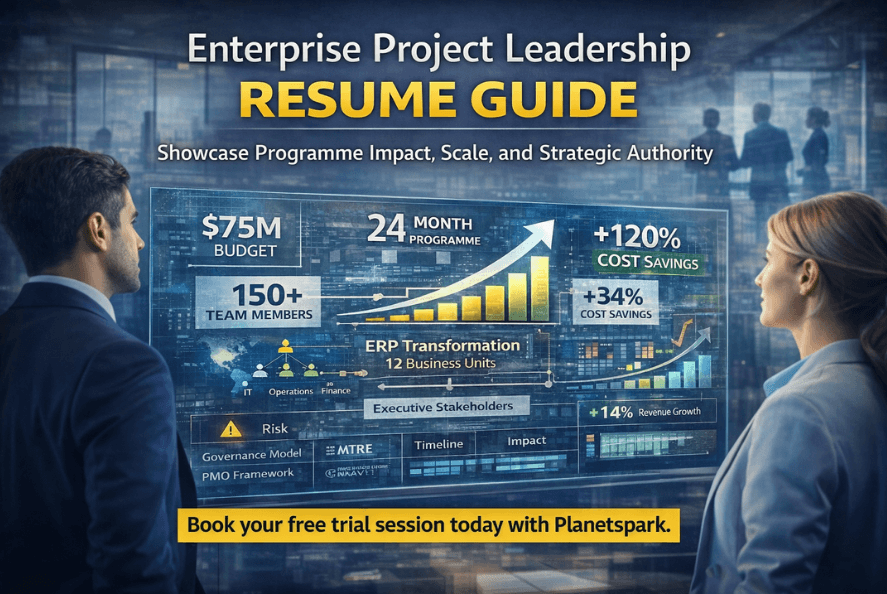
Enterprise Project Leadership Resume Guide: Showcase Programme Impact, Scale, and Strategic Authority
Most resume advice is built for individual contributors—people who execute tasks. But enterprise project leadership is fundamentally different. It requires managing complexity, leading cross-functional teams, controlling large budgets, and delivering outcomes that shape entire organisations. Yet many professionals fail to communicate this level of impact effectively on their resumes.
This guide, built from a structured enterprise-level template pack, helps you position your experience in a way that reflects scale, authority, and measurable outcomes—exactly what enterprise hiring panels expect.
Book your free trial session today with Planetspark.
Download for more details or PDF file.
Who Is This Blog For?
- Project managers aiming to transition into enterprise-scale roles
- Programme directors managing multi-million-dollar initiatives
- PMO leads building or governing large project portfolios
- Consultants moving into in-house enterprise delivery roles
- IT delivery heads leading transformation programmes
- Professionals with 0–15 years of experience targeting large organisations
Why This Topic Matters Today?
Enterprise organisations—banks, telecom companies, consulting firms, and global tech organisations—are hiring differently.
They are not evaluating:
- Task execution
- Individual contributions
They are evaluating:
- Leadership at scale
- Stakeholder management at executive level
- Risk governance across large programmes
- Delivery of strategic business outcomes
However, many professionals struggle because their resumes:
- List responsibilities instead of programme outcomes
- Omit budget size, team scale, and stakeholder level
- Use junior-level language for senior roles
- Fail to quantify transformation impact
This mismatch often leads to rejection—even for highly capable candidates.
Core Concept or Framework Explained
The central framework of this guide is enterprise-level resume positioning.
Unlike standard resumes, enterprise resumes must communicate:
- Programme scale
- Leadership authority
- Strategic impact
The templates in the resource are scenario-driven, each aligned with a specific enterprise role such as:
- Programme delivery director
- PMO build lead
- Digital transformation programme manager
- Agile-at-scale delivery lead
- Global programme manager
Each template is designed to reflect real-world enterprise hiring expectations and signals.
The framework focuses on three key pillars:
Scale
Clearly define:
- Budget handled
- Number of workstreams
- Team size
- Geographic scope
Authority
Show your role in:
- Decision-making
- Governance
- Stakeholder leadership
Impact
Quantify results such as:
- Cost savings
- Time reductions
- Adoption rates
- Business transformation outcomes
How This Blog and Guidebook Help You?
This blog and the template pack help you reposition your resume from operational execution to enterprise leadership.
You will learn how to:
- Present your experience as large-scale programmes
- Highlight governance, risk, and stakeholder management
- Quantify enterprise-level outcomes
- Align your resume with ATS systems used by large organisations
- Position yourself for senior roles such as Programme Director or PMO Head
This transforms your resume into a strategic leadership document.
Step-by-Step Breakdown
Choose the Right Enterprise Scenario
The resource includes 10 templates, each mapped to a specific enterprise context.
Examples include:
- Programme delivery director for multi-million programmes
- PMO build lead for governance setup
- Digital transformation PM for ERP or cloud initiatives
- M&A integration programme manager
- Global programme manager for cross-border delivery
Selecting the right template ensures alignment with your actual experience and target role.
Replace Placeholders with Enterprise Metrics
Each template includes structured placeholders for:
- Programme scope
- Budget
- Team size
- Timeline
- Outcomes
You must replace these with real data such as:
- “Managed £20M programme across 5 countries”
- “Led 40-member cross-functional team”
- “Delivered programme 8 weeks ahead of schedule”
These details define enterprise readiness.
Highlight Programme-Level Outcomes
Focus on outcomes, not activities.
For each programme, include:
- Programme name
- Scope and scale
- Key challenges
- Actions taken
- Measurable results
For example:
- Delivered ERP implementation impacting 8,000 users across 6 countries
- Achieved 90% user adoption within 3 months
This demonstrates both execution and leadership.
Showcase Governance and Leadership
Enterprise roles require strong governance capabilities.
Highlight:
- Steering committee management
- Risk mitigation strategies
- Programme governance frameworks
- Executive reporting
Avoid using language that sounds like coordination—focus on leadership and ownership.
Customise Summary for Each Role
The professional summary is critical.
Tailor it to:
- The company
- The programme type
- The methodology used
For example:
- If the role focuses on Agile transformation, highlight SAFe or Lean-Agile experience
- If it focuses on compliance, highlight governance and regulatory delivery
This significantly improves shortlisting chances.
Ensure ATS Compatibility
Enterprise hiring relies heavily on ATS systems like Workday and Taleo.
Best practices include:
- Use exact keywords from job descriptions
- Avoid complex formatting
- Maintain clean, linear structure
- Include certifications prominently
This ensures your resume passes initial screening.
Common Mistakes or Pitfalls to Avoid
Avoid these mistakes highlighted in the resource:
- Listing responsibilities instead of programme outcomes
- Ignoring scale (budget, team size, geography)
- Using junior-level language for senior roles
- Failing to quantify results
- Not highlighting governance frameworks
- Submitting generic summaries
For example:
Instead of:
- Managed project delivery
Write:
- Delivered £18M infrastructure programme across 14 sites with zero critical defects
The difference is clarity, authority, and impact.
How Should You Use This Guidebook Effectively?
To maximise results, follow a structured workflow:
Step 1: Select the Right Template
Choose based on your actual experience and target role.
Step 2: Gather Key Metrics
Collect:
- Budget size
- Team size
- Programme duration
- Outcomes achieved
Step 3: Fill and Customise
Replace placeholders with real, quantified achievements.
Step 4: Tailor for Each Application
Rewrite the summary and adjust keywords for every job.
Step 5: Validate and Export
Ensure no placeholders remain and export as PDF for submission.
Time Investment
- Initial resume creation: 3–4 hours
- Customisation per application: 20–30 minutes
This significantly improves interview conversion rates.
Key Takeaways
- Enterprise resumes must highlight scale, authority, and impact
- Programme-level outcomes are more important than task descriptions
- Metrics such as budget, team size, and timelines are essential
- Scenario-based templates improve positioning and clarity
- Tailored summaries increase shortlisting success
- ATS optimisation is critical for enterprise roles
- Strong resumes communicate leadership, not coordination
- Quantified results define credibility in enterprise hiring
Your Next Step: Accelerate Your Career with PlanetSpark
Creating an impact-driven resume is not just about landing your next job—it’s about owning your professional story and presenting it with clarity, confidence, and credibility. When your resume clearly communicates value, results, and impact, opportunities follow naturally.
At PlanetSpark, we are committed to empowering working professionals with practical, outcome-focused resources that drive real career growth. From resume building and workplace communication to leadership presence and professional writing, our programs are designed to help you succeed in today’s fast-evolving job market.
Visit https://www.planetspark.in/resources to explore:
- Career and resume-building guides
- Workplace communication and professional writing resources
- Skill-development tools curated for working professionals
Want a deeper, hands-on experience?
You can also book a free trial session to learn more about PlanetSpark’s Working Professional Courses, designed to accelerate your career through personalised coaching, real-world practice, and expert guidance.
Your career deserves more than generic advice.
It deserves clarity, confidence, and measurable impact.
Personalized Communication Roadmaps
Record a video to get a AI generated personalized communication reports