
Everything You Need to Know About Mapping Career Transition Trade-Offs


Smarter, Risk-Aware Career Decisions with Mapping Career Transition
Choosing a new career direction is exciting—but it’s also one of the most complex decisions a working professional can make. Many people focus only on the potential upside of a transition: better salary, more meaningful work, or improved work-life balance. However, what often gets overlooked are the trade-offs involved.
Every career move comes with gains and losses. Ignoring these trade-offs leads to unrealistic expectations, poor decisions, and regret after the transition. Professionals often realise too late that while they gained one benefit, they sacrificed something equally important—such as stability, income consistency, or growth speed.
This is why mapping career transition trade-offs before committing is critical. Instead of making emotional or impulsive decisions, you take a structured, analytical approach to evaluate what you are gaining, what you are giving up, and whether the trade is worth it.
This guide helps you systematically identify, assess, and prioritise trade-offs so you can make confident, informed career decisions aligned with your long-term goals.
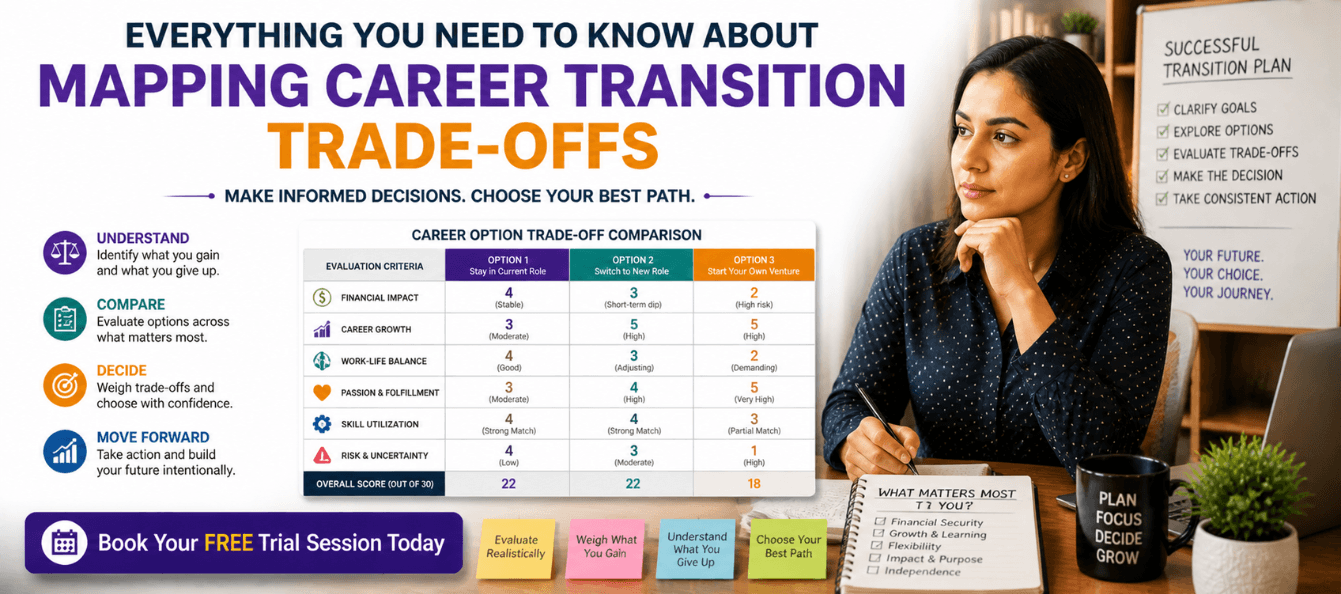
Download these resources and apply them alongside your daily work for improved clarity, productivity, and professional growth. You can also book a free trial to gain expert guidance and enhance your communication, problem-solving, and decision-making skills. The materials are designed in a clear, structured format to help professionals learn efficiently and implement insights with confidence.
Who Is This Blog For?
- Working professionals considering a career switch but unsure about the risks involved
- Individuals comparing multiple career options or opportunities
- Mid-career professionals balancing stability with growth ambitions
- Job seekers evaluating offers with different benefits and compromises
- Professionals who want to make rational, well-informed career decisions
Why This Topic Matters Today?
In today’s dynamic job market, career transitions are more frequent and often necessary for growth. However, the complexity of these transitions has increased significantly.
Common challenges include:
- Choosing between higher salary and better work-life balance
- Trading job security for growth opportunities in new industries
- Accepting short-term setbacks for long-term career gains
- Managing uncertainty during transitions
- Lack of clarity on what truly matters in decision-making
Many professionals make decisions based on incomplete information or short-term thinking. Without evaluating trade-offs, they risk making choices that don’t align with their priorities.
A structured trade-off mapping approach ensures that decisions are balanced, realistic, and aligned with both professional and personal goals.
Core Concept or Framework Explained
Mapping career transition trade-offs involves identifying and evaluating the key factors that will change as a result of your decision.
Instead of viewing a transition as purely positive or negative, you break it down into measurable components and assess the impact of each.
The framework includes:
- Identifying key factors: Salary, growth potential, work-life balance, job security, learning opportunities, location, and role satisfaction
- Evaluating gains and losses: Understanding what improves and what declines in each option
- Prioritising factors: Determining which elements matter most to you
- Comparing options: Analysing different career paths based on these trade-offs
- Making informed decisions: Choosing the option that offers the best overall balance
For example, moving from a stable corporate job to a startup role may offer faster growth and learning but involve higher risk and longer working hours. A structured framework helps you decide whether this trade-off aligns with your priorities.
How This Blog and Guidebook Help You?
This blog converts the concept of trade-off mapping into a practical decision-making system. By applying this approach, you will:
- Gain clarity on what you truly value in your career
- Avoid impulsive or emotionally driven decisions
- Evaluate opportunities with a structured framework
- Make balanced decisions that align with long-term goals
- Reduce regret by understanding trade-offs upfront
Instead of guessing, you will make decisions backed by analysis and self-awareness.
Step-by-Step Breakdown
Define Your Career Options Clearly
Start by identifying the specific options you are considering.
Examples:
- Staying in your current role
- Transitioning to a new role within the same industry
- Switching to a different industry
- Pursuing freelance or entrepreneurial paths
Clarity is essential before comparing trade-offs.
Identify Key Decision Factors
List the factors that will influence your decision.
Common factors include:
- Compensation and financial stability
- Career growth and progression
- Skill development and learning opportunities
- Work-life balance
- Job security
- Personal satisfaction and interest
You can customise this list based on your priorities.
Evaluate Gains and Losses for Each Option
For each career option, assess what you gain and what you lose.
Example:
Option A: Stay in current role
- Gain: Stability, predictable income
- Loss: Limited growth, slower skill development
Option B: Move to a startup
- Gain: Rapid learning, higher growth potential
- Loss: Uncertainty, longer working hours
This comparison makes trade-offs visible and tangible.
Assign Priority Levels to Each Factor
Not all factors are equally important.
Rank them based on your current life stage and goals.
Example:
- High priority: Financial stability, growth
- Medium priority: Work-life balance
- Lower priority: Location flexibility
Your priorities will guide your final decision.
Score and Compare Options
Assign scores to each option based on how well they meet your priorities.
You can use a simple scale (for example, 1 to 5) for each factor.
Example:
- Salary: Option A (4), Option B (3)
- Growth: Option A (2), Option B (5)
This structured comparison reduces bias and improves clarity.
Analyse Long-Term vs Short-Term Impact
Some trade-offs involve short-term sacrifice for long-term gain.
Ask:
- Will this decision benefit me in 2 to 5 years?
- Am I willing to accept short-term challenges for future growth?
This perspective prevents short-sighted decisions.
Make a Decision with Clear Justification
After analysing all factors, choose the option that aligns best with your priorities.
Ensure that your decision:
- Reflects your long-term goals
- Balances risks and rewards
- Is based on structured analysis, not emotion
Document your reasoning to reinforce confidence
Common Mistakes or Pitfalls to Avoid
- Focusing only on benefits while ignoring trade-offs
- Overvaluing short-term gains over long-term growth
- Ignoring personal priorities and external constraints
- Making decisions based on peer pressure or trends
- Failing to reassess priorities over time
These mistakes often lead to dissatisfaction after the transition.
How Should You Use This Guidebook Effectively?
To maximise the value of this guidebook, follow a consistent process:
- Set aside dedicated time to evaluate your options thoroughly
- Write down all trade-offs instead of relying on memory
- Use a scoring system to compare options objectively
- Revisit your analysis after a few days for clarity
- Discuss your evaluation with trusted mentors or professionals
A structured approach ensures better decision-making outcomes.
Key Takeaways
- Every career transition involves trade-offs—acknowledge them early
- Identify and prioritise the factors that matter most to you
- Evaluate gains and losses for each option clearly
- Use scoring and structured comparison to reduce bias
- Consider both short-term and long-term impacts
- Make decisions based on alignment with your goals, not assumptions
Your Next Step: Accelerate Your Career with PlanetSpark
Creating an impact-driven resume is not just about landing your next job—it’s about owning your professional story and presenting it with clarity, confidence, and credibility. When your resume clearly communicates value, results, and impact, opportunities follow naturally.
At PlanetSpark, we are committed to empowering working professionals with practical, outcome-focused resources that drive real career growth. From resume building and workplace communication to leadership presence and professional writing, our programs are designed to help you succeed in today’s fast-evolving job market.
Visit https://www.planetspark.in/resources to explore:
- Career and resume-building guides
- Workplace communication and professional writing resources
- Skill-development tools curated for working professionals
Want a deeper, hands-on experience?
You can also book a free trial session to learn more about PlanetSpark’s Working Professional Courses, designed to accelerate your career through personalised coaching, real-world practice, and expert guidance.
Your career deserves more than generic advice.
It deserves clarity, confidence, and measurable impact.
Start building that advantage today—with PlanetSpark.
Personalized Communication Roadmaps
Record a video to get a AI generated personalized communication reports