
Executive Communication Guide for Working Professionals 2026

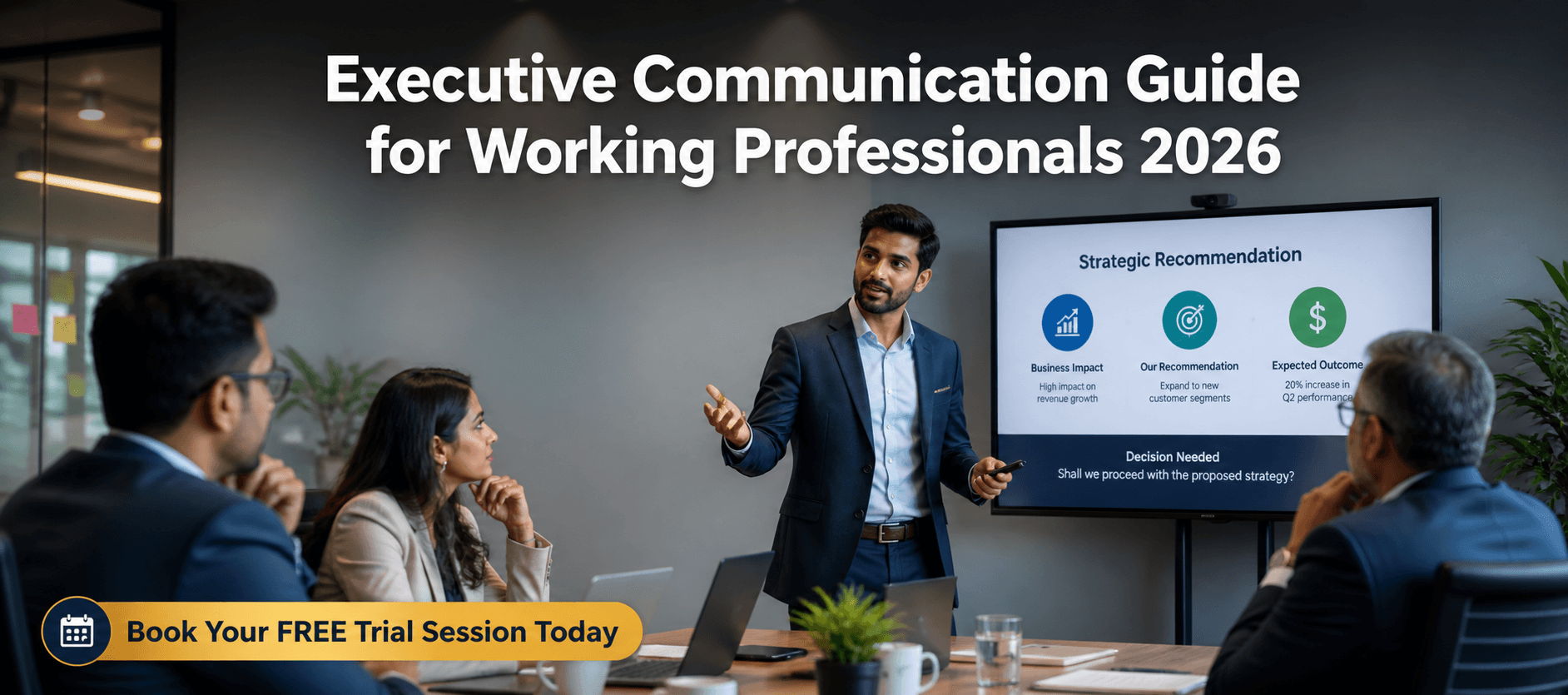
How to Communicate with Senior Leaders
In today’s workplace, your ability to communicate effectively can determine how fast your career grows. You might be technically strong, hardworking, and knowledgeable—but if you struggle to present your ideas clearly to senior leaders, your impact remains limited.
Many professionals face this exact challenge. They enter meetings with executives, write long emails, or create detailed presentations—only to see confusion, lack of response, or missed opportunities. The problem is not lack of effort. It is lack of structure.
Senior leaders operate differently. They are time-constrained, outcome-focused, and constantly making decisions that affect the entire organisation. If your communication does not align with how they think, it gets ignored—even if your ideas are valuable.
This is where a structured approach to executive communication becomes a game-changer. The guide introduces proven frameworks, practical tools, and real-world examples that help professionals communicate with clarity, confidence, and influence at the highest levels.
Download these resources and apply them alongside your daily work for improved clarity, productivity, and professional growth. You can also book a free trial to gain expert guidance and enhance your communication, problem-solving, and decision-making skills. The materials are designed in a clear, structured format to help professionals learn efficiently and implement insights with confidence.
Who Is This Blog For?
- Managers and team leads interacting with senior leadership
- Consultants presenting ideas, proposals, or recommendations
- Career switchers entering corporate environments
- Mid-level professionals aiming for leadership roles
- Anyone who wants to improve clarity, confidence, and influence
Why This Topic Matters Today?
Modern workplaces demand more than technical expertise. Professionals are expected to influence decisions, present ideas effectively, and communicate with leadership teams.
According to the guide, one of the biggest career bottlenecks is the inability to communicate effectively with executives
Key challenges professionals face today:
- Executives have limited time and high cognitive load
- Communication is evaluated based on outcomes, not effort
- Poorly structured messages lead to missed decisions
- Long explanations reduce clarity and impact
In this environment, communication is no longer just a soft skill—it is a strategic career advantage.
Core Concept or Framework Explained
At the heart of effective executive communication lies a powerful structure: the CLEAR Framework.
This framework is designed to align your communication with how executives think and make decisions.
Conclusion First
Start with your main point immediately. Executives prefer the outcome before the explanation. If your conclusion is buried, your message may never land.
Logic Bridge
Support your conclusion with three key points. Each point should include:
- A clear claim
- Supporting evidence
- Business relevance
This “rule of three” improves clarity and retention.
Evidence and Examples
Back your arguments with data, facts, or examples. This builds credibility and trust quickly.
Ask Explicitly
State exactly what you need—approval, decision, or action. Keep it clear, specific, and early.
Risk and Next Steps
Highlight what happens if no action is taken. This creates urgency and completes the decision-making picture.
This structured approach ensures that every communication is clear, concise, and actionable.
How This Blog and Guidebook Help You?
This blog and the guide provide practical tools to transform how you communicate at work.
You will learn how to:
- Structure emails, presentations, and meetings effectively
- Capture attention quickly in high-stakes conversations
- Communicate with confidence and authority
- Influence decisions with clarity and logic
- Reduce over-explaining and increase impact
The result is stronger visibility, better opportunities, and faster career growth.
Step-by-Step Breakdown
Step 1: Understand the Executive Mindset
Before structuring your message, understand your audience.
Executives focus on:
- Business outcomes over detailed processes
- Strategic impact rather than operational steps
- Clear decisions rather than lengthy discussions
Shift your thinking from “how” to “so what.”
Step 2: Answer the Four Key Executive Questions
Every executive is mentally evaluating your communication using four filters:
- Why does this matter?
- What do you need from me?
- Can I trust this?
- What happens if no action is taken?
If your message answers these clearly, it is far more likely to succeed.
Step 3: Apply the CLEAR Framework
Use this structure consistently across all formats:
- Start with your conclusion
- Present three supporting points
- Add relevant evidence
- State your ask clearly
- Highlight risks and next steps
This creates a predictable, effective communication pattern.
Step 4: Structure Executive Emails
Emails should be concise and action-driven.
Best practices:
- Use clear, outcome-focused subject lines
- Start with your ask or recommendation
- Keep the body short and structured
- End with a specific action and deadline
Avoid long, unstructured emails that delay decisions.
Step 5: Build Effective Presentations
Your presentation should support decisions, not just share information.
Key structure:
- Slide 1: Situation, recommendation, and ask
- Slides 2–4: Supporting arguments with evidence
- Slide 5: Risks and next steps
Each slide should communicate one clear idea.
Step 6: Improve Verbal Communication
In meetings, clarity and brevity are essential.
Follow these rules:
- Answer questions in under 30 seconds
- Provide additional detail only if requested
- Stay calm when challenged
- Be direct and confident
This builds trust and authority.
Step 7: Use Pre-Communication Planning Tools
Before any executive interaction:
- Define your main message
- Prepare supporting points
- Anticipate questions
- Decide your desired outcome
Preparation increases confidence and clarity.
Step 8: Conduct a Communication Audit
Before sending or presenting, check:
- Is the conclusion stated upfront?
- Are there only three key points?
- Is the ask clear and specific?
- Is the risk of inaction mentioned?
- Is the tone confident and concise?
This final check ensures quality and effectiveness.
Common Mistakes or Pitfalls to Avoid
Many professionals unintentionally weaken their communication.
Common mistakes include:
- Burying the main point under too much context
- Including too many ideas or arguments
- Using vague or unclear asks
- Over-explaining due to lack of confidence
- Ignoring the consequences of inaction
Better alternatives:
- Lead with your conclusion
- Limit to three strong points
- Be specific about what you need
- Use confident, clear language
- Highlight risks to drive decisions
How Should You Use This Guidebook Effectively?
To get maximum value from this resource:
- Read the guide once for overall understanding
- Apply the framework in real work scenarios
- Use checklists before important communication
- Practice regularly in emails and meetings
- Reflect after each interaction
Suggested workflow:
- Spend 10–15 minutes preparing using the framework
- Apply it in your communication
- Review performance and improve
Consistency is key to mastering executive communication.
Key Takeaways
- Executive communication requires clarity, not complexity
- Always lead with your conclusion
- Limit your message to three key points
- Use structured frameworks like CLEAR
- Make your ask explicit and actionable
- Highlight risks to encourage decision-making
- Adapt your style based on the audience
- Preparation and practice drive long-term improvement
Your Next Step: Accelerate Your Career with PlanetSpark
Creating an impact-driven resume is not just about landing your next job—it’s about owning your professional story and presenting it with clarity, confidence, and credibility. When your resume clearly communicates value, results, and impact, opportunities follow naturally.
At PlanetSpark, we are committed to empowering working professionals with practical, outcome-focused resources that drive real career growth. From resume building and workplace communication to leadership presence and professional writing, our programs are designed to help you succeed in today’s fast-evolving job market.
Visit https://www.planetspark.in/resources to explore:
- Career and resume-building guides
- Workplace communication and professional writing resources
- Skill-development tools curated for working professionals
Want a deeper, hands-on experience?
You can also book a free trial session to learn more about PlanetSpark’s Working Professional Courses, designed to accelerate your career through personalised coaching, real-world practice, and expert guidance.
Your career deserves more than generic advice.
It deserves clarity, confidence, and measurable impact.
Personalized Communication Roadmaps
Record a video to get a AI generated personalized communication reports