
Explaining AI-Driven Outcomes Clearly to Business Teams

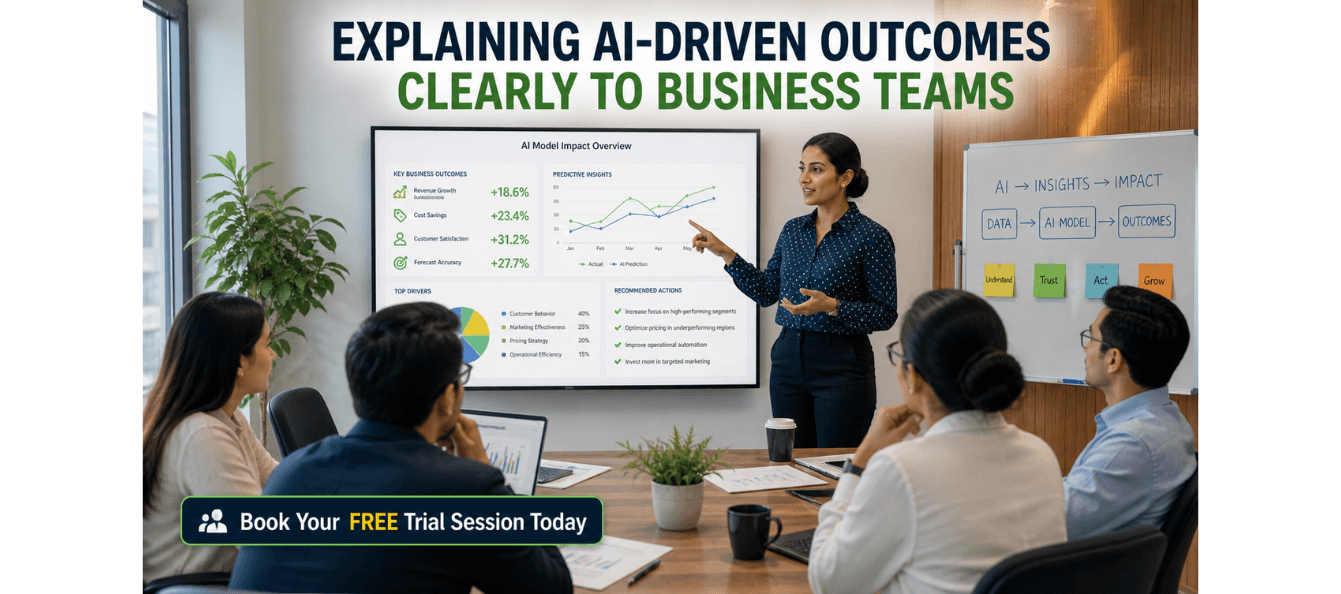
Upgrade Your Impact: How to Communicate AI-Driven Results to Non-Technical Stakeholders
In the world of AI-driven innovations, translating complex insights into clear, actionable results is crucial for success. As a professional working with AI tools, you might run into a common barrier: communicating technical results to stakeholders who don’t have a technical background. The challenge? Making them understand the value of your work without overwhelming them with jargon.
This guide will walk you through a proven framework and provide scripts to help you confidently communicate AI results in a way that resonates with non-technical audiences. By using these methods, you’ll ensure that your AI-driven insights lead to actionable decisions and support for your initiatives.
Download these resources and apply them alongside your daily work for improved clarity, productivity, and professional growth. You can also book a free trial to gain expert guidance and enhance your communication, problem-solving, and decision-making skills. The materials are designed in a clear, structured format to help professionals learn efficiently and implement insights with confidence.
Who Is This Blog For?
- Career switchers entering data or AI roles
- Early–mid career professionals presenting upward
- Consultants briefing non-technical clients
- Managers translating team outputs to leadership
Why This Topic Matters Today?
AI has the potential to revolutionize industries, but a significant portion of AI initiatives fail due to poor communication. The ability to translate complex AI models and outputs into clear, business-focused insights is essential for driving results. Whether you’re presenting to a CFO, a manager, or a board of directors, the key to securing buy-in is effectively demonstrating AI’s impact in terms they care about—business value, customer impact, and profitability.
For many professionals, the difference between a stalled project and one that gets full funding comes down to this: can you communicate your findings clearly? The failure to do so is often the number one reason AI projects lose momentum, making this communication skill vital for every career focused on AI.
Core Concept or Framework Explained
To help you effectively communicate AI-driven results, we introduce the CLEAR Framework—a five-part model designed to turn your technical work into compelling business conversations.
1. Context
Set the stage by clearly explaining the business problem you are addressing. This is where you hook your audience with something that resonates with their priorities.
2. Link
Connect your AI solution to a familiar business concept or goal. Help stakeholders see how your approach aligns with their objectives.
3. Evidence
Share the results using business language—think revenue impact, time savings, or customer satisfaction. This ensures your audience understands the significance of your findings.
4. Action
Tell them exactly what you recommend and why taking action now is critical. Make it clear and actionable.
5. Risk
Be transparent about any limitations of the AI model. Acknowledge risks honestly, but explain how they are being mitigated.
By structuring your communication in this way, you align with how decision-makers think: problem → solution → proof → decision → risk. You’re not oversimplifying the work; you’re translating it into business language that gets results.
How This Blog and Guidebook Help You?
This blog, along with the playbook, will provide you with:
- A structured communication framework that works for every non-technical audience
- Ready-to-use scripts for different AI results scenarios
- Confidence in handling tough questions with calm and clarity
- Real-world examples from various industries to guide your communication
Using these tools, you’ll be able to present AI results effectively, ensuring that your message is understood and trusted by stakeholders.
Step-by-Step Breakdown
Step 1: Set the Stage – Opening Scripts That Land
The first 60 seconds of your communication are critical. Always start with the business problem and avoid diving straight into technical details. For example, instead of starting with a model explanation, you could say:
- "Last quarter, we set out to reduce customer churn. Using AI, we identified the top 500 customers most likely to leave in the next 30 days — with enough lead time to intervene. Here's what we found, and what I'd recommend we do next."
This positions the AI work around a business outcome, making it easier for stakeholders to connect with.
Step 2: Translate Results into Business Language
When presenting AI results, translate technical terms into business consequences. Here’s a common example:
- "The model correctly identifies at-risk customers about 87% of the time. In practical terms, that means if we act on its recommendations, we’d expect to retain roughly 8 or 9 out of every 10 customers it flags — compared to our current approach, where we’re largely guessing."
By framing the model's accuracy in terms of tangible outcomes, you make the information much more accessible to non-technical stakeholders.
Step 3: Handle Tough Questions with Confidence
Stakeholder Q&A sessions are where many AI professionals lose credibility. Non-technical questions might feel like challenges, but they’re often requests for reassurance. Respond calmly, acknowledging concerns, and providing business-level clarity:
- "Can we trust this?"
- "Trust is built over time, and I'd encourage a phased approach. The model has been validated on historical data and performs well — but I'd recommend a 30-day pilot to validate it in our live environment before committing fully."
This builds trust by showing that you’re prepared and proactive.
Step 4: Use Real-World Case Examples
Case examples bring your framework to life. Here’s how you could apply the CLEAR model across industries:
- Retail – Reducing Stockouts
"We’ve been losing an estimated £180K annually to stockouts. Using AI-driven demand forecasting, we reduced stockout frequency by 43% in pilot stores over 90 days. I recommend rolling this out to all locations before the peak season."
- Healthcare – Patient Risk Flagging
"Our AI tool now flags patients at high risk of readmission within 30 days. In the trial, it identified 76% of readmitted cases, giving clinical teams a 48-hour window to intervene."
- Finance – Fraud Detection
"Our new AI model reduces false fraud alerts by 60%, saving the team 15 hours per week. We’re now able to focus on more accurate cases."
Common Mistakes or Pitfalls to Avoid
1. Leading with the model, not the outcome
Always start with the result and its impact on the business before delving into technical details.
2. Presenting uncertainty as weakness
Be transparent about model limitations, but always pair them with a plan for mitigation.
3. Overloading slides with data
Focus on one key result. Supporting data can be placed in an appendix.
4. Failing to make a clear recommendation
Always conclude with a clear, actionable recommendation. This drives the decision-making process.
How Should You Use This Guidebook Effectively?
This guidebook can be used as a reference for preparing your communication strategy, whether you’re presenting to clients, leadership, or stakeholders. To get the most out of it:
- Identify your audience and their concerns
- Use the CLEAR framework to structure your communication
- Practice responses to common questions
- Always end with a clear recommendation and next steps
Key Takeaways
- Communicate business outcomes first—avoid leading with technical details
- Use the CLEAR framework to structure every conversation
- Translate metrics into business language for clarity
- Address questions with calm, confidence, and transparency
- Always close with a specific, actionable recommendation
Your Next Step: Accelerate Your Career with PlanetSpark
Creating an impact-driven resume is not just about landing your next job—it’s about owning your professional story and presenting it with clarity, confidence, and credibility. When your resume clearly communicates value, results, and impact, opportunities follow naturally.
At PlanetSpark, we are committed to empowering working professionals with practical, outcome-focused resources that drive real career growth. From resume building and workplace communication to leadership presence and professional writing, our programs are designed to help you succeed in today’s fast-evolving job market.
Visit https://www.planetspark.in/resources to explore:
- Career and resume-building guides
- Workplace communication and professional writing resources
- Skill-development tools curated for working professionals
Want a deeper, hands-on experience?
You can also book a free trial session to learn more about PlanetSpark’s Working Professional Courses, designed to accelerate your career through personalised coaching, real-world practice, and expert guidance.
Your career deserves more than generic advice.
It deserves clarity, confidence, and measurable impact.
Personalized Communication Roadmaps
Record a video to get a AI generated personalized communication reports